CherryShot AI

    What Separates a $10M Ecommerce Brand From a $100K One Visually
    April 01, 2026

    The visual difference between a $100K and a $10M ecommerce brand comes down to aesthetic consistency at scale. Seven-figure operations treat their product photography as a unified system. Smaller businesses treat image creation as a sporadic task. Any founder who accepts mismatched lighting across a product grid is actively capping their conversion rate. Uniform lighting, strict color accuracy, and a standardized aspect ratio define premium ecommerce brand visuals.

    High revenue ecommerce brands achieve this look by relying on automated style guides and AI-driven image generation rather than variable freelance shoots. They understand that every pixel on a collection page either builds consumer trust or dismantles it. When you eliminate the visual friction from a shopping experience, price resistance vanishes alongside it.

    Key Takeaways

    • Consistent visual language across a catalog creates the trust required to charge premium prices.
    • Seven-figure brands separate their photography into high-volume catalog assets and low-volume hero imagery.
    • Uniform lighting and shadow direction separate professional storefronts from amateur operations.
    • AI workflows eliminate the scaling costs that traditionally prevented small brands from looking premium.
    73%

    of consumers say product photos are the most important factor in their purchase decision. Salsify Consumer Research, 2023

    The Core Elements of Premium Ecommerce Brand Visuals

    What makes an ecommerce brand look premium relies entirely on structural discipline. Visitors make snap judgments about the quality of your physical product based solely on the quality of your digital presentation. Professional brand photography investment centers on creating an environment where the product looks inevitable and important.

    Mastering Lighting Consistency Across the Catalog

    Lighting serves as the most immediate subconscious signal of brand maturity. When a customer scrolls a collection page, their brain registers variations in shadow direction, brightness, and color temperature before they even read a product title. High revenue ecommerce brands ensure that every single item on a grid looks like it was captured in the exact same environment at the exact same moment. This uniformity creates a cohesive visual rhythm that keeps the user browsing.

    Smaller brands often mix natural light shots with flat lays and artificial studio setups. That visual friction destroys trust. The human eye interprets mismatched lighting as disorganization. Disorganization implies risk. Shoppers do not spend premium dollars with brands that look risky.

    Designing Contextual Storytelling Without Clutter

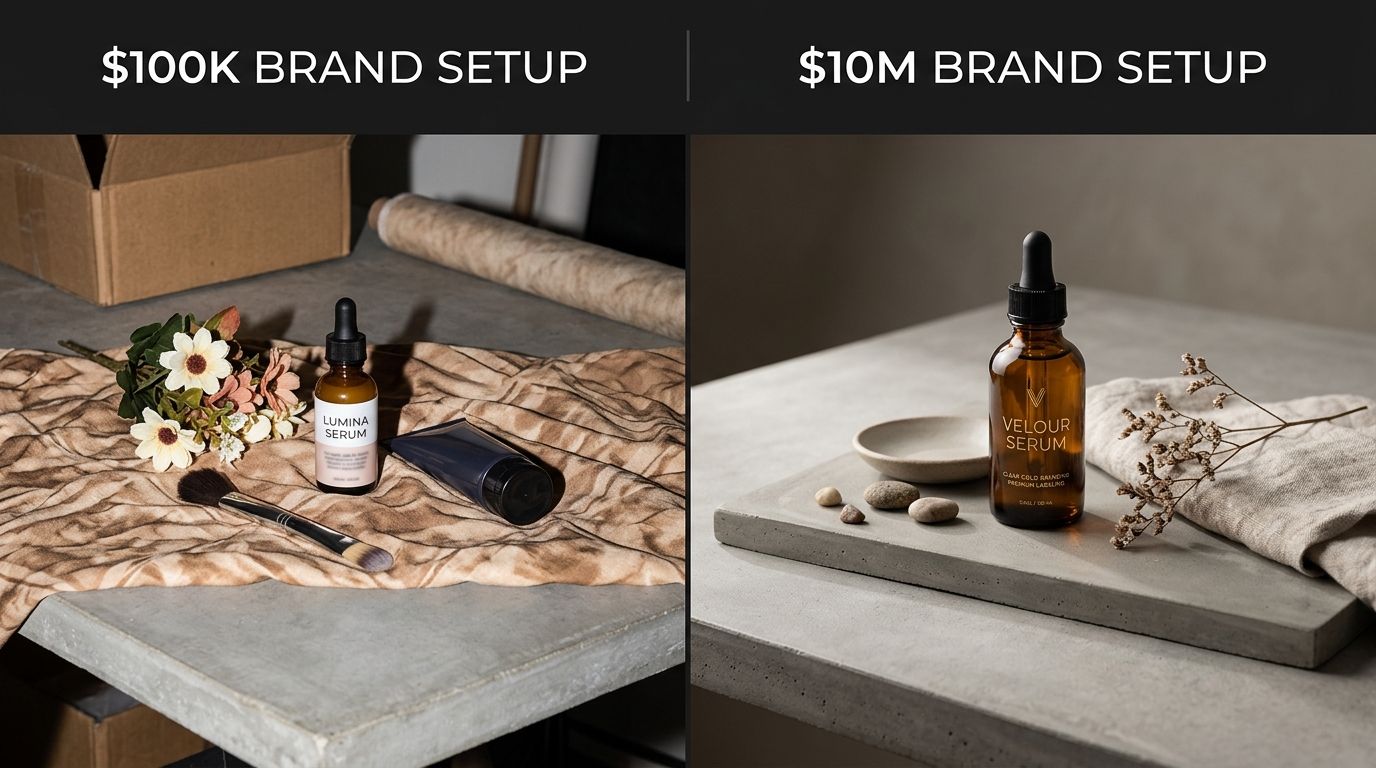
    Premium product photography ecommerce thrives on restraint. A $10M brand understands that props and backgrounds must elevate the product rather than compete with it. A $100K brand usually crams too many elements into a frame. They attempt to sell a lifestyle by adding coffee cups, magazines, and sunglasses to a shot of a simple leather wallet. The wallet gets lost in the noise.

    High-end aesthetics use subtle textures, architectural shadows, or minimalist color blocking to imply luxury. The product remains the undisputed focal point.

    Side-by-side comparison of a cluttered product setup against a crisp, well-lit minimalist product image of skincare bottles on a white marble plinth.
    Moving from amateur setups to uniform, minimalist layouts shifts customer perception and justifies higher price points.

    What Makes an Ecommerce Brand Look Premium at Scale

    Scaling visual identity used to require immense capital and coordination. The landscape has shifted fundamentally over the last two years.

    Replacing Logistics with Artificial Intelligence

    The average DTC apparel brand updates its core catalog imagery every six to eight weeks. Running a traditional studio shoot for every seasonal drop demands a dedicated producer, a photographer, lighting assistants, and location fees. That logistical burden limits how quickly a brand can launch new inventory. High-revenue operations bypass this bottleneck completely. They adopt AI photography tools to maintain extreme consistency without the overhead.

    You upload a standard product photo, apply a locked visual mode, and generate hundreds of campaign-ready images that perfectly match the existing brand aesthetic. CherryShot AI allows brands to select a specific aesthetic like Minimalist or Avant Garde and standardize an entire collection in minutes. The output matches a high-end studio result without the scheduling delays.

    (Worth noting: this is less about replacing photographers and more about eliminating the scheduling dependency that adds three weeks to every product launch timeline.)

    Establishing a Brand Visual Hierarchy Online Store

    Visual hierarchy dictates where the customer looks first. Premium brands structure their visual assets to guide the eye precisely toward the add-to-cart action. They use bold, dynamic lifestyle imagery for hero banners to capture attention. They transition into clean, distraction-free imagery for individual product cards.

    This tiered approach to 7 figure ecommerce brand photography ensures the aesthetic serves the user experience rather than overwhelming it. Small brands frequently make the mistake of using highly stylized lifestyle shots as primary product images on collection pages. This forces the customer to hunt for the actual item being sold. High converting ecommerce aesthetics require absolute clarity at the point of decision.

    Analyzing the Visual Difference High Revenue Ecommerce Brands Exploit

    The nuances of image production separate acceptable storefronts from exceptional ones. Top tier operators control variables that beginners ignore.

    The Psychology of Color Temperature

    Color temperature plays a massive role in brand perception. High-end brands meticulously calibrate their white balance so that every image shares the exact same warm or cool undertone. A cohesive color temperature makes the entire website feel deliberate. If a brand uses cool, clinical lighting for a modern tech accessory, that specific lighting must persist across the entire SKU count.

    Smaller brands frequently ignore white balance. They upload images supplied by different manufacturers. This results in a jarring user experience where a white shirt looks yellow in one photo and blue in the next.

    Aspect Ratios and Grid Alignment

    Nothing ruins a premium aesthetic faster than a misaligned product grid. Seven-figure brands enforce strict cropping rules. Every product occupies the exact same percentage of the frame. If a shoe takes up sixty percent of the image canvas, every other shoe in the catalog will match that proportion. This creates a satisfying, predictable scroll for the shopper. When small brands upload images with random crops and varied dimensions, the website layout breaks. Predictability builds consumer confidence.

    How High Revenue Brands Handle Professional Brand Photography Investment

    Smart visual operations divide their asset requirements into two distinct categories to maximize their operational budgets.

    The 80/20 Rule of Product Assets

    Eighty percent of an ecommerce store consists of standard catalog imagery. These are the straightforward product-on-background shots required for grids, variant selectors, and shopping feeds. Twenty percent consists of creative hero imagery used for homepages and major ad campaigns. High revenue brands allocate their resources accordingly. They use tools like CherryShot AI to automate the eighty percent. Generating uniform catalog shots through AI drops the per-image cost to fractions of a dollar while enforcing perfect visual identity scale.

    Quality is no longer the bottleneck.

    Standardizing the On-Model Aesthetic

    On-model photography presents the greatest scaling challenge for growing apparel and accessories brands. Human models introduce infinite variables. Posture, expression, and skin tone variations can disrupt a collection page if not art directed with militant precision. Premium brands solve this by defining strict rules for model cropping and posing.

    When standardizing an entire season of inventory, AI modes like the Lifestyle setting in CherryShot AI allow brands to generate consistent contexts without coordinating massive agency shoots. A growing brand can now achieve the exact visual output of a legacy retailer using only a laptop and a stable internet connection.

    Frequently Asked Questions

    What do high-revenue ecommerce brands do differently with photography?

    High-revenue ecommerce brands treat their visual assets as a scalable system rather than a collection of individual creative projects. They establish rigid guidelines for lighting ratios, shadow angles, and background hex codes to ensure every product looks like it belongs to the same family. Instead of relying entirely on expensive manual studio sessions for every new SKU, they automate their high-volume catalog requirements using AI generation. This systematic approach strips out the variable costs of production and allows them to launch new products weeks faster than their competitors. They invest their actual creative budget solely into high-impact campaign imagery.

    Can a small brand achieve a premium visual look without a big budget?

    Small brands achieve a premium aesthetic by leaning into extreme minimalism and leveraging AI photography tools. By removing complex props and relying on automated tools to generate crisp studio environments, founders bypass the high costs of location rentals and professional lighting gear. Consistency always looks more expensive than complexity.

    What is the ROI of investing in premium-looking product photography?

    The return on investment for premium product photography typically manifests as a 15 to 30 percent lift in baseline conversion rates within the first quarter of implementation.

    Where do most small brands make their biggest visual mistakes?

    The most common mistake is mixing different lighting styles and aspect ratios on a single collection page. A grid that features one product shot in harsh sunlight next to another shot in a dim room instantly signals an amateur operation. Customers perceive visual friction as brand instability.

    If you want to see what this level of consistency looks like for your specific product category, CherryShot AI starts at $10 for 50 images.