Flat Lay Photography for Ecommerce: How to Get Professional Results Every Time
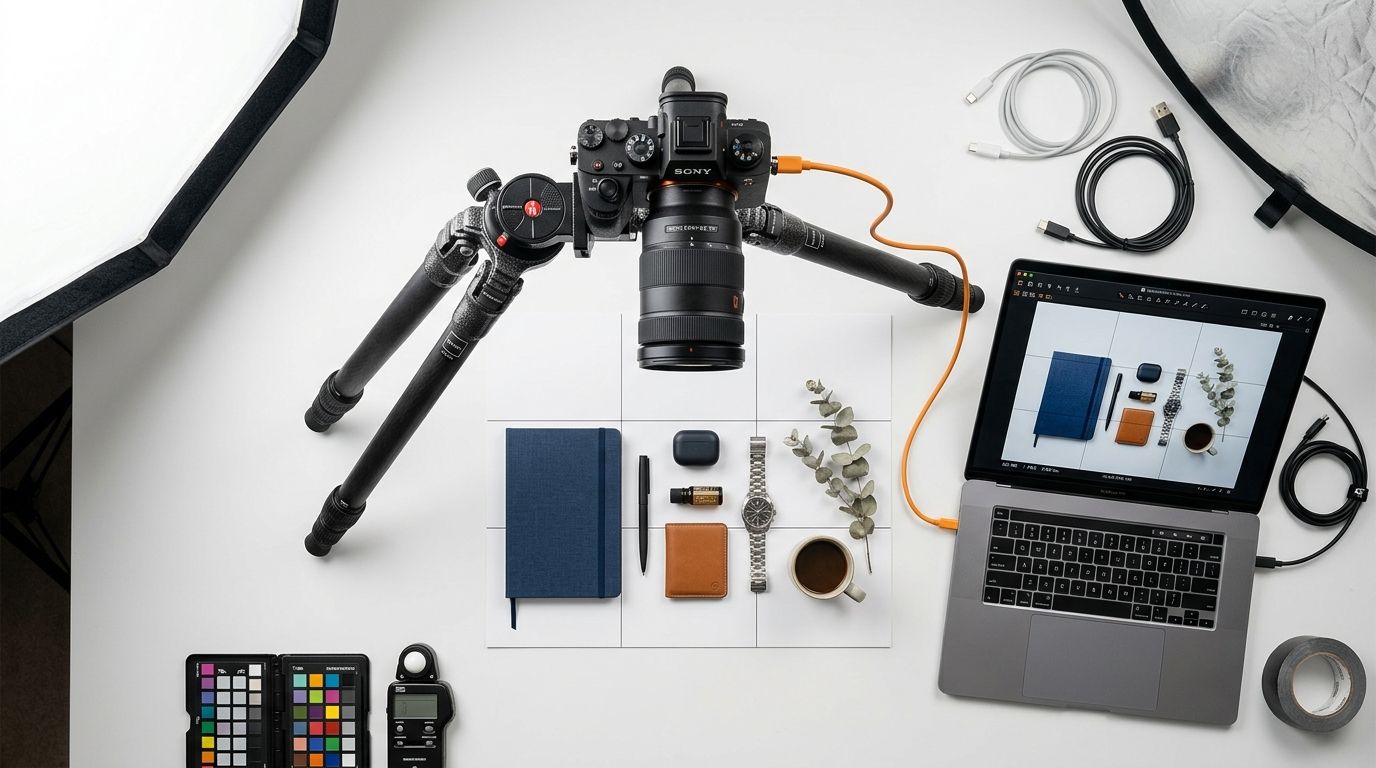
Flat lay photography is a top-down product shot where items are arranged on a flat surface and photographed with the camera pointed straight down, parallel to the ground. Ecommerce stores use it for catalog and PDP images because it shows true color, texture, and layout without the distortion or shadow variance of angled shots. It works best for clothing, accessories, cosmetics, and any product where a clean, repeatable grid of images matters more than showing scale on a body.
Definition
Flat lay photography is the practice of arranging products on a horizontal surface and capturing them from a top-down, overhead perspective. It is commonly used in ecommerce to display products clearly while maintaining a high level of organization and visual appeal.
Why Flat Lay Works for Modern Brands
Customers want to see exactly what they are getting without the clutter of a messy environment. Flat lays remove depth-of-field issues and focus purely on the product, which is why the format is essential for photographing clothing where fabric and layout are key. Done well, it creates a uniform look across a catalog, and that consistency is what makes a storefront feel like one brand instead of a pile of unrelated listings. If a flat lay isn't the right fit for your product, a white background product photo is the other standard option for marketplace listings.
The Psychology of Knolling
Knolling is the practice of arranging objects at 90-degree angles on a flat surface, a habit borrowed from industrial design studios that lay out tools before a shoot. It taps into a basic human preference for order. A knolled arrangement feels satisfying to look at and signals that whoever shot it cared about the details, which customers read as a proxy for product quality. You do not need to knoll every shot, but the discipline behind it, straight edges, even spacing, deliberate gaps, is what separates a flat lay that looks styled from one that looks dumped on a table.
Lighting for Flat Lays: Flash vs Continuous vs Window Light
Lighting is where most flat lay setups fall apart, and it is the single question that comes up most often in photographer forums when someone is building their first overhead rig. The three realistic options are strobe/flash, continuous LED panels, and natural window light. Each has a different failure mode, so the right choice depends on your volume and your space.
Flash and strobe lighting
Flash gives you the most light for the least heat and the shortest exposure time, which matters when you are shooting dozens of products in a session and do not want fabric or reflective packaging to pick up ambient color shifts. Two speedlights or monolights positioned at 45-degree angles above the frame, each through a softbox or shoot-through umbrella, is a reliable starting setup. Flash also lets you shoot at a low ISO and a small aperture, keeping the entire flat surface in focus edge to edge, which matters more in flat lay than in most product photography since the whole frame is your subject plane. The tradeoff is that flash requires correct metering before every batch, and it is less forgiving if you are new to manual exposure. If your ratios are off, you will not see it until the shot is on your screen, not while you are composing.
Continuous lighting
Continuous LED panels let you see your lighting in real time, which is why beginners and solo ecommerce sellers often prefer them. Nudge a panel two inches and the shadow moves immediately, rather than requiring test shots and screen checks. The downside is heat and power draw during long sessions, and continuous light is generally dimmer than flash at the same price point, which can push your ISO up and introduce noise, especially on darker products or matte fabrics that already absorb light. For high-volume work, flash tends to win on image quality and shoot speed. For low-volume, one-person operations, continuous is the easier tool to learn on.
Window light
A large north-facing window with diffused daylight is still one of the best free light sources for flat lay, particularly for cosmetics and jewelry where you want soft, wraparound highlights without a visible light source reflecting in glass or metal. Position your setup perpendicular to the window rather than directly under it, and use a white foam board on the opposite side to bounce fill light into the shadows. The catch is consistency: window light shifts with the time of day and weather, so batches shot across multiple sessions can drift in color temperature. If you rely on window light, shoot your entire product run in one sitting and lock your white balance manually rather than leaving it on auto.
Backgrounds and Surfaces for Flat Lay Shots
The surface under your product does as much work as your lighting. It sets the mood, frames the color palette, and either supports the product or fights it for attention.
Neutral surfaces
Matte white, light gray, and pale wood remain the safest defaults because they read as clean and let product color stay true across a catalog. These surfaces are also the most forgiving in post-production, since batch color correction is easier when every background in the shoot started from the same neutral base.
Textured and branded surfaces
Concrete, linen, marble-effect vinyl, and colored card stock add personality but need to match your brand's palette rather than being picked because they look nice empty. A busy marble texture can overwhelm a small, pale product like a bar of soap or a piece of jewelry, while it works well under a bold, saturated item like a bright sneaker. Test the surface with your actual product before committing to a full batch.
Practical surface tips
Buy backdrops in vinyl or PVC rather than paper when you shoot flat lay regularly. Paper creases and shows crease shadows from directly overhead in a way it never does in angled shots, and vinyl wipes clean between products, which matters with cosmetics, food, or anything that can leave residue. Keep two or three go-to surfaces on hand so you are not reshooting an entire category because a new product does not suit your only background. For a deeper look at surface options, see our guide to backdrops for product photography.
Styling Flat Lays by Vertical
Flat lay is not one technique. What works for a folded t-shirt does not work for a ring, and what works for a lipstick does not work for a bowl of granola. Styling has to adapt to the product category.
Clothing
Clothing flat lays live or die on how the garment is folded and filled. Flat, lifeless fabric reads as cheap even if the product isn't, so most professional clothing flat lays use tissue paper, foam inserts, or double-sided tape under sleeves and collars to create the illusion of volume, the same trick as if a body were still inside the garment. Keep sleeves and hems symmetrical, square up the shoulders, and steam or iron before the shoot since overhead lighting shows every wrinkle. For multi-item outfits, group by a consistent visual rhythm, largest item top-left, accessories bottom-right, rather than scattering pieces randomly.
Jewelry
Jewelry is the hardest flat lay category because reflective metal and faceted stones pick up every light source in the room, including your own camera and hands. Use a light tent or a large diffusion panel directly overhead to soften reflections, and angle secondary fill light low and to the side to bring out texture without creating a hot spot. Museum putty or clear jewelry tape keeps chains from sliding out of position, since even a slightly crooked clasp is obvious at this scale. Shoot tighter than you think you need to; jewelry loses impact fast as a small object lost in a large frame. For a full setup breakdown by piece type, see our jewelry photography guide.
Cosmetics
Cosmetics flat lays need to sell texture: the sheen of a lip gloss, the powder finish of an eyeshadow pan, the gel consistency of a serum. Side lighting at a low, raking angle across the surface reveals texture that flat, even overhead light flattens out. Glass and acrylic packaging benefit from a black card or gobo placed just outside the frame to create a defined reflection line rather than a washed-out highlight. Group products by function or a shared color story rather than by brand alone, since a flat lay that pairs a product with its actual use, a cleanser next to a folded washcloth, a serum next to its dropper mid-drip, tells a more complete story than the bottle alone. Our cosmetics photography guide covers texture lighting in more depth.
Food and packaged goods
Food flat lays follow different rules again: styling has a shelf life measured in minutes before ice cream melts or garnishes wilt, so lighting and composition should be planned and tested with a stand-in before the real product goes down. Warmer color temperature light, around 3200 to 4000 Kelvin, tends to suit food better than the cooler daylight-balanced light that flatters cosmetics and jewelry. Props should support the story, a linen napkin, a wooden board, scattered ingredients, without crowding the hero item out of the frame.
Camera and Phone Settings for Sharp Flat Lays
Flat lay rewards technical discipline more than most product photography styles because the entire frame sits on one plane and any softness or unevenness has nowhere to hide.
Camera settings
Shoot in manual mode with a mid-range aperture, f/8 to f/11 on a full-frame camera, to keep the whole surface in focus without the diffraction softness that creeps in past f/16. Keep ISO as low as your lighting allows, ideally 100 to 400, since flat lay surfaces often show fine texture like fabric weave or paper grain that picks up noise quickly. A 50mm or 85mm prime lens produces less edge distortion than a wide zoom, which matters at the corners of a top-down frame where straight lines need to stay straight. Use a two-second timer or a remote trigger so pressing the shutter does not introduce camera shake through your overhead rig.
Phone settings
Modern phone cameras handle flat lay well if you control the variables manually rather than trusting auto mode. Turn on the grid overlay to square your camera to the surface, lock focus and exposure by tapping and holding on the product, and turn off any "smart HDR" or scene-detection feature that tries to warm up the shot, since these often shift your background's white balance between frames. Shoot from directly overhead, not at a slight tilt, since even a five-degree tilt is obvious once you place a flat lay grid next to a genuinely parallel shot. A basic phone tripod with an extendable overhead arm solves the tilt problem for under the cost of a single professional shoot.
| Requirement | Standard | Pro Tip |
|---|---|---|
| Lighting | Soft, diffused light | Bounce fill with white foam board |
| Background | Flat, neutral surface | Use vinyl for easy cleaning |
| Alignment | Camera perfectly parallel | Check with a clipped bubble level |
| Aperture | f/8 to f/11 | Avoid past f/16 to prevent diffraction softness |
| ISO | 100 to 400 | Push lower if lighting allows |
| Editing | Batch color correction | Shoot a gray card at the start of every session |
Flat Lay Product Photography Workflow for a Full Catalog
Shooting one great flat lay is easy. Producing thirty consistent ones for a full collection launch is where most in-house teams run into trouble, which is why a repeatable workflow matters more than any single tip above.
Lock your camera height and angle first, then leave the tripod in place for the entire session rather than adjusting it between products. Shoot a gray card or color checker at the start under your working light so you have a fixed reference for batch color correction later. Photograph products in order of similar size and shape so composition adjustments are incremental, not a fresh start every time. Build a shot list before you begin so styling decisions, folded versus flat, grouped versus solo, are made once in planning rather than improvised mid-shoot, which is usually where inconsistency creeps into a catalog.
If you are working from existing product photos rather than reshooting from scratch, CherryShot's AI photoshoot generator can create new flat lay compositions directly from a real product image, keeping the item's true shape, color, and proportions while placing it into a fresh overhead layout. That is useful for brands that need to refresh a catalog's visual style or add new surface and prop variations without booking a studio day for every SKU.
Common Flat Lay Mistakes to Avoid
Most flat lay problems trace back to a handful of repeat offenders rather than anything exotic.
Uneven lighting across the frame. A single light source close to the setup often leaves one side brighter than the other, invisible on a small preview screen but obvious at full size on a product page. Check the corners, not just the center, before moving on.
A camera that is not truly parallel to the surface. Even a slight tilt distorts straight edges and throws off focus consistency. A bubble level clipped to your hot shoe takes ten seconds to check and prevents an entire batch from needing a reshoot.
Backgrounds that compete with the product. Busy textures, strong patterns, or colors close to the product's own hue reduce contrast and make the item harder to read at a glance, which matters most on a search grid where shoppers scan fast.
Inconsistent framing between products in the same collection. If your camera height, crop, or lighting shifts between shots, the collection page looks assembled from different photographers rather than one brand. Lock your settings once per session.
Overstyling. Props exist to support the product, not compete with it. If a customer has to search the frame to find what is for sale, the styling has gone too far.
Frequently Asked Questions
What equipment do I need for flat lay photography?
Start with a stable tripod or a dedicated overhead rig to ensure your camera stays perfectly parallel to the floor. Use a quality prime lens to minimize distortion and capture sharp textures across the entire frame. Good lighting for product photography is the final requirement for a clean result, so aim for soft, diffused light sources that fill shadows without creating harsh highlights on your product surfaces.
What are the best backgrounds for flat lay product photos?
Neutral textures like matte paper, light wood, or concrete work best because they do not distract from your product. You should choose surfaces that complement the color palette of your brand to maintain a consistent aesthetic across your catalog. Investing in professional vinyl backdrops allows for easier cleaning and better durability, which helps you maintain the best backgrounds for product photos over a long period.
How do I keep products from shifting during flat lay shoots?
Use small pieces of double-sided tape or museum putty hidden beneath your items to lock them into place. Gravity can cause fabric or small accessories to migrate during long setup sessions, so secure them before you take the final test shot. This approach prevents time-consuming adjustments and helps you maintain your perfect composition while swapping different products in and out.
When should I use flat lay vs on-model photography?
Flat lay photography serves as the perfect solution for organized catalog shots that highlight product details and material quality. Choose on-model photography when you need to show scale, fit, or the way a fabric moves on a person. Mixing both styles provides a more complete picture for your customers, especially when photographing clothing for ecommerce where fit remains a primary concern for the shopper.
Is flat lay photography still popular for ecommerce?
Yes. Flat lay remains a standard format for catalog and PDP images because it is fast to shoot, easy to batch, and gives shoppers a distortion-free view of texture and detail. It has not replaced on-model or lifestyle photography, but most stores use it as the baseline shot and add other formats around it.
What are the most common flat lay mistakes?
Uneven lighting that leaves one corner darker than the rest, a camera that is not truly parallel to the surface, backgrounds that compete with the product, and inconsistent framing between shots in the same collection. Each of these breaks the uniform grid look that makes flat lay galleries feel professional, so they are worth checking before you shoot a full batch.
What is the 20-60-20 rule in photography?
It is a rough guide for balancing visual weight in a composition: roughly 20 percent of the frame carries the boldest element, 60 percent is a supporting mid-weight area, and the remaining 20 percent stays quiet. In flat lays it is a useful gut check for how much space your hero product should take up against props and negative space, not a rule to measure with a ruler.
How much do ecommerce photographers make?
Rates vary widely by market, experience, and whether the photographer works per project or on retainer. Freelance product photographers in the US commonly charge per-image or day rates that scale with volume and retouching needs, while in-house ecommerce photographers are salaried. Because rates depend on location and scope, get quotes directly from photographers in your market rather than relying on a single average.
Key Takeaways
- Choose flash for high-volume, repeatable shoots and continuous or window light for smaller, hands-on sessions.
- Match your surface and prop styling to the vertical: volume for clothing, glare control for jewelry, texture lighting for cosmetics.
- Shoot manual, keep the camera parallel, and lock your settings for the entire session to keep a catalog visually consistent.
- Check corners for uneven light and verify parallel alignment before running a full batch, not after.
- Use flat lay as your catalog baseline and layer in on-model or lifestyle shots where scale and fit matter more.
Streamline your product photography workflow
If manual studio setups are slowing down your launch timeline, you can experiment with AI-driven visual modes to generate consistent catalog imagery in minutes. Test your product against different styles to see what converts best with your specific audience.
Try CherryShot AIFlat lay photography rewards the same discipline every time: consistent light, a parallel camera, and styling that fits the product in front of you. Get those three right and the rest of the catalog falls into place shot by shot.