Product Photography Storytelling for Ecommerce
Every single day, I look at ecommerce sites that treat their product gallery like a police evidence locker. They provide a front view, a side view, and a back view on a stark white background. They prove beyond a reasonable doubt that the item exists. They do absolutely nothing to make anyone actually want it.
Definition
Product photography storytelling is the deliberate process of designing image galleries that walk a shopper through logical and emotional buying phases. It combines lifestyle contexts, precise lighting, and targeted close-ups to prove value without relying on written descriptions. This method answers visual objections directly to increase conversion rates.
Product photography storytelling for ecommerce is not about making things look pretty. It is about guiding a buyer from passing curiosity to absolute purchase confidence without requiring them to read a single word of your description. Most brands fail here because they believe a visual story requires a massive budget and a five-day location shoot. It does not. It requires intent.
When you map your product images to the psychological journey of your buyer, the gallery stops being a passive catalog. It becomes an active sales mechanism. Let us break down exactly how to stop documenting your inventory and start narrating its value.
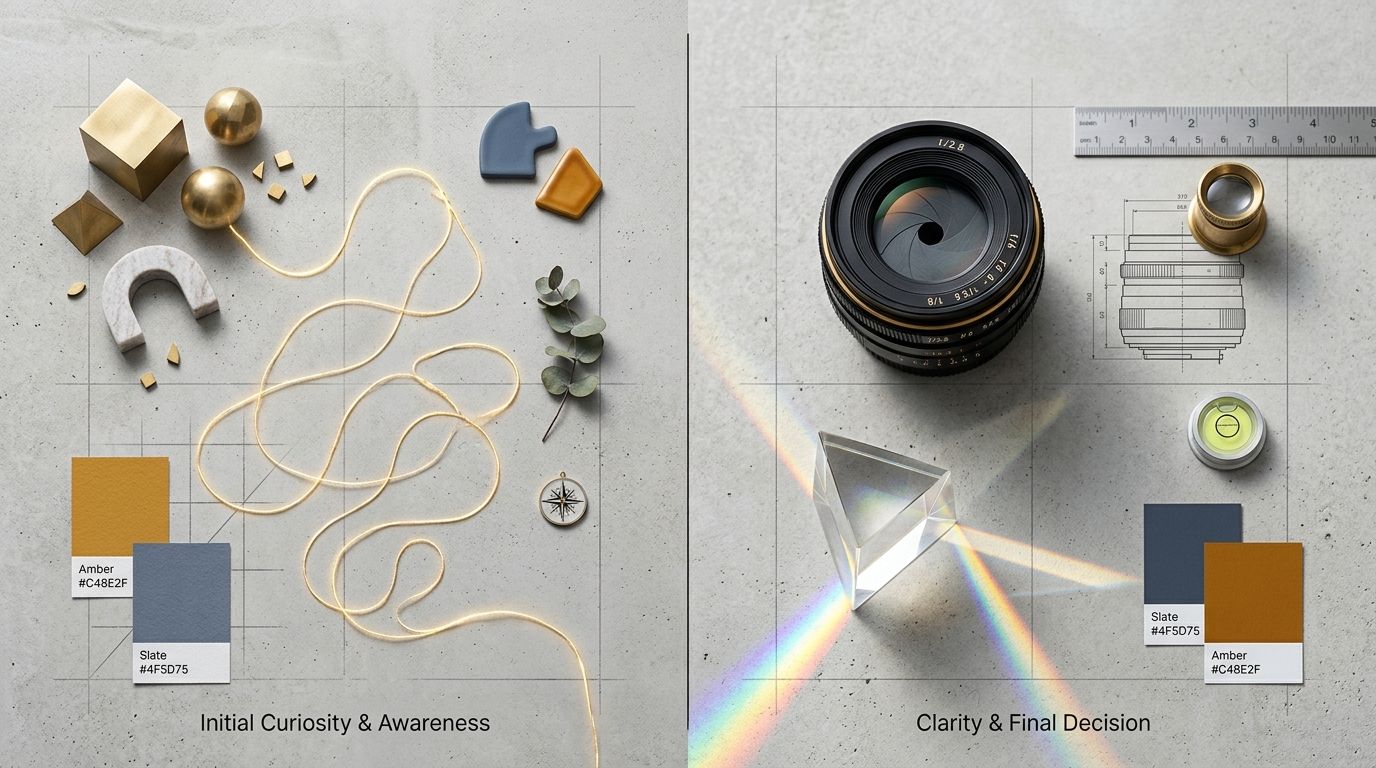
Product photography storytelling requires moving beyond the standard white background to show the product living in the customer's world.
The Difference Between Documentation and Storytelling
Documentation is a white background shot of a ceramic coffee mug. It shows the handle shape and the glaze color. Storytelling is that same mug resting on a stack of worn paperback books next to a half-eaten croissant on a Sunday morning. One tells you the specs. The other sells you a feeling.
When I ran my second apparel brand, we spent an entire Tuesday trying to make a hiking boot look adventurous in a studio setting. We brought in fake rocks. We brought in bags of dirt. The invoice arrived two weeks later, and the photos looked exactly like what they were: a boot sitting on a pile of studio dirt. We documented the boot, but we completely failed to tell its story. The customer felt nothing, and our conversion rates reflected that apathy.
| Photography Style | Primary Objective | Effect on Shopper |
|---|---|---|
| Standard Documentation | Shows physical specifications clearly | Creates basic awareness |
| Lifestyle Context | Demonstrates the item in an idealized environment | Builds emotional desire |
| Macro Detail Shots | Highlights material quality and construction | Removes hesitation at checkout |
Creating a genuinely emotional visual arc requires more upfront thought than simply handing your products to a photographer on a white sweep. That is a genuine trade-off. You have to understand who your customer wants to become when they buy your product, and then you have to visually place your product in that idealized life.
If your gallery lacks this context, you will inevitably deal with a massive drop-off at the consideration phase. This is often the root of the problem when founders ask me about images affecting add-to-cart rate on their store. Shoppers are looking at the item, but they cannot visualize it in their own hands.
The Three-Act Structure of a Product Gallery
A high-converting product gallery follows a specific narrative arc. Think of it as a three-act play. You cannot jump straight to the conclusion, and you cannot start with the boring details. You have to earn the buyer's trust step by step.
Act One: Curiosity and The Hook
Your hero image is the cover of the book. Its only job is to stop the scroll and earn a click. In an ad format or a collection page, this image must visually shout your core value proposition in a fraction of a second. It should be aspirational. It needs perfect lighting, a strong silhouette, and just enough environmental context to hint at the lifestyle.
If you sell premium skincare, your hook is not a flat lay of the bottle. It is the bottle bathed in golden hour light on a marble vanity, surrounded by an atmosphere of calm. You are selling the morning routine, not just the serum.
Act Two: Connection and Context
Once they click through to the product page, the story expands. This is where you deploy lifestyle photography for brand perception. The buyer needs to see the product being used by someone they relate to, in an environment they desire. This is where desire solidifies into intent.
For home goods, this is the wide shot of the lamp illuminating a cozy reading nook. For apparel, this is the jacket being worn on a windy city street, showing how the fabric moves and drapes. You are answering the unspoken question: "How does this fit into my life?"
Act Three: Confidence and Proof
This is where the story shifts from emotional to logical. The buyer wants the item, but their brain is looking for reasons to say no. Your final images must systematically dismantle those objections.
Show extreme macro shots of the stitching. Show the texture of the material. Show a hand holding the object to establish true scale. (Worth noting here: a narrative does not replace the need for clear documentation. A beautiful lifestyle image will not save you if the customer cannot clearly see the clasp mechanism on your bag. You need both.) You are providing visual proof that the item is worth their money.
The Logistical Nightmare of the Narrative Shoot
Understanding this three-act structure is easy. Executing it used to be a logistical nightmare. Coordinating a multi-stage narrative shoot meant booking a location, hiring talent, finding props, and hoping the art director completely understood the brief. A simple product story could take three weeks and thousands of dollars to execute.
Most founders I have talked to cannot name the actual per-image cost of their last shoot. When they calculate it, the number is usually somewhere between $80 and $200 per finished image. When you multiply that by thirty SKUs and four narrative stages per SKU, the math simply does not work for growing brands.
This is exactly why we built CherryShot AI. You do not need to scout locations or rent a prop house. You upload your standard documentation shot, select the Lifestyle, Luxury, or Influencer mode, and generate the exact narrative images you need in minutes. The barrier to entry for visual storytelling is no longer budget or scheduling. It is simply your own imagination.
Eliminating the Final Friction
When your image gallery successfully executes a narrative, your product page does the heavy lifting for you. You no longer have to rely on bullet points to convince someone the leather is soft or the sizing is accurate. The story has already been told.
Brands that fail to tell this story often find themselves desperately optimizing their checkout flow, completely unaware of the connection between visual trust and checkout abandonment. The customer did not leave because the shipping was too high. They left because your images never made them confident enough to finish the transaction.
Stop treating your product pages like an inventory system. Treat them like a pitch. Give the buyer a hook, give them context, and give them proof. When you build a visual narrative, the product stops being a commodity and becomes a necessity.
Key Takeaways
- Documentation proves an item exists, while storytelling proves an item is valuable.
- A high-converting gallery follows a three-act structure of curiosity, connection, and confidence.
- Detail and scale shots are critical for closing the sale and preventing cart abandonment.
- AI tools eliminate the massive logistical costs previously required to shoot lifestyle narratives.
Frequently Asked Questions
What is product photography storytelling?
Product photography storytelling is the strategic sequence of images designed to move a customer through specific emotional and logical buying phases. This approach relies on environmental context, deliberate lighting, and carefully chosen props to demonstrate an item's real-world value. A complete sequence replaces the physical retail experience by visually answering unasked questions about scale, texture, and daily application before the shopper reads a single word.
How do I use images to guide buyers through a purchase decision?
Guide buyers by structuring your product image carousel to precisely mirror their psychological decision process. Lead with a striking hero hook to command immediate attention, follow with relatable lifestyle shots that build desire, and conclude with tight macro details to prove material quality. This specific visual arrangement systematically removes hesitation and prevents shoppers from abandoning their carts during the final stages of checkout.
What is the buyer journey in product photography?
The visual buying process consists of three distinct phases: curiosity, connection, and confidence. Curiosity requires a strong hero image to force a click from a crowded catalog page. Connection relies on relatable lifestyle environments that help shoppers visualize ownership. Finally, confidence demands extreme detail and scale shots to eliminate any remaining doubts about material construction before the customer reaches the checkout screen.
How does storytelling in product photography affect conversion?
Visual narrative structures directly increase conversion rates by keeping users engaged and actively removing purchasing friction from the product page. Shoppers stop looking for reasons to leave your site when the image gallery successfully anticipates and answers their logical objections. Providing clear proof of quality alongside aspirational context creates a highly convincing pitch, which significantly lowers cart abandonment metrics across your store.
What are the stages of a visual product story?
A complete visual narrative includes the hero shot, the environment shot, the detail shot, and the action shot. The hero commands initial attention, the environment establishes scale and mood, the detail highlights craftsmanship, and the action demonstrates practical use. Combining these specific angles builds a comprehensive sales pitch that thoroughly convinces the buyer without requiring long paragraphs of supporting text.
The days of waiting weeks for a lifestyle shoot to validate your product concepts are over. If you want to see how fast you can turn a basic documentation photo into a full visual narrative, upload your assets to CherryShot AI and start telling a better story today.
Audit your product image narrative before your next launch
Look at your top-selling product gallery right now and count how many images are purely documentation. You can instantly test new lifestyle contexts and macro detail shots without booking another studio day. Generate high-converting visual proof with CherryShot AI to close more sales.
Try CherryShot AI