DSLR vs Mirrorless Camera for Product Photography: 2026 Decision Guide
If you are debating between a DSLR camera for product photography and a modern mirrorless system in 2026, the technical answer is mirrorless. The mirrorless platform won the hardware war years ago. But the real answer is that you are likely asking the wrong question entirely. Buying a camera is the cheapest, easiest part of bringing ecommerce photography in-house. The actual expense hides in the lighting grids, the styling props, the talent day rates, and the brutal reality of post-production bottlenecks.
Definition
Product photography involves capturing high-quality images of items for sale in online stores. This process requires precise lighting, controlled camera settings, and consistent staging to accurately represent product features, textures, and colors for potential customers.
Most brands start researching a dslr vs mirrorless ecommerce comparison because they are tired of paying a freelancer thousands of dollars for a dozen photos. They assume owning the equipment solves the timeline delays and the budget constraints. This is almost never true.
(Let me be clear: a dedicated physical shoot still holds massive value for highly conceptual hero banners and complex lifestyle scenes where human interaction is required. A skilled photographer pointing a premium lens at a model wearing your product is unmatched for your homepage banner.)
But if your goal is scaling standard catalog imagery across a growing SKU count, buying a camera is a trap. You do not have a hardware problem. You have a throughput problem.
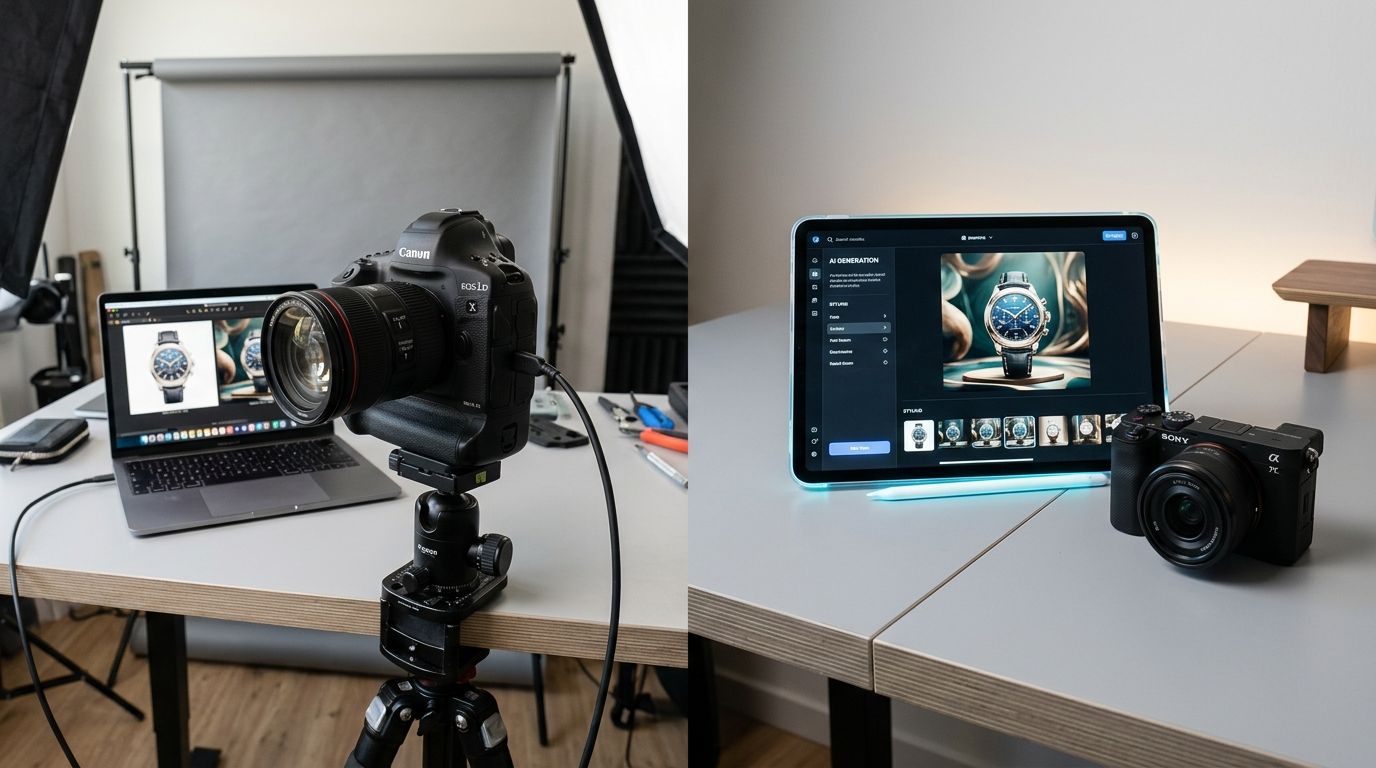
Mirrorless camera systems offer real-time exposure feedback through electronic viewfinders, making them the standard for modern tethered studio workflows.
The state of the DSLR camera for product photography in 2026
Ten years ago, the DSLR was the undisputed king of the product studio. Today, finding a brand new DSLR from a major manufacturer is becoming difficult. Canon and Nikon have shifted almost all of their research, development, and lens manufacturing to their mirrorless mounts.
Why the industry shifted to mirrorless
A DSLR relies on a physical mirror mechanism that bounces light up into an optical viewfinder. When you press the shutter, the mirror flips out of the way to expose the sensor. Mirrorless cameras remove this mechanical step entirely. The light hits the sensor constantly, and the camera feeds a digital image to an electronic viewfinder or the rear screen.
For live view product photography, this is a massive advantage. What you see on the screen is exactly what the sensor captures. Exposure, white balance, and depth of field are rendered in real time. If your lighting is too harsh or your white background is slightly gray, you see it before you take the photo, not after.
Mirrorless bodies also offer tools like focus peaking. When you are shooting a macro photograph of a diamond ring, nailing the exact point of focus is critical. Focus peaking highlights the high-contrast edges in your viewfinder with a bright color, proving exactly what is in focus before you trigger the strobe.
Are DSLRs completely obsolete for ecommerce?
You can buy a used, professional-grade DSLR for a fraction of the cost of a new mirrorless camera. If you are locked into an absolute minimum budget for an essential photography setup, a ten-year-old DSLR will still take a remarkably sharp photo. The physics of light have not changed. If you put good glass in front of an older sensor and understand critical lighting techniques, your customer will never know what camera you used.
But you are trading cash upfront for workflow friction every day after. Tethered shooting with older DSLRs can be clunky. Software compatibility updates occasionally break older camera connections. The initial savings erode quickly when your photographer spends twenty minutes troubleshooting a bad cable connection instead of styling products.
Technical specs that actually matter for ecommerce
If you commit to buying a camera, you have to ignore marketing materials designed for sports and wildlife photographers. You do not need a camera that shoots thirty frames per second. You do not need advanced subject tracking autofocus. Your product is sitting perfectly still on a table.
Megapixels and camera resolution ecommerce needs
Camera brands sell megapixels because larger numbers look impressive on a retail box. Founders routinely ask if they need a 60-megapixel camera to make their products look premium online. The math says otherwise.
A standard Shopify product page displays an image at roughly 2000 pixels on the long edge. That equates to about four megapixels of resolution. Even if you want to offer an extreme zoom function for a customer inspecting the stitching on a leather bag, an eight-megapixel image provides more than enough detail.
A standard 24-megapixel sensor gives you massive flexibility to crop your images aggressively without ever dipping below ecommerce resolution requirements. Buying a 60-megapixel camera just guarantees you will need to buy external hard drives twice as fast to store massive RAW files.
Full frame product photography vs crop sensor
The sensor size debate is another area where standard photography advice fails the ecommerce use case. Full frame sensors are physically larger than crop sensors (APS-C). They gather more light and provide a shallower depth of field. Portrait photographers love full frame cameras because they easily blur the background into a smooth wash of color.
Product photography demands the opposite. You want maximum depth of field. If you are shooting a shoe at a three-quarter angle, you want the toe box and the heel tab to be perfectly sharp. Achieving this on a full frame camera requires stopping the lens down to a very narrow aperture, which demands incredibly powerful studio strobes to properly expose the image.
A crop sensor camera gives you deeper depth of field inherently. It is actually easier to keep an entire product in focus using an APS-C camera than it is using a premium full frame body. Unless you plan to shoot all your products in incredibly low light conditions without studio strobes, paying the premium for a full frame sensor is wasted capital.
When to buy a camera and build an in-house studio
There is a specific scenario where building an in-house photography operation makes total mathematical sense. If your brand sells hundreds of visually similar items that require the exact same lighting setup, the studio becomes a machine. Think of an eyewear brand shooting 400 different frames. You set the lights once, lock the camera on a heavy tripod, and spend your days swapping out sunglasses and clicking the shutter.
| Method | Studio Workflow | Scaling Ability |
|---|---|---|
| Mirrorless Setup | Manual staging and lighting | Low (labor intensive) |
| Old DSLR Setup | Manual staging and lighting | Low (technical friction) |
| CherryShot AI | Digital asset generation | High (instant scaling) |
In this scenario, consistency is your primary goal. The initial $8,000 investment in a camera body, macro lens, strobe lighting kit, and tethering software pays for itself quickly when amortized across thousands of SKUs.
The hidden costs of the DIY route
However, if your catalog requires aesthetic variety, the physical studio rapidly becomes an anchor. Shooting a white sneaker on a plain white background takes ten minutes. Shooting that exact same white sneaker styled on a concrete block surrounded by moss requires three hours of sourcing materials, cleaning dirt off the seamless paper, and tweaking lighting angles to cast interesting shadows.
Most brands severely underestimate the logistical friction of creative photography. The camera only records what you build in front of it. The impact on conversions comes from the styling and the environmental context, not the brand logo printed on the camera strap.
When AI product photography replaces the camera purchase
This is where the decision matrix has fundamentally shifted in 2026. A brand launching five new product variants a month no longer needs to weigh the pros and cons of mirrorless camera autofocus tracking. They just need campaign assets.
Breaking the production bottleneck
When you use CherryShot AI, you bypass the hardware decision entirely. You upload a basic, sharply lit photo of your product, which you can often take with your manufacturer's reference images or a simple smartphone shot. You select a visual mode like Minimalist, Loud Luxury, or Magazine. The AI generates professional, campaign-ready imagery in minutes.
There is no studio to rent. There is no heavy concrete styling prop to carry up a flight of stairs. There is no invoice from an art director.
The per-image cost drops to under $5. The turnaround time goes from a three-week scheduling nightmare to a Tuesday afternoon task. This allows a lean ecommerce team to test different visual aesthetics quickly. If your audience responds better to a moody Avant Garde setting than a bright Lifestyle setting, you generate new assets in fifteen minutes. Doing that with a physical camera setup requires a total tear-down and rebuild of your lighting grid.
A camera captures reality exactly as it exists in your room. If your room is a messy garage with bad lighting, you get a messy, poorly lit photo. AI product photography creates the reality your brand deserves without the logistical overhead.
Streamline your product asset creation
Instead of investing in complex studio hardware, use your existing product images to generate professional lifestyle assets instantly. This approach removes the bottleneck of physical photoshoots and allows you to test new visual styles across your catalog in minutes.
Try CherryShot AIFrequently Asked Questions
Is a DSLR or mirrorless better for product photography?
Mirrorless cameras are the standard for modern ecommerce production. Electronic viewfinders display exact exposure levels in real time while offering precise manual focus tools like peaking for intricate macro shots. Although older DSLRs remain capable of capturing sharp images, the market has shifted entirely toward mirrorless platforms for future firmware updates and lens compatibility. These systems reduce technical friction during the shooting process and allow for faster adjustments while working in a studio.
What megapixel count do I need for product photography?
A 24-megapixel sensor provides more than enough data for professional ecommerce needs. Standard Shopify product displays utilize roughly four megapixels of actual resolution. Choosing a camera with 24 megapixels grants enough headroom for tight cropping on small product details without sacrificing image sharpness. Investing in higher resolution sensors often just increases file sizes and slows down your post-production workflow without delivering a noticeable visual upgrade for the typical online shopper viewing your store.
Do I need full frame for product photos?
Full frame sensors are unnecessary for most product photography applications. These sensors are designed for low light or shallow depth of field effects which contradict typical studio needs. Studio work usually happens on a tripod with bright lighting where keeping an entire product in focus is the priority. Crop sensor cameras offer deeper depth of field at equivalent apertures, making it significantly simpler to maintain sharp focus from the front to the back.
What is the best affordable camera for ecommerce photography?
Used mirrorless bodies from several years ago serve as the best entry point for budget-conscious brands. Prioritize the quality of your lens and your lighting equipment over the age of the camera body. High-quality strobes and modifiers will always produce superior ecommerce imagery than a new camera paired with inconsistent light. Spending your budget on light shaping tools creates a more professional final result than chasing the latest high-end camera sensor specifications.
Is a phone camera good enough for product photography?
Smartphone cameras are insufficient for professional catalog requirements. Computational photography often interferes with color accuracy and texture detail by applying automatic sharpening and contrast adjustments. These devices also lack the hardware to communicate with studio strobes reliably. While mobile cameras function for social media posts or casual behind-the-scenes content, a dedicated camera or AI generation platform is necessary to maintain visual consistency across a large number of products in your digital store.
Key Takeaways
- Mirrorless cameras have entirely replaced DSLRs for efficient tethered studio workflows.
- A 24-megapixel crop sensor camera provides maximum utility for ecommerce depth of field requirements.
- Building a physical studio only yields positive ROI when shooting high volumes of visually identical setups.
- AI product photography eliminates the hardware bottleneck and turns weeks of production into minutes.
The decision to buy a camera should be based on your operational volume, not an outdated idea of what makes a brand legitimate. If your constraints are time, styling budget, and aesthetic flexibility, a camera will not solve your problem. A smarter software workflow will. CherryShot AI gives you the visual assets of a massive studio without the massive invoice.