How to Build Trust on Your Ecommerce Website: The Visual Layer Most Guides Skip
Most guides on how to build trust on an ecommerce website point you toward security badges and five-star reviews. That advice is fundamentally outdated. By the time a shopper scrolls down to read your return policy, they have already decided if you are a legitimate business. That decision happens in milliseconds. It is entirely visual. If your store looks like a dropshipping template slapped together on a Tuesday, no amount of Norton Secure logos will save your conversion rate.
Definition
Visual trust in ecommerce refers to the immediate credibility a brand establishes through professional design and photography before a customer reads any text. It relies on consistent lighting, sharp image resolution, and clean website layouts to signal operational stability and product authenticity. A store with strong visual trust looks like a permanent, reliable business capable of fulfilling orders and handling returns.
You cannot hack trust with website widgets. Trust is the natural byproduct of visual competence. When a customer lands on your store, they are looking for signs of stability. They want to know you actually hold the inventory you claim to sell, that you care about the details, and that you will still be in business next week to handle a potential return.
This is where most independent brands fail. They spend weeks wordsmithing their about page while leaving their primary product pages filled with poorly lit, inconsistent imagery. They beg for trust through copy while actively destroying it through design.
The First 50 Milliseconds of Ecommerce Trust
Human brains process images significantly faster than text. We are wired to detect anomalies in our visual environment. When a shopper opens your website, they do not read your headline first. They scan the hero image, the typography, the white space, and the overall color harmony.
If you are using a low-resolution image stretched across a massive desktop monitor, the brain flags it as an anomaly. If the lighting on your hero product looks dull or unnatural, the shopper feels immediate friction. They might not be able to articulate why the site feels cheap, but their finger is already hovering over the back button.
Why above the fold trust matters most
The content located before a user has to scroll is your only guaranteed real estate. This above the fold section must instantly communicate professionalism. A crisp, high-definition lifestyle image showing your product in context proves that your brand exists in the real world.
Too many brands clutter this space with aggressive pop-ups offering a ten percent discount in exchange for an email address. Asking for personal data before you have established baseline visual credibility is a tactical error. It feels desperate. Establish your visual authority first. Let them see the quality of your goods. The email capture can wait until they actually want what you are selling.
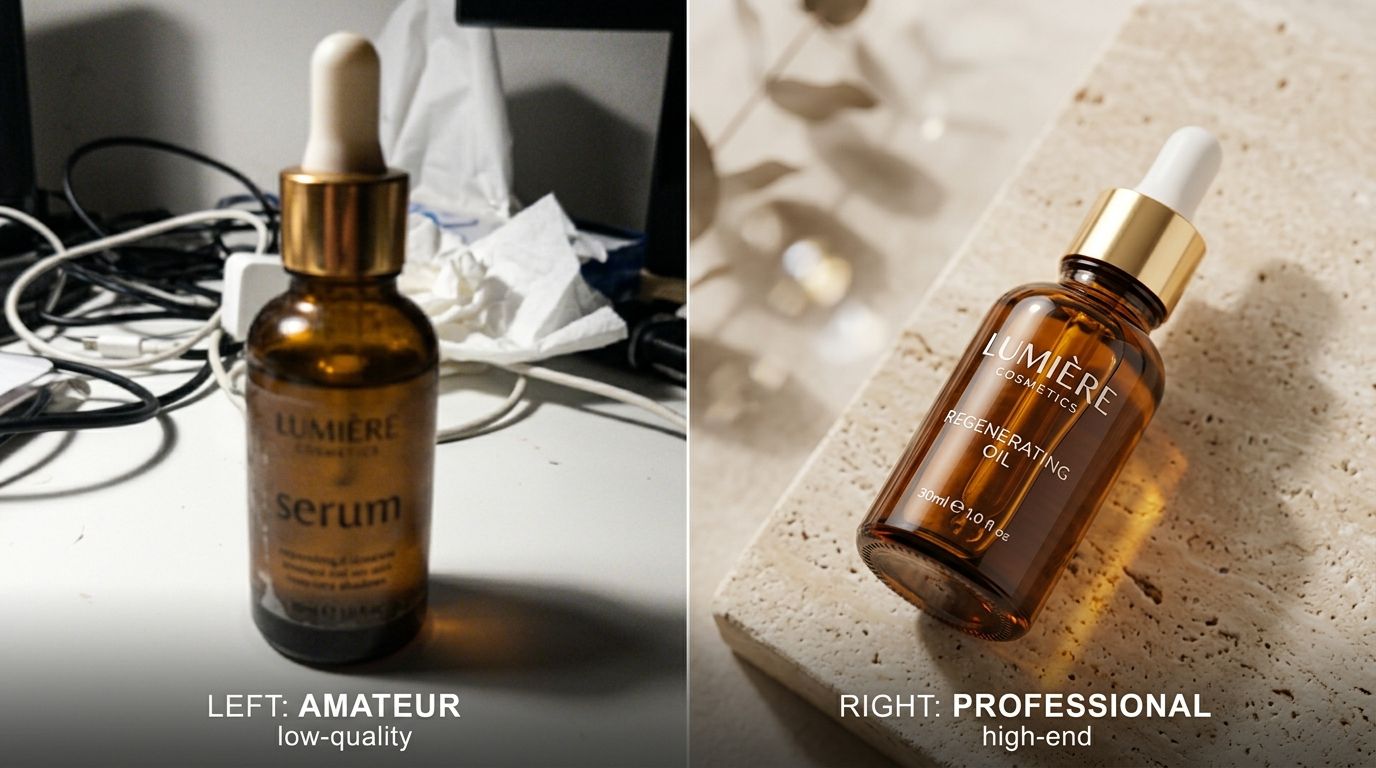
Clean typography and consistent image lighting instantly separate established brands from transient dropshippers.
Professional Product Images Are Non-Negotiable
Your product photography is the absolute loudest trust signal on your entire website. In a physical retail environment, shoppers can pick up an item, feel the weight of the fabric, check the seams, and inspect the packaging. In an online store, your photos have to do all of that heavy lifting. They are the only proxy the customer has for physical reality.
When you present a product with a flat, poorly lit photo taken on a smartphone under fluorescent garage lights, you are telling the customer that you do not take your own product seriously. If you do not value it enough to light it properly, why should they pay eighty dollars for it? If you are struggling with this baseline presentation, taking steps toward making your brand look premium is entirely dependent on fixing those visual assets.
The danger of the supplier catalog
Using default images provided by your manufacturer is a massive conversion killer. Shoppers are highly sophisticated. They know how to reverse image search, and even if they do not, they recognize the sterile, contextless aesthetic of an Alibaba stock photo. Nothing destroys trust faster than a customer realizing they can buy the exact same item from a marketplace for a fraction of the price.
You need original visual context. You need shadows that make sense. You need angles that highlight the specific details you talk about in your copy. Getting these assets through traditional studio shoots is undeniably expensive and slow. It is a genuine trade-off that small brands face when trying to scale. A weekend lifestyle shoot can easily cost five thousand dollars, money that could otherwise be spent on inventory.
This bottleneck is exactly why we built CherryShot AI. You need original, campaign-ready photos to build trust, but you cannot afford to halt your launch calendar waiting for a photographer to deliver retouched files. Uploading a flat product shot and generating a professional lifestyle image in minutes changes the entire dynamic of how you present your brand.
Brand Visual Consistency Stops Cart Abandonment
Trust is not just about making one good first impression. It is about maintaining that impression throughout the entire buying journey. A shopper might land on a beautiful hero image, click into a collection page, and suddenly find a chaotic mess of inconsistent background colors, varied cropping ratios, and conflicting lighting styles.
Inconsistency creates cognitive friction. When a product grid looks like a patchwork quilt of different photo shoots, the store looks disorganized. The shopper begins to wonder what else is disorganized. Is the fulfillment process this messy? Are returns handled this haphazardly? This kind of subconscious doubt is exactly where visual trust and checkout abandonment intersect. Shoppers rarely abandon carts because they forgot their wallet. They abandon carts because the website gave them a reason to pause, and in that pause, they decided the risk was not worth it.
Aligning your visual modes
Creating consistency does not mean every photo must look exactly the same. It means your catalog needs a defined visual language. If your brand leans into a Minimalist aesthetic, your shadows should be harsh and deliberate, and your backgrounds should be sparse. If you are selling high-end skincare, a Luxury or Magazine style dictates softer lighting, reflections, and premium prop placement.
(To be fair, you do need a secure checkout protocol and clear terms of service. You just cannot rely on them to do the heavy lifting of customer acquisition.)
A unified visual language proves to the customer that someone is paying attention. It signals a level of operational maturity that inherently makes the checkout process feel safer.
The Problem With Defensive Trust Signals
We need to talk about trust badges. Sometime around 2014, a myth permeated the ecommerce industry that plastering McAfee Secure, Norton AntiVirus, and 100% Satisfaction Guarantee badges directly under the add to cart button would skyrocket conversions.
Today, these badges often do the exact opposite. They are defensive. They scream insecurity. Premium brands do not need to remind you that their checkout is secure. Apple does not put a padlock icon next to the iPhone buy button. By loudly proclaiming that you are not a scam, you accidentally plant the idea in the shopper's head that you might be one.
Offensive trust building through transparency
Instead of relying on clipart badges, build trust offensively through absolute visual transparency. Show the product from the back. Show the inside lining. Zoom in on the stitching. The more visual information you provide, the less risk the customer feels.
This approach also impacts your bottom line long after the sale is complete. When customers know exactly what they are buying because your imagery is crystal clear, they are far less likely to send it back. The relationship between detailed product photos and returns is a straight line. Visual trust secures the initial conversion, but visual honesty secures the retained margin.
| Visual Element | Low-Trust Presentation | High-Trust Presentation |
|---|---|---|
| Product Photography | Generic supplier stock photos with flat lighting | Original imagery with accurate shadows and lifestyle context |
| Hero Section | Cluttered layout dominated by discount wheel pop-ups | Clean, high-resolution lifestyle images with ample white space |
| Catalog Consistency | Mixed aspect ratios and conflicting background colors | Uniform lighting style and strict, predictable cropping rules |
| Trust Signals | Flashing security badges and artificial countdown timers | Transparent product details and high-fidelity macro shots |
Frequently Asked Questions
How do I build trust on my ecommerce website?
You establish immediate credibility by prioritizing high-resolution, context-rich product photography before the customer ever reads a single line of your store's copy. Visual consistency across your entire catalog proves you operate a stable business that physically holds inventory rather than running a temporary drop-shipping storefront. Strip away defensive security badges from your hero section and replace them with clean studio shots alongside lifestyle imagery that highlight material details, physical scale, and precise manufacturing quality.
What visual elements build the most trust on an ecommerce site?
Professional product photography quality drives the highest level of consumer confidence during the critical initial evaluation phase of a store visit. Secondary visual indicators like strict typography hierarchy, intentional white space, and high-definition hero banners work collectively to validate the baseline legitimacy established by your imagery. You must ensure your entire product catalog relies on uniform lighting setups and identical cropping ratios to prevent the subconscious friction that causes potential buyers to doubt your operational competence.
Does product photography quality affect shopper trust?
High-fidelity product photography serves as the ultimate tactile substitute for digital buyers who are entirely unable to physically inspect an item inside a traditional retail store. Substandard images actively destroy conversions because they force potential customers to guess about material durability, true color accuracy, and overall manufacturing quality. You need to present every item using sharp macro shots detailing specific hardware or fabric textures, confirming you handle customer fulfillment with the exact same care as your visual presentation.
What is the fastest way to improve trust on an ecommerce product page?
You can instantly elevate perceived legitimacy by swapping cheap supplier stock photos for visually consistent, high-resolution original images that definitively prove you hold actual inventory. Stripping away artificial urgency elements like flashing countdown timers and aggressive security banners removes the desperation typically associated with low-quality operations. Simply feature one perfectly lit, color-accurate studio shot alongside a realistic contextual lifestyle image to communicate quiet brand confidence without ever begging the customer for validation.
Key Takeaways
- Consumers evaluate website credibility through visual design in milliseconds before reading any text.
- Original, high-quality product photography is your strongest tool to distance your brand from cheap dropshipping operations.
- Visual consistency across your entire catalog reduces the cognitive friction that leads to cart abandonment.
- Defensive trust badges often hurt conversions by making the site look cluttered and insecure.
Building trust is not a one-time setup step you complete before launching your store. It is a continuous practice of presenting your products with the utmost respect for your customer's attention. Start by auditing your current catalog, stripping away the defensive clutter, and elevating the visual standard of your product photography. When your site looks undeniable, the conversions will follow.
Audit your product catalog imagery before your next campaign
Identify the weakest product photos on your storefront and systematically replace them with consistent, high-resolution visuals. You can generate professional studio and lifestyle shots directly from your existing basic photos to establish immediate credibility. Elevate your visual baseline without waiting for an expensive physical photoshoot.
Try CherryShot AI