How to Launch 10 New SKUs a Month With Consistent Product Photography
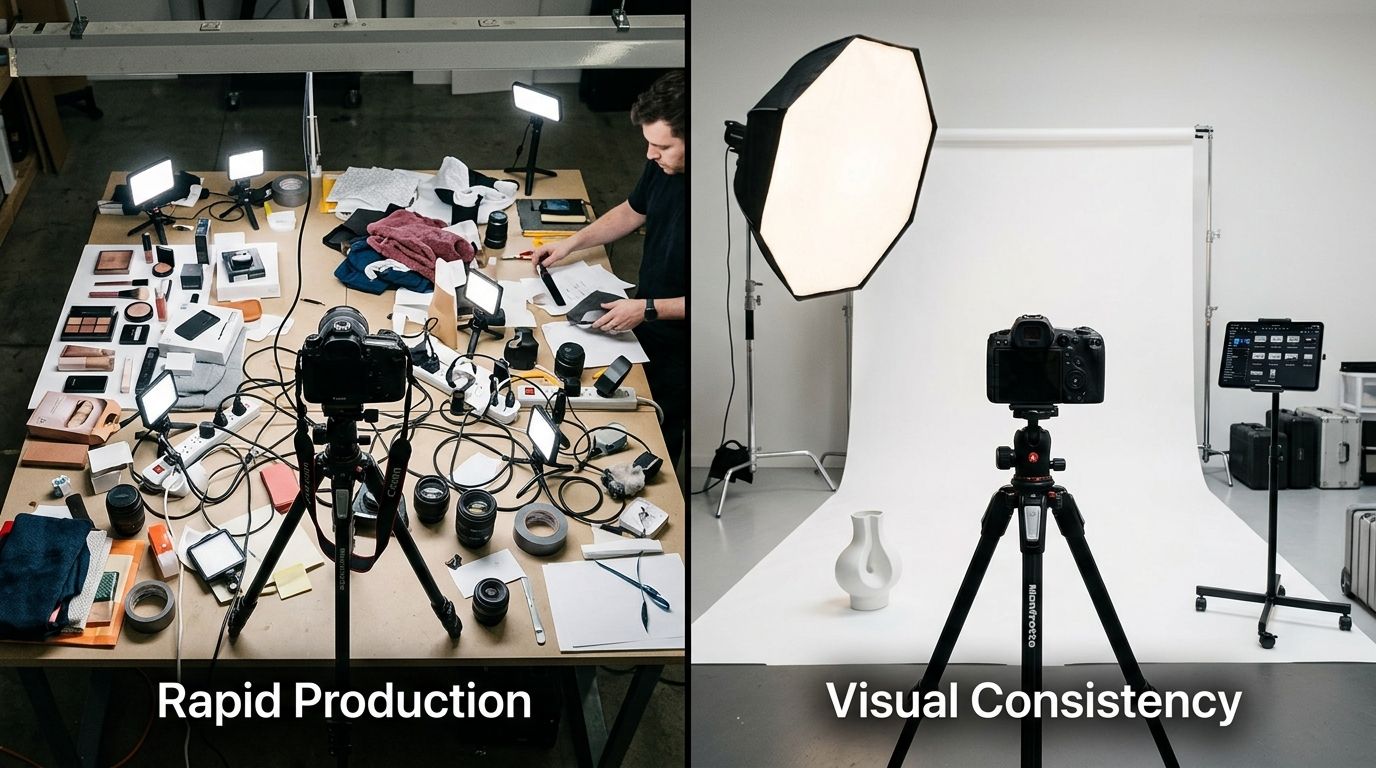
Launching new products is the engine of your ecommerce growth, but the photography process is usually where the wheels fall off. If you are still relying on traditional studio shoots for every new release, you are likely trading velocity for a marginal gain in control. High-frequency launches require a shift in how you think about your visual pipeline.
Definition
High-frequency SKU launching is the practice of systematically releasing new inventory on a predictable schedule. It depends on minimizing the time between product finalization and the live product page. This approach prioritizes speed and consistency over the custom styling required for single campaign hero shots.
Why Your Current Shoot Cycle is Holding You Back
The math of traditional studios rarely favors high-volume retailers. When you book a studio for ten SKUs, you are paying for the rental, the lighting technician, and the retoucher who needs five days to turn around the files. Every time you have to coordinate these schedules, you create a bottleneck that slows your entire team down.
Smart founders have realized that they can launch products faster by decoupling their imaging process from physical studio time. While a high-end editorial shoot has its place, it should never be the barrier to entry for your weekly inventory updates.
The Hidden Costs of Traditional Scheduling
Scheduling is the unseen tax on your growth. You spend hours communicating with vendors, preparing the shipment of samples, and tracking packages. If a single sample is delayed or a photographer is booked, your launch date slips. This ripple effect happens every month, and it is a massive waste of energy.
| Workflow Element | Traditional Studio | AI-Powered |
|---|---|---|
| Turnaround Time | 2 to 3 weeks | Same-day |
| Cost Per SKU | $80 to $200 | Under $5 |
| Scheduling | Required weeks prior | On-demand |
| Consistency | Varies by session | Automated |
Building a Scalable Visual Content Pipeline
Consistency is the secret sauce for brands trying to build a professional-looking site. If every image has different lighting or a different angle, your site looks like a collection of random parts rather than a cohesive shop. You need a system that ensures a consistent product catalog regardless of when a product was launched.
The Role of Digital Assets
By moving to a digital-first photography workflow, you store your brand style in your toolset rather than in a photographer's head. You simply upload a base image of your product and apply your chosen visual mode. This process allows your team to maintain that high-end look without needing to explain it to a new freelancer every month.
I have spent years managing teams that were bogged down by these exact issues. Every minute you spend debating if a product angle is "close enough" is a minute you aren't spending on your marketing strategy. Modern tools like CherryShot AI give you that time back immediately.
Consider whether you truly need a human operator for your base catalog images. (Note: A professional photographer is still essential for hero imagery and large-scale creative campaigns where artistic direction is the primary value, but for bulk SKU production, it is often overkill.)
Frequently Asked Questions
What photography workflow supports frequent new product launches?
A high-frequency workflow abandons the idea of one-off studio bookings for every new item. You must adopt a system where digital assets are created in parallel with product development. Relying on reusable templates and style guides allows your team to keep a consistent visual identity without needing a new production crew for every batch of ten items.
How do fast-growing brands photograph new SKUs without falling behind?
Successful brands treat photography as a data-driven pipeline rather than a creative event. They minimize the time between having a physical sample and getting that image onto the live store page. By using standardized settings and automated tools, they reduce the friction that usually delays launches by weeks.
What is the minimum photography needed before a new product goes live?
Customers require at least one hero shot on a clean background, a detail shot showing texture, and a lifestyle image for context. While more content helps with conversion, these three angles represent the absolute threshold for a successful product page. Achieving these basics quickly is far more important than perfection in the first twenty-four hours of a launch.
How does AI photography change the timeline for new product launches?
AI shifts the timeline from weeks of studio scheduling to a few hours of digital processing. You no longer wait for gear setup, lighting adjustments, or post-production retouches from a contractor. This shift lets your team push new SKUs live as soon as the design is approved, keeping your inventory turnover high.
Key Takeaways
- Remove scheduling dependency to reduce launch times by several weeks.
- Maintain visual consistency across your catalog by using standardized templates.
- Treat product imagery as a scalable, automated pipeline rather than a creative project.
- Focus on core angles first to ensure you meet the minimum requirement for conversion.
Audit your current launch workflow today
Review the time it takes from your final prototype to a live site listing. If that number is over three days, you have room to optimize your imagery process.
Try CherryShot AISpeed is the most significant advantage for a modern brand. By scaling without content bottlenecks using tools like CherryShot AI, you can iterate faster than your competitors can set up their tripod.