Product Photography Props: What to Use and What Hurts Conversion
Props do not sell products. Products sell products. A prop only exists to give your item scale, context, or an emotional anchor. The moment a styling piece fights your product for the buyer's attention, it starts hurting your conversion rate.
Definition
A product photography prop is any secondary object placed in a frame to establish physical scale, highlight ingredients, or provide environmental context. Its sole purpose is to answer visual questions for the buyer without distracting from the main item being sold.
I have watched brands spend thousands on elaborate set designs and custom acrylic blocks. I have paid those invoices myself. More often than not, the plain white background shots outperformed the highly styled images by double digits. When you look at data on what makes converting product photos, visual clarity always wins over artistic complexity.
If a customer remembers the prop instead of the product, your image failed.
That is the harsh truth about product photography props. Styling a scene entirely without props can sometimes make an item feel sterile, but over-propping guarantees distraction. You have to find the middle ground. (Worth noting: a completely bare white background is a strict requirement for Amazon main listings, but your secondary carousel images absolutely need context to answer visual questions for the buyer.)
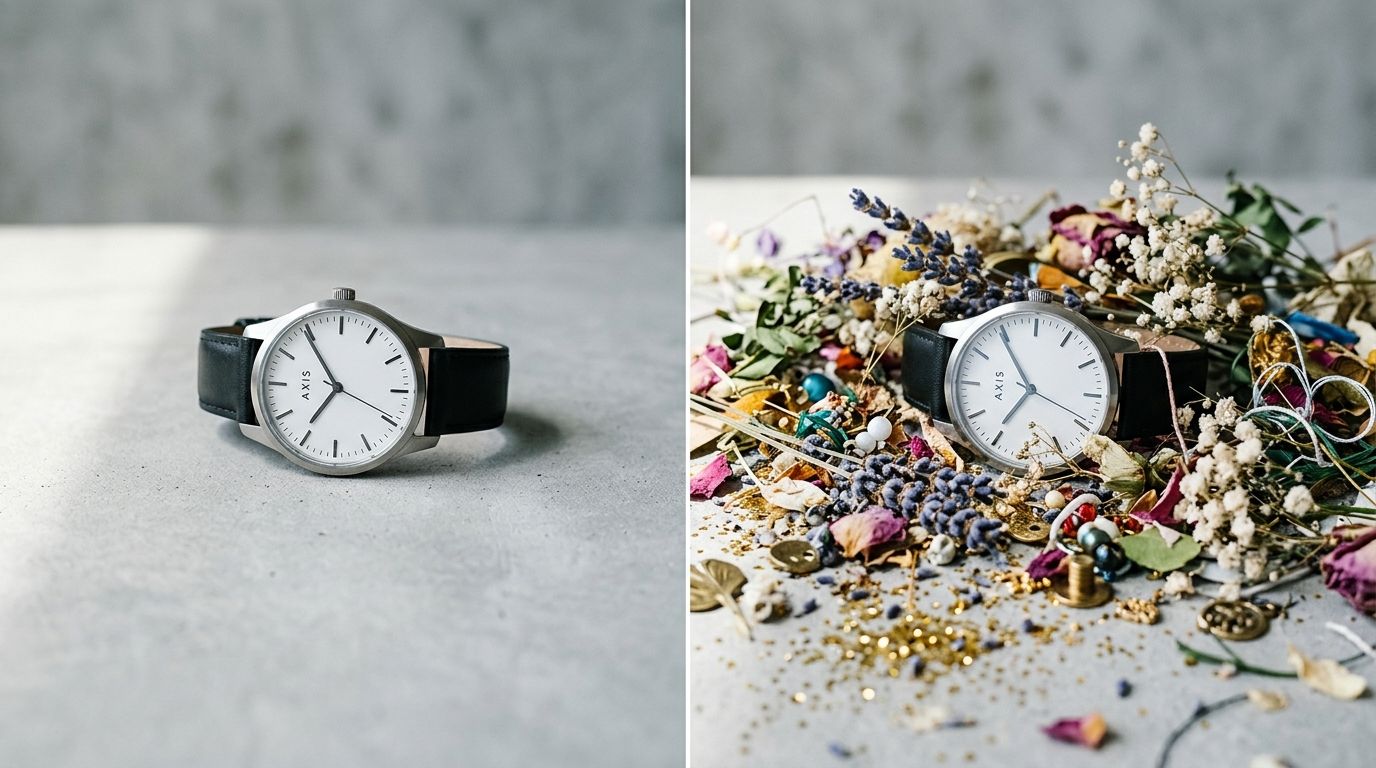
Every element in the frame must serve the product. If a prop does not add necessary scale or context, remove it.
The conversion-neutral prop philosophy
A conversion-neutral prop is an object that your brain registers but ignores. It provides a service to the primary product without demanding any cognitive load from the viewer. Think of a simple stone slab under a moisturizer bottle, or a plain ceramic plate under a pastry.
When you select styling props for product photography, you are creating a visual hierarchy. The product is the headline. The prop is the subtext. Many photographers get this wrong because they want to build an editorial portfolio. They introduce loud colors, complex geometric shapes, and high-contrast shadows. The resulting image looks beautiful on Instagram but performs terribly on a Shopify product page.
If you are committed to avoiding a cheap brand look, you need to ruthlessly audit every object in your frame. Ask yourself what job the prop is doing. If you cannot articulate exactly why that specific object needs to be in the photo, take it out.
The psychology of scale in product photography styling
One of the primary jobs of a prop is establishing size. A buyer cannot touch your product. They cannot pick it up to feel the weight or gauge the dimensions. If you shoot a handbag floating on a white background, it could be the size of a coin purse or a weekend duffel.
Scale anchors fix this. A pair of sunglasses next to a book immediately tells the brain how large the glasses are. A coffee mug next to a laptop provides instant context. The best product photo props ideas rely on universal objects. Everyone knows roughly how big a standard keyboard, a coffee bean, or a human hand is. When you place your product next to these universal anchors, you eliminate the friction of uncertainty in the buyer's mind.
| Prop Characteristic | Conversion-Driven Props | Distraction Props |
|---|---|---|
| Primary Function | Establishes physical scale or context | Builds an artistic or editorial mood |
| Material Quality | Authentic stone, water, or organic ingredients | Artificial plants or printed vinyl textures |
| Composition Volume | Strictly limited to the rule of three | Multiple competing lifestyle objects |
What props for product photography actually drive sales
The effectiveness of a prop depends entirely on your product category. What works for fine jewelry will ruin a shot for consumer electronics. You have to match the prop category to the emotional trigger of the purchase.
Organic elements for skincare and beauty
Skincare buyers are looking for purity, hydration, and results. Your props need to communicate those exact concepts visually. Water droplets, ripples, natural stone, and specific botanical ingredients are the standard here for a reason. They work.
Placing a vitamin C serum next to a sliced orange is a classic ingredient cue. It tells the buyer what is inside the bottle without forcing them to read the ingredient list. Using a shallow pool of water as a surface communicates hydration immediately. These natural props for product photography reinforce the core marketing claims of the item.
Ingredient cues and tools for food and beverage
Food photography is its own specialized world. If you want specific food photography tips, the rules change entirely toward ingredient cues and preparation tools.
Nobody wants to buy a protein bar sitting on a sterile plastic sheet. They want to see the rough texture of the oats and the cracked chocolate chips next to it. They want to see a dusting of cocoa powder. Raw ingredients make the final packaged product feel fresher and more premium. Subtle utensils like a vintage spoon or a rustic cutting board provide context for consumption.
Textural contrasts for apparel and soft goods
When shooting clothing, blankets, or leather goods flat on a surface, the background itself becomes the primary prop. The goal is to highlight the texture of your product. You do this through contrast. If you are selling a soft, plush cashmere sweater, you do not shoot it on a soft, plush rug. You shoot it on hard concrete, rough wood, or smooth marble. The hardness of the prop accentuates the softness of the product.
The props that actively hurt your conversion rate
Just as good prop selection in product photography elevates perceived value, bad prop selection destroys it. The wrong prop does not just distract the buyer. It actively lowers their willingness to pay your asking price.
Fake textures and cheap plastics
Artificial plant leaves, printed vinyl backdrops made to look like wood, and cheap plastic geometric blocks are the fastest way to ruin a shoot. High-resolution cameras capture everything. If that marble slab is actually a piece of printed contact paper over cardboard, the lens will reveal it. When a buyer spots a fake prop, they subconsciously assume the product itself is also cheap. If you cannot source the real material, shoot on pure white instead.
Highly reflective surfaces
Mirrors and highly polished acrylics are incredibly difficult to manage on set. They bounce studio lighting in unpredictable ways, creating hot spots that draw the eye away from the product. They also reflect the camera, the photographer, and the studio ceiling. Unless you have a master grip adjusting flags and bounce cards for three hours, skip the mirrors.
Over-styled lifestyle scenes
There is a massive difference between useful context and cluttered lifestyle photography. A coffee cup next to a bag of beans is context. A coffee cup, a bag of beans, a newspaper, reading glasses, a croissant, a vase of flowers, and a house cat all in the same frame is a mess.
This is known as a distraction prop in ecommerce. The buyer spends three seconds looking at the croissant to figure out if it is real, and forgets they clicked the ad to buy your coffee. Stick to the rule of three. Product, primary prop, subtle background. Stop adding things.
How AI is fixing the prop logistics nightmare
The biggest problem with prop selection is the actual logistics. Sourcing physical props is a nightmare. It means driving to craft stores, ordering heavy stone slabs online, storing fragile acrylics in a studio closet, and spending hours setting up a scene only to realize the client hates the color of the wood. Most founders I talk to hate this process. You end up paying a photographer a day rate just to watch them adjust a fake leaf by half an inch.
AI product photography changes the workflow entirely. Tools like CherryShot AI remove the need for physical props altogether. You upload a flat image of your product. You select a mode like Minimalist, Luxury, or Lifestyle. The AI understands the geometry of your product, generates the props digitally, and accurately maps the shadows and lighting in minutes.
If you want to see what your bottle looks like sitting on river stones surrounded by water ripples, you just click a button. You do not have to buy river stones. You do not have to build a water tank in the studio. If the stones distract from the label, you switch to a clean marble surface instantly. The cost per image drops from eighty dollars to under five dollars, and the turnaround time drops from three weeks to ten minutes.
This is exactly how high-volume brands are testing different visual contexts without blowing their margin on set design. You get the conversion benefits of environmental styling without the studio overhead.
Frequently Asked Questions
What props should I use for product photography?
Select props that establish physical scale, highlight key ingredients, or indicate the natural environment of the item. This approach anchors the product in reality without forcing the viewer to imagine its size or context. If you shoot a silver ring, placing it next to a hardcover book gives the buyer an immediate reference point for its dimensions and visual weight.
Do I need props for product photography?
You only need props for your secondary carousel images, as primary hero shots typically require a plain white background. Contextual items answer unspoken buyer questions about scale and physical texture that a bare studio shot ignores. Adding a simple coffee cup next to a keyboard gives the browser an instant mental map of how much desk space the product occupies.
What props hurt product photography conversion?
Artificial textures, highly reflective acrylics, and overly complex lifestyle arrangements actively distract buyers and reduce conversion rates. The camera lens captures the flaws in cheap vinyl backdrops or fake plastic plants, which subconsciously lowers the perceived value of your core item. Swap highly polished mirrors that create unpredictable light glares for matte stone surfaces to keep the visual focus entirely on your merchandise.
How many props should be in a product photo?
You must limit your composition to the main product, one primary contextual prop, and a subtle background texture. Limiting the frame to three total elements prevents visual competition and forces the viewer's eye exactly where you want it. Adding a fourth object, like a random reading glass next to a coffee bag, immediately forces the buyer to search for the item they actually intend to purchase.
Can AI add props to product photos?
Artificial intelligence tools render highly realistic contextual items around a bare product image using digital depth mapping. This completely removes the physical logistics and costs associated with buying, storing, and adjusting heavy studio materials. You upload a flat image of your bottle and instantly place it on a wet river stone without ever building a water tank in your studio.
Key Takeaways
- Props should answer visual questions about scale or usage, never compete for attention.
- Fake textures and overly busy lifestyle scenes actively lower perceived product value.
- Follow the rule of three by limiting your frame to the product, one prop, and a background.
- AI tools eliminate the physical logistics and costs of sourcing and storing studio props.
Great product photography removes friction from the buying decision. Props should serve that goal exclusively. If you are tired of paying day rates to watch a stylist arrange ceramic blocks, head over to CherryShot AI to generate campaign-ready scenes digitally in minutes.
Generate contextual props for your products instantly
Stop buying expensive marble slabs and acrylic blocks for a single shoot. Upload a bare photo of your item to test dozens of conversion-neutral environments in minutes.
Try CherryShot AI