Product Video for Ecommerce: Why Brands Convert 80% More
You already know product video for ecommerce drives sales. The data has been screaming this for a decade. The reason your product pages are still entirely static is not a lack of belief in video. It is a lack of budget and time. Traditional video production is a logistical nightmare. To unlock that conversion lift without tanking your margins, you have to stop treating catalog videos like Super Bowl commercials and start building a scalable production system.
Definition
Product video for ecommerce involves using short, looping motion assets on a product page to demonstrate an item's scale, texture, and functionality. These videos replace or supplement static photography to give online shoppers a realistic understanding of what they are buying.
Every founder eventually hits the wall of visual scale. You launch a new collection, organize the photography shoot, fight through the editing revisions, and barely get the static assets live before the launch date. Suggesting that the team also needs to shoot, edit, and compress a distinct motion asset for all forty new SKUs sounds like a joke. Yet, the brands that figure out how to create product videos ecommerce shoppers actually watch are the ones pulling ahead in acquisition costs.
Video will always increase your page load time. That is the unavoidable tax of motion assets. You have to balance the visual impact against site speed by ruthlessly compressing your files and relying on modern hosting solutions. The trade-off is absolutely worth it when executed correctly. The movement proves the product is real. It builds a level of trust that no high-resolution JPEG can ever match.
Why ecommerce product videos actually convert
A static image is a highly curated lie. Every consumer shopping online implicitly understands this. We have all bought a shirt that looked structured on the model but arrived looking like a deflated balloon. We have all ordered a ceramic mug that looked massive on the product page but turned out to hold barely six ounces of coffee. Still photography hides flaws through careful lighting and clever angles.
Video destroys that skepticism. You cannot easily fake the drape of a heavy cotton t-shirt when someone is walking in it. You cannot fake the satisfying mechanical click of a premium wallet clasp in a video. A strong product demo video ecommerce shoppers can interact with removes the final friction points before checkout.
If your store is leaking traffic at the final step, evaluating your media stack is one of the most effective ecommerce conversion rate fixes available. Shoppers linger longer on pages with motion. That increased time on page signals intent. When they watch a five-second loop of the product rotating, they are answering their own subconscious questions about depth, texture, and manufacturing quality.
A basic motorized turntable and continuous LED lighting eliminate the need for an expensive studio day.
The problem with product video production cost
The barrier has never been the data. The barrier is the traditional production model. Most founders I speak with calculate their product video production cost by asking a local videographer for a day rate. The videographer quotes fifteen hundred dollars. The founder divides that by twenty SKUs, assumes seventy-five dollars per video, and signs the contract.
The hidden invoice
That math is wrong. The day rate is only the beginning. You have to ship the physical samples to the studio. The videographer spends four hours setting up a massive lighting rig because video requires continuous light, unlike photography strobes. They shoot the footage. Then comes the editing phase. You receive the first cut a week later. The color grading is slightly off. You send notes. Another week passes.
By the time you have the final files formatted for your store, you have spent three weeks and hundreds of dollars per SKU. If you run a high-volume brand launching new items every month, this cycle becomes a massive operational bottleneck.
Founders often assume motion requires a massive budget, but you can actually produce videos without a team by stripping away the narrative elements. A catalog video does not need a plot. It just needs clean light and a steady lens. Stop trying to film a commercial when the customer only wants to see the back of the shoe.
| Production Method | Cost per SKU | Turnaround Time |
|---|---|---|
| Traditional Agency Shoot | $300 - $800 | 2-3 weeks |
| In-House Smartphone Setup | $0 recurring | 1-2 days |
| AI Video Generation | Pennies per asset | Minutes |
Three formats for product videos for online stores
Not all video serves the same purpose. Your homepage hero video requires different production values than your catalog grid. For the actual product pages, you should focus on three distinct formats.
The 360-degree rotation
This is the workhorse of ecommerce product videos. It is brutally simple. The product sits on a motorized turntable. The camera remains locked on a tripod. The product spins once. The loop takes five seconds. This format provides immediate structural context. The shopper sees the front, sides, and back without clicking through a carousel of distinct images. It proves the product has depth.
The detail macro
If you sell a premium product, the margin lives in the details. A static photo of stitching can look flat. A slow, panning macro video of that same stitching catching the light proves the quality of your manufacturing. Use this format to highlight specific features like custom hardware, embossed logos, or complex fabric weaves. This is where video on product page conversion metrics spike the highest.
The human context
A lifestyle product video solves the scale problem. A handbag floating on a pure white background has no size reference. When you film a person opening that bag, putting a phone inside, and holding it against their hip, the customer instantly understands the dimensions. You do not need professional models for this. You just need hands interacting with the object naturally.
Solving the static bottleneck with AI product video
The ecommerce landscape is shifting away from physical lenses. If you are still shipping cardboard boxes of inventory to a warehouse in Brooklyn just to get clean white-background photos, you are bleeding margin.
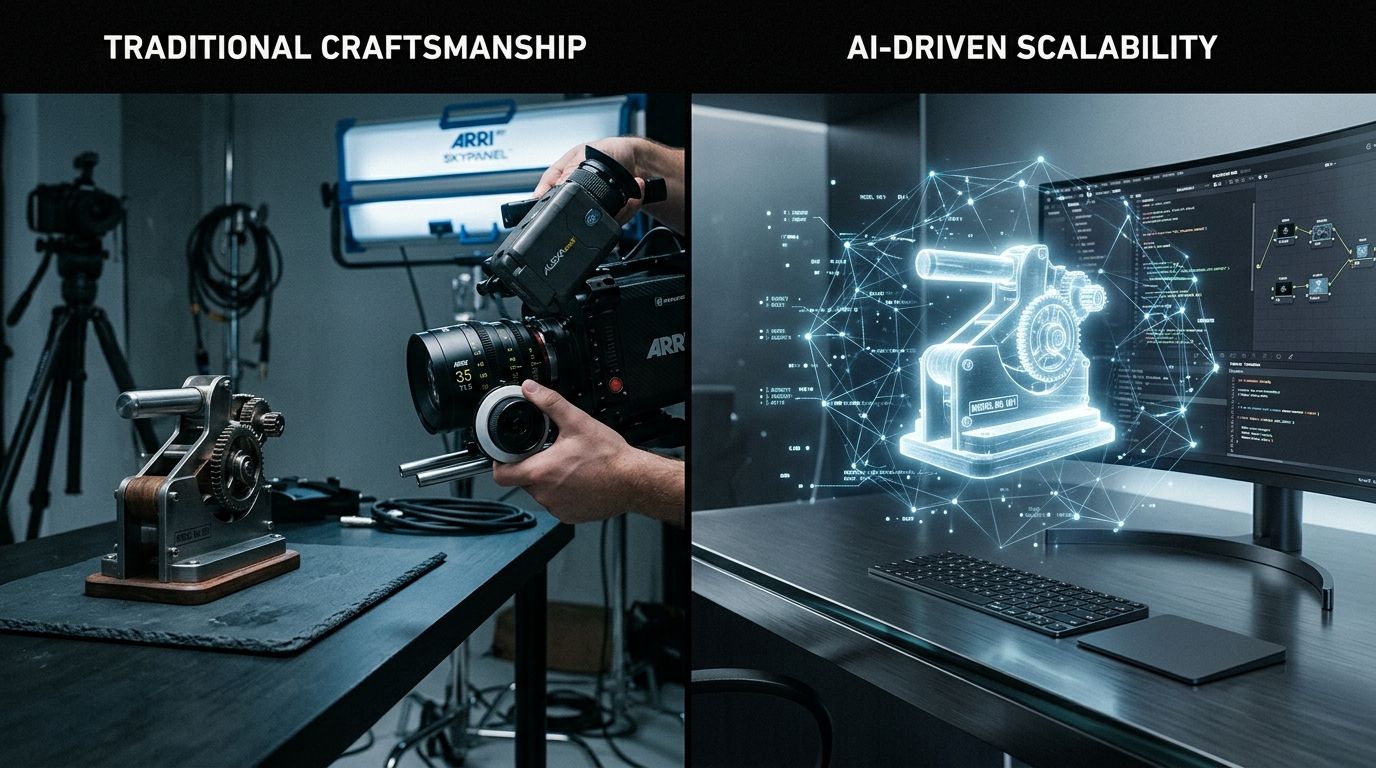
The smartest brands are separating their creative direction from their logistics. Once you solve the static image bottleneck by scaling visuals with AI, motion becomes the logical next step. Tools like CherryShot AI allow you to upload a simple smartphone photo and generate campaign-ready photos in minutes. Pick a visual mode, apply your brand aesthetic, and your static catalog is done.
(Worth noting: a high-end lifestyle video with speaking talent still requires a proper human crew. But for the basic product demo videos that live above the fold, paying day rates for a director of photography makes zero financial sense.)
When the base imagery costs less than five dollars a shot and is delivered in an afternoon, your media budget completely opens up. Brands are taking these flawless AI-generated stills and running them through motion synthesis tools. They add subtle camera pans, falling shadows, or background movement. The result is a dynamic, engaging product page built entirely without a traditional studio shoot.
How to start testing video today
Do not try to roll out video across your entire catalog at once. It will paralyze your team. Start with your top three best-selling SKUs. These are the products where a slight conversion bump translates to immediate cash flow. Film a basic turntable loop or generate a motion asset from your existing still photography.
Upload the video as the second item in your image carousel. Do not replace the primary hero image. Let the customer see the clean static shot first, then discover the motion asset when they swipe. Measure the impact on time-on-page and add-to-cart rates for those three specific products over a two-week period. The data will give you the confidence to scale the workflow to the rest of the store.
Frequently Asked Questions
Do product videos increase ecommerce conversion?
Product videos consistently increase online store conversion rates. A motion asset bridges the sensory gap by demonstrating the exact scale, material texture, and dynamic movement that shoppers cannot experience through a flat screen. You will typically see a thirty to eighty percent conversion lift on product pages that feature high-quality looping videos because buyers feel entirely confident in the physical reality of the item.
What types of product videos work best for ecommerce?
The most effective motion assets focus entirely on utility over entertainment. Providing a 360-degree turntable spin serves as the baseline standard because it proves the product exists in three dimensions for hesitant shoppers. Detail macro shots and human scale demonstrations work exceptionally well for luxury goods, apparel, and hardware since they explicitly highlight manufacturing quality without requiring a complex narrative arc.
How do I create product videos for ecommerce without expensive equipment?
You create catalog video by stripping away complex sets and focusing strictly on physical stabilization and clean lighting. Modern smartphone cameras shooting in high resolution provide more than enough visual fidelity for standard product page implementation. Mount your phone to a heavy tripod, point two continuous LED panels at a motorized turntable, and capture dozens of SKUs in a single afternoon without renting a professional cinema camera.
How much does a product video cost?
A standard catalog video costs between three hundred and eight hundred dollars per SKU when hiring a traditional production agency. Building an in-house modular setup with continuous lighting and a smartphone drops your recurring expense to zero after the initial minor equipment purchase. Modern generation tools push this expense down even further, often pricing out at mere pennies per generated second for high-quality motion assets.
Can AI create product videos for ecommerce?
Artificial intelligence models actively generate high-converting motion assets for online product catalogs. Brands currently use generation tools to create perfect static base images before passing them through motion models to add subtle camera pans or environmental effects. This specific workflow allows catalog managers to produce dynamic visual assets for their entire inventory without ever renting a studio space or turning on a physical camera.
Key Takeaways
- Pages with high-quality motion assets see massive conversion lifts because video proves the physical reality of the product.
- Traditional production costs kill margins, but building an in-house continuous lighting setup removes the recurring expense.
- You do not need plots or actors. A simple five-second looping turntable spin answers most customer questions about depth and scale.
- Brands are using AI to solve the static photography bottleneck first, freeing up resources to focus purely on motion.
Adding motion to your product pages is no longer an enterprise luxury. It is a baseline expectation for modern consumers. Stop waiting for the budget to hire a film crew. Automate your static visual pipeline with CherryShot AI, and use the time and money you save to start building motion assets that actually close sales.
Generate base imagery for your next motion asset
Stop waiting weeks for costly photo shoots just to start your video production process. You can create flawless, campaign-ready static images of your products right now, giving you the perfect foundation to apply motion.
Try CherryShot AI