How to Increase Ecommerce Conversion Rate: The Product Page Fixes That Move the Needle
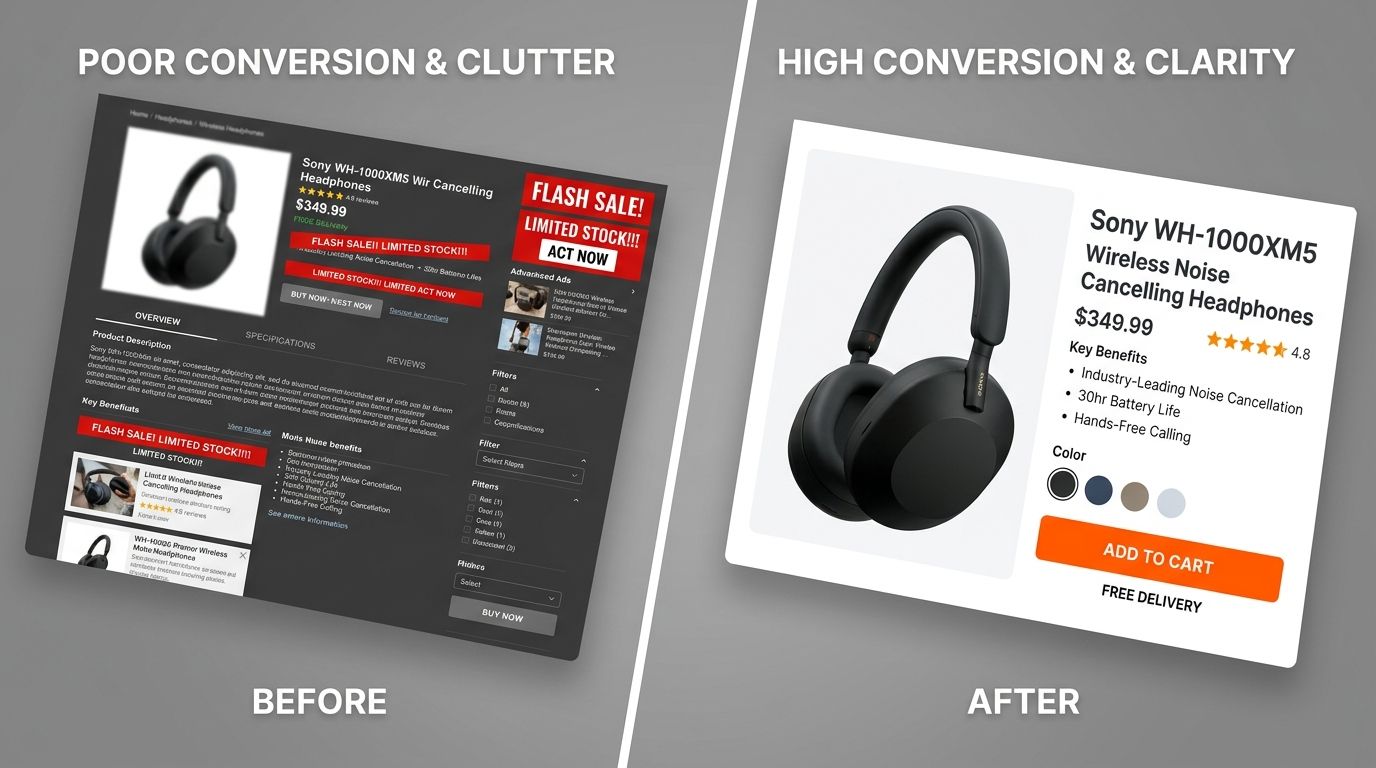
You do not need to overhaul your entire website to drive more sales. Increasing your ecommerce conversion rate usually comes down to removing specific friction points on your product pages that prevent shoppers from clicking the buy button. Small, data-backed changes to your visuals and copy often yield much higher returns than a full site redesign.
Definition
Ecommerce conversion rate is the percentage of total store visitors who complete a purchase. It acts as the primary health metric for your online business, indicating how effectively your site turns traffic into actual revenue.
Why Your Product Pages Are Leaking Revenue
Most visitors arrive on a product page with high intent but leave because they encounter a missing piece of information. When a shopper cannot verify the quality or size of an item, they hesitate. That split second of hesitation is exactly where you lose the sale. Understanding low add-to-cart rate causes is the first step toward reclaiming those lost customers.
The Visual Trust Gap
Shoppers cannot touch your product. They can only see it. If your photography feels inconsistent or lacks detail, the visitor subconsciously assumes the product quality is also lacking. It is not just about having pretty images, it is about having images that answer the questions a customer would normally ask a floor salesperson.
Mapping Out the Friction
Take a hard look at your mobile view. If your images are tiny or your add-to-cart button sits below the fold, you are adding unnecessary work for the user. Every extra click or scroll is a potential exit point.
| Strategy | Impact | Ease of Implementation |
|---|---|---|
| Optimize hero imagery | High | Easy |
| Fix checkout flow | Very High | Medium |
| Add social proof | Medium | Easy |
| Improve page speed | High | Difficult |
The Role of Product Imagery in Conversion
Visuals are the most influential element on your page. If you are still using a single flat product shot, you are likely missing out on the conversion potential that comes from showing variety. Learning how to A/B test product photos can show you exactly which visual angles trigger that final purchase decision.
Scaling Your Photography Strategy
Most brands struggle because professional photography is slow and expensive. When you need to update a product page for a new colorway, you do not want to wait three weeks for a studio shoot. CherryShot AI solves this by letting you generate campaign-ready imagery in minutes, ensuring your product pages always look fresh and professional without the heavy logistical overhead.
Frequently Asked Questions
What is a good ecommerce conversion rate?
Most successful ecommerce brands see conversion rates between two and three percent. While industry averages often hover closer to one percent, high performing stores consistently push beyond the three percent threshold. Focus your efforts on steady improvements rather than chasing arbitrary benchmarks set by competitors.
What changes to a product page have the biggest impact on conversion rate?
Visual clarity and trust signals create the most immediate lift in shopper confidence. Visitors decide whether to trust your brand in seconds based on high resolution imagery and clear product descriptions. Eliminating friction during the checkout process follows immediately as a critical priority for store owners.
How much do product images affect ecommerce conversion rate?
Product imagery often acts as the primary surrogate for physical touch in an online environment. When shoppers cannot inspect an item personally, they rely entirely on visual cues to assess quality and scale. Poorly lit or inconsistent photography remains one of the largest silent killers of online sales.
How do I audit my ecommerce product page for conversion problems?
Start by tracking your bounce rate on mobile devices to identify potential layout or speed issues. Review your heatmaps to see where users scroll and where they stop interacting with your content. Finally, compare your site navigation against a simple list of top selling competitors to find missing information.
Key Takeaways
- Remove friction points like hidden costs and unclear buttons.
- Prioritize high quality imagery that answers specific product questions.
- Use data and heatmaps to identify where users drop off.
- Maintain site consistency to build trust with new visitors.
Refresh your product catalog with professional AI photography
If your current images are inconsistent, your conversion rate is paying the price. Use CherryShot AI to generate uniform, high-quality campaign imagery today.
Try CherryShot AIImproving your ecommerce conversion rate is an ongoing process of small, iterative adjustments. By focusing on the visual and functional gaps in your current setup, you can turn more visitors into long-term customers.