Size Guide for Ecommerce: Why the Size Chart Is Not Enough
A detailed size chart is not a shield against returns. If your product photography lacks immediate visual scale, customers will ignore the dimensions table and guess their fit based on an isolated white background shot. They will guess wrong, and you will pay for the return label. You are losing margin right now because your visual assets do not provide scale. The reality is that shoppers do not measure their waists or visualize a thirty centimeter strap drop while browsing on their phones. They look at the photos and assume they understand the proportions.
Definition
A scale reference shot is an ecommerce product image that places an item next to a recognizable object or human element to demonstrate its true physical size. This visual context allows online shoppers to understand the product's proportions instantly without needing to consult a numerical dimensions table.
Most brands treat sizing as a logistical problem when it is actually a visual communication failure.
The fastest way to build a reliable size guide for ecommerce and reduce returns is to stop relying exclusively on text. You have to prove scale through imagery. The moment you place a product next to a recognizable human element, the return rate drops. (To be fair, you will never completely eliminate returns driven by pure vanity sizing, but you can absolutely kill the returns caused by visual ambiguity.)
This means overhauling your image stack. A standard flat lay shows the material, but it does not show scale. You have to anchor the item to reality.
The failure of the traditional size chart
Numbers do not translate to reality
A grid of measurements asks the customer to do work. They have to find a tape measure, check their own dimensions, and trust that your chest width measurement was taken exactly where they are measuring theirs.
Nobody does this.
They look at your size guide, get frustrated, and order two sizes with the intent of returning one. This behavior eats your margin alive. If you want to fix high return rates with product photography, you have to replace these mental calculations with immediate visual proof.
The model height disclaimer is a crutch
Writing that the model is five foot nine and wearing a size medium assumes your customer can accurately scale that information to their own five foot four frame. They cannot. You are essentially asking them to perform spatial geometry in their head. The result is a guess. When that guess is wrong, the product comes back in a polybag two weeks later.
Showing the product in context solves the problem before the customer ever clicks into the sizing tab.
| Visual Approach | Information Conveyed | Risk of Return |
|---|---|---|
| Standard White Background | Material and basic color | High (forces mental spatial math) |
| Numerical Dimensions Table | Exact physical measurements | Moderate (often ignored by shoppers) |
| Contextual Lifestyle Shot | True physical proportions | Low (provides immediate visual proof) |
What your product photography needs to show instead
The scale reference shot
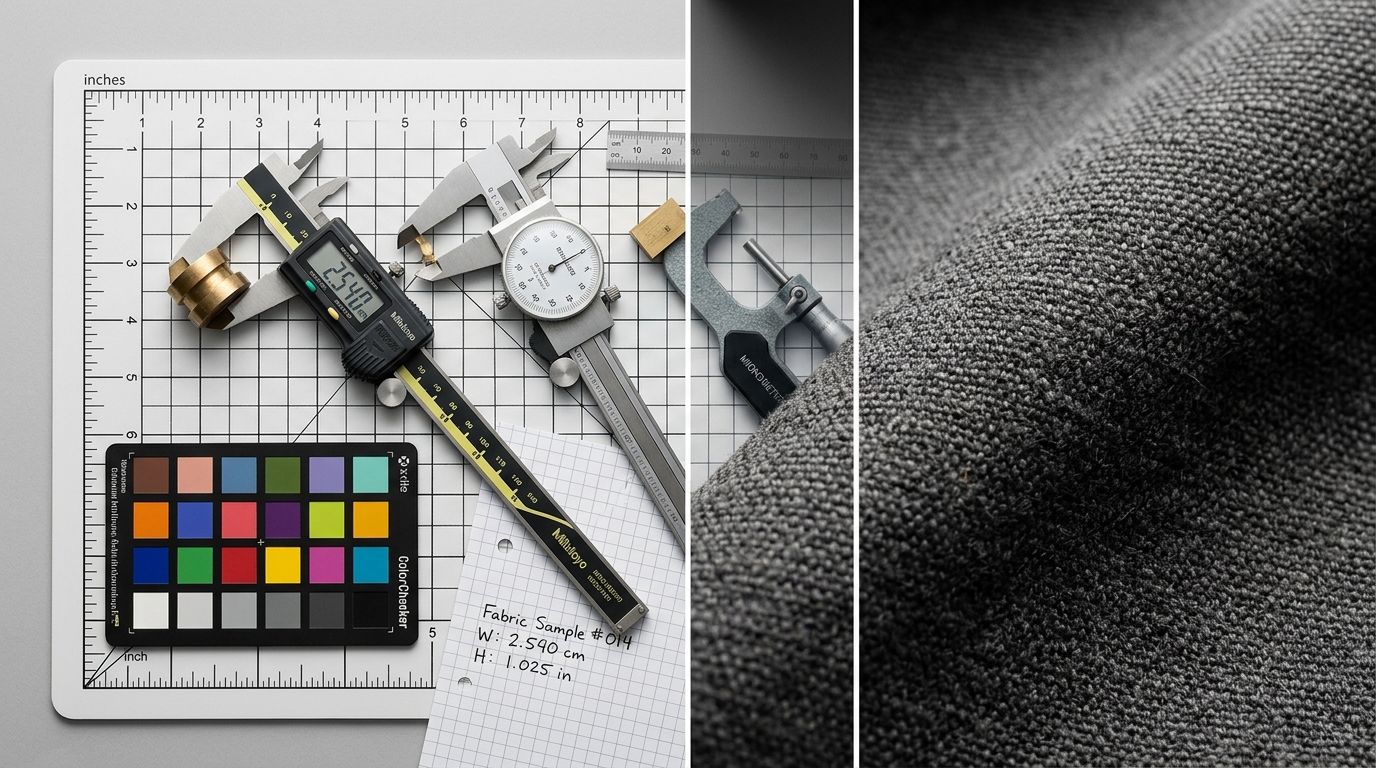
A scale reference shot places your product next to an object with a universally understood size. For accessories and smaller items, this is often a hand scale shot. When a customer sees a handbag being held by the strap, they instantly understand its volume. A ruler scale photography setup works for hardware or technical gear, but human elements work best for fashion and lifestyle products.
Contextual lifestyle anchoring
Placing the item in a real environment provides a second layer of scale. A piece of luggage sitting next to a standard airport terminal chair communicates its size faster than listing its cubic liter capacity.
The limitation here is production budget. Shooting every product in a lifestyle context takes time and money. Booking a location, hiring talent, and running a full production day for a visual size reference is expensive. This is the trade-off traditional brands face. You want better scale reference product photography, but the per-image cost of a traditional studio shoot destroys the unit economics of the item itself.
Why specific product categories demand better visual sizing
Handbags and accessories
A shoulder bag shot on a white background tells you nothing about where it rests on the hip. A customer needs to see the strap drop length in action. When they open the box and find the bag sits three inches higher than they imagined, they print a return label. A model size reference provides the exact visual data they need to confirm the purchase.
Home goods and furniture
The scale problem is not limited to fashion. A table lamp looks identical to a floor lamp when isolated on a white seamless backdrop. Customers will not read the height specifications. They will look at the image, assume it fits their nightstand, and realize their mistake during unboxing. Contextual lifestyle anchoring places that lamp next to a standard sofa, instantly communicating its true footprint.
Building a visual size guide without exploding production costs
Creating model size reference variations
The ideal ecommerce size guide shows the same garment on three different body types. It is the most effective way to prevent size returns in ecommerce. Customers find the model that matches their shape and purchase with confidence.
Historically, this required booking three different models for a catalog shoot. The invoice for that day was enormous. The logistics alone added a month to the launch schedule. You had to coordinate schedules, manage a massive shot list, and hope the photographer captured the angles perfectly.
The shift to AI generated context
This is where AI product photography fundamentally alters the margin profile of your brand. You do not need to book three models to show three fits.
With CherryShot AI, you upload your flat lay or basic product image, select a visual mode, and generate campaign-ready photos in minutes. You can place your product in realistic environments or on human figures to establish immediate scale. The per-image cost drops to under five dollars. You bypass the scheduling nightmare entirely.
Brands that address the visual gap when selling clothes online are the ones winning repeat customers. They are using technology to generate the visual context that shoppers demand. You can now show clothing on a model without a photoshoot to establish accurate proportions, saving both time and production budget.
Measuring the impact on reverse logistics
Tracking the right metrics
When you upgrade your visual assets, the primary metric to watch is your return rate for fit and size. This data lives in your return portal. If your return platform requires customers to select a reason for the return, monitor the categories labeled too small or too large.
The compounding value of visual accuracy
Every percentage point you shave off your return rate drops directly to your bottom line. You save on the outbound shipping, the return label, the warehouse processing time, and the potential markdown if the item comes back out of season. Investing in clear, context-heavy imagery is not a marketing expense. It is a strict operational cost reduction strategy.
Key Takeaways
- Size charts force customers to guess, leading directly to higher return rates and crushed margins.
- Visual scale references communicate fit and proportion instantly without requiring measurements.
- Showing the product on multiple body types is the most effective way to build buyer confidence.
- AI tools allow brands to generate these contextual shots without booking expensive studio time.
Frequently Asked Questions
Why do customers still return products even when there is a size chart?
Customers ignore size charts because converting numerical grid measurements into physical reality requires deliberate mental effort. Most online shoppers prefer estimating fit based entirely on the visual cues provided in your primary product photos. Adding a recognizable object or human element next to the item establishes immediate visual context and directly prevents the inaccurate scale assumptions that inevitably trigger reverse logistics.
What is a scale reference shot in product photography?
A scale reference shot places the target product next to a universally recognizable object or a human element to demonstrate true proportions. This photographic technique allows the viewer to immediately comprehend the actual physical dimensions of the item without ever consulting a dimensional table. Including a hand holding a small accessory or showing a garment on a model anchors the item in reality and answers the scale question instantly.
How do I show product size accurately in ecommerce photos?
You show product size accurately by physically anchoring the item in a familiar, real-world environment. Surrounding the product with universally recognized spatial markers eliminates the ambiguity found in standard white-background catalog shots. Photographing a piece of luggage next to a standard airport terminal chair instantly communicates its true volume to the buyer better than listing its cubic liter capacity.
What is the best way to photograph product size?
The optimal approach pairs a standard white-background catalog shot with a highly contextual lifestyle image. Displaying the item alongside relatable human proportions provides the most accurate representation of true physical scale for your buyers. Applying AI product photography software generates these required background environments and model variations in minutes without the massive financial overhead of coordinating multiple physical studio photoshoots.
Does showing product scale in photos reduce returns?
Providing visual scale directly targets and reduces return rates caused by incorrect fit and sizing expectations. Shoppers process images faster than text, making contextual photography your strongest defense against buyers ordering multiple sizes to try on at home. Adding a single image of your product resting on a standard dining table stops spatial miscalculations before the checkout process begins.
Stop asking your customers to interpret a grid of numbers. Give them the visual proof they actually want. Upload a basic product photo to CherryShot AI and start generating the scale reference imagery your catalog needs to protect your margin.
Audit your product pages for visual scale gaps
Review your top ten highest-returning items right now and check if their primary images include a human element or familiar object. If they only feature isolated white backgrounds, you are losing margin to predictable sizing errors. Generate contextual lifestyle and model shots for those products immediately to stop the bleeding.
Try CherryShot AI