TikTok Product Video Ecommerce Guide
Dropping a polished commercial onto TikTok is the fastest way to get swiped past. A high-converting TikTok product video for ecommerce does not look like an ad. It looks like a creator sharing a genuine discovery. The format must be vertical. The hook must land in three seconds. The visual style must prioritize raw authenticity over studio gloss. If your video feels too polished, the user immediately identifies it as a disruption to their feed and scrolls away.
Definition
A TikTok product video is a vertical, short-form visual asset designed to sell physical goods by mimicking the look and feel of organic user-generated content. It relies on native text overlays, rapid pacing, and unpolished authenticity rather than traditional commercial aesthetics to hold viewer attention. The format prioritizes a strong three-second hook to drive direct response conversions without interrupting the platform experience.
Most brands I talk to still struggle with this transition. They hand their creative agency a massive budget to produce a highly stylized campaign, cut it into a 9:16 aspect ratio, and wonder why their return on ad spend sits at zero. High production value is actually a conversion killer on TikTok. The algorithm rewards content that feels native to the platform environment.
A true TikTok ecommerce video relies on rapid pacing, native text overlays, and trending audio. It does not require a film crew or a massive budget. It requires a deep understanding of how people actually consume content on the platform. You have to speak the visual language of the For You Page.
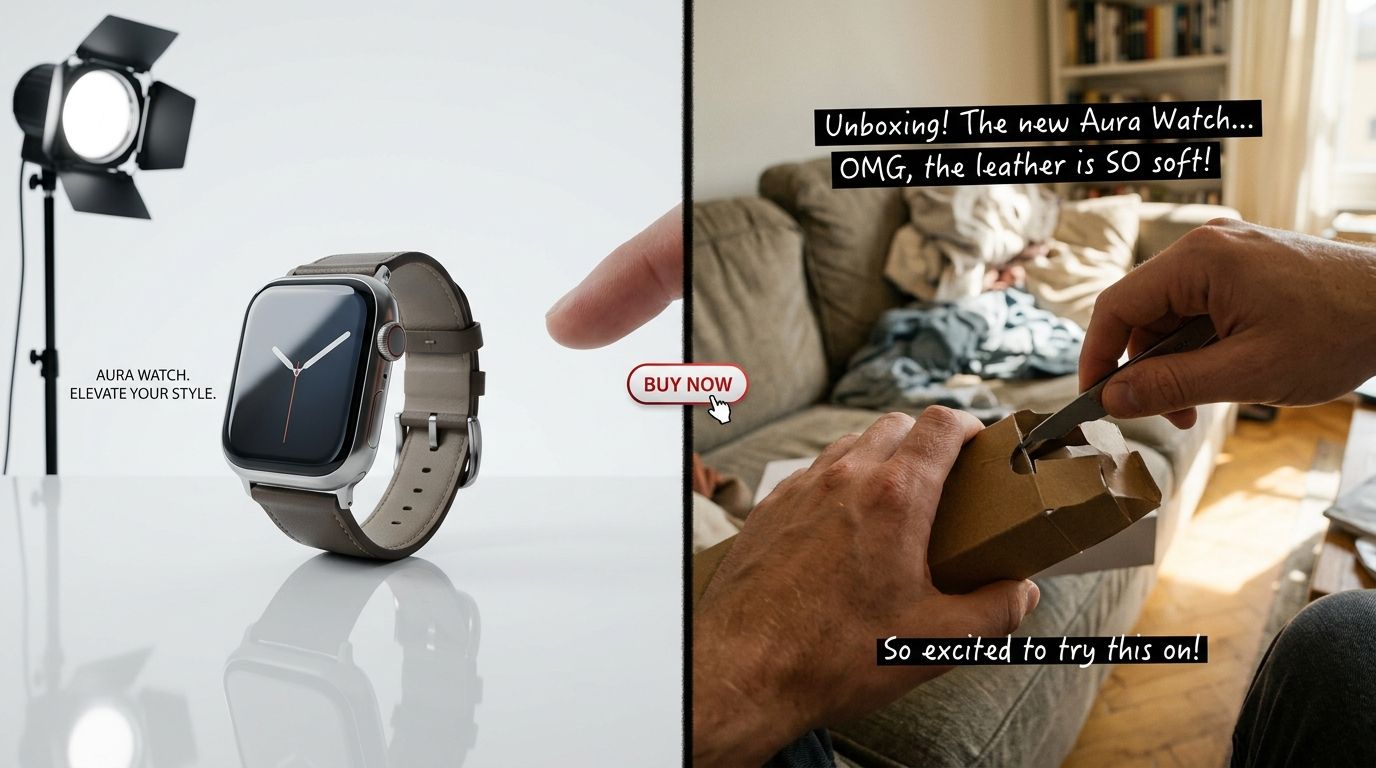
The most effective TikTok ecommerce videos abandon studio polish in favor of native platform aesthetics.
Why your Instagram reels fail on TikTok
Instagram was built on aspiration. The platform rewards curated aesthetics, beautiful lighting, and perfect composition. Brands spend years perfecting their visual identity to succeed on that platform. When they try to port that exact strategy over to TikTok, they fail.
TikTok was built on entertainment and raw participation. The user base is highly sensitive to traditional advertising formats. When they see a perfectly lit product spinning on a seamless white backdrop, their brain categorizes it as a commercial. Before your voiceover even begins, they have already scrolled to the next video.
| Visual Element | Instagram Reels | TikTok Feed Ads |
|---|---|---|
| Lighting style | Curated, high-fidelity studio lighting | Raw, unpolished window or ring light |
| Pacing | Smooth transitions with aesthetic focus | Rapid cuts with high-energy movement |
| Text integration | Minimal text, focus on visual composition | Native platform fonts dominating the screen |
| Core appeal | Aspirational and highly polished | Authentic, relatable, and native |
The unpolished aesthetic
The most successful product videos on TikTok look like they were filmed in a messy bedroom or a standard kitchen. The lighting is often slightly harsh window light or a cheap ring light. The person holding the product might have slightly shaky hands. This lack of polish signals authenticity. It tells the viewer that a real person is holding a real product.
Before you even begin scripting your next campaign, you have to accept that what makes product visuals convert on TikTok completely breaks the rules of traditional brand photography. You are not trying to win a design award. You are trying to stop a thumb from scrolling. You do that by blending in with the surrounding organic content.
The anatomy of a converting TikTok ecommerce video
You cannot just turn on a camera and start talking. A native TikTok product video requires strict adherence to a specific structural format. Every element must work together to maintain viewer retention.
The three-second hook
You have exactly three seconds to convince the viewer to stay. If nothing compelling happens in that window, you lose them. A strong TikTok hook consists of three layers working simultaneously.
First, you need a visual hook. This could be pouring liquid, dropping the product, or starting the video with an extreme close-up. Second, you need a text hook. Native platform text must appear on screen immediately stating the value proposition. Do not use your brand font. Use the default TikTok fonts. Third, you need an audio hook. This is usually a trending sound or a very energetic voiceover asking a relatable question.
If you master the hook, you can make product videos without a production team and still outperform massive agencies. The platform rewards psychology over technology.
Aspect ratio and safe zones
Shooting in a vertical 9:16 format is non-negotiable. If you post a horizontal video with black bars on the top and bottom, the algorithm will aggressively suppress your reach. The video must take up the entire screen.
Equally important is respecting the platform safe zones. TikTok overlays its own user interface on top of your video. The profile picture, like button, comment button, and share button block the entire right side of the screen. The caption and music track block the bottom fifth of the screen. If you put your product demonstration or your text hook in those blocked areas, nobody will see them.
TikTok product video length: Shorter is not always better
For years, the standard advice from social media managers was to keep every video under seven seconds. The logic was simple. Shorter videos have higher completion rates, and the algorithm loves completion rates. Brands started posting incredibly short clips set to trending audio.
That strategy generates views, but it rarely generates sales. Seven seconds is not enough time to explain a product, handle customer objections, and deliver a clear call to action. The user watches the loop twice, feels entertained, and leaves without ever clicking your link.
(Worth noting: a seven-second video is highly effective for simple brand awareness at the very top of the funnel. But if your goal is direct response conversion, you need more time.)
The shift toward longer content
TikTok is actively changing its algorithm to reward longer content. The platform wants to keep users engaged for extended periods. For standard ecommerce feed ads, the sweet spot has settled between 21 and 34 seconds. This gives you three seconds for the hook, fifteen seconds for the product demonstration, and a few seconds for a strong call to action.
There is a real trade-off here. Longer videos give you the necessary space to build a compelling sales pitch, but they require significantly stronger storytelling to prevent viewers from dropping off halfway through. You cannot just ramble. You have to introduce visual changes every few seconds to reset the viewer's attention span.
If you are utilizing TikTok Shop, the rules change entirely. Videos over one minute are heavily favored by the TikTok Shop algorithm. When a user is making a direct purchasing decision within the app, they want comprehensive details. They want to see the texture of the fabric, the size of the packaging, and how the product looks from multiple angles.
Building a TikTok Shop video strategy without a massive budget
The biggest hurdle brands face is content velocity. The TikTok algorithm is hungry. If you want to scale your revenue, you need to test multiple hooks and visual angles every single week. You cannot schedule a studio shoot every time you need new ad creative.
Repurposing static assets into video
You do not actually have to film new video footage every day. Some of the highest converting ad formats on TikTok right now are rapid-fire photo montages. The photo carousel format performs incredibly well when set to a trending beat.
This is where smart brands leverage technology to bypass the production bottleneck. They take a single product image, upload it into an AI tool like CherryShot AI, and generate dozens of campaign-ready shots in minutes. They select the Influencer mode for that native, organic look, then grab a few shots in Lifestyle mode to show context.
Once you have those distinct, varied static images, you simply drop them into a CapCut template. The software automatically syncs the photo transitions to a high-energy audio track. You just add your native text overlays. Suddenly, you have a dynamic, engaging piece of content that feels completely native to the platform. Understanding when product video converts better than photos is crucial, but knowing how to turn those photos into video is the actual cheat code for scaling your brand.
A successful TikTok ecommerce strategy is about volume and iteration. Stop planning massive shoots that take weeks to execute. Start generating the assets you need in minutes, test them immediately, and double down on the formats that actually drive checkouts.
Frequently Asked Questions
How do I make a product video for TikTok?
Start with a native vertical format and prioritize raw authenticity over traditional television commercial production value. You can shoot everyday footage on a smartphone or generate multiple static product images using artificial intelligence tools to sequence together in a fast-paced slideshow. Focus your entire editing effort on nailing the first three seconds with a highly engaging visual and text hook.
How long should a TikTok product video be?
Standard feed ads and simple product awareness campaigns consistently perform best in the 21 to 34-second range. Longer durations provide enough time to properly explain product features and build genuine trust with the viewer before asking for the direct sale. Videos running over one minute often generate higher conversion rates specifically when demonstrating a complex use case directly through TikTok Shop.
What makes a TikTok product video convert?
A high-converting video feels like organic content created by a peer rather than a traditional advertisement. Viewers respond best when the format clearly states the value proposition immediately while maintaining retention through constant visual changes or highly engaging storytelling. You must avoid high production value and studio lighting because those elements immediately signal to the user that they are being sold to.
How is TikTok product video different from other platforms?
TikTok completely rejects the curated aesthetics of Instagram and the structured storytelling production standards required by YouTube. The algorithm explicitly rewards raw, unpolished authenticity and strict adherence to current platform trends rather than traditional high-fidelity visuals. A highly stylized video that succeeds on Instagram Reels will almost always fail to generate meaningful sales when ported over to the TikTok feed.
Can AI create TikTok-ready product videos?
Artificial intelligence solves the asset generation bottleneck by eliminating the need to film expensive B-roll footage. Brands generate dozens of high-quality product images in different lifestyle contexts and import those static assets into editing apps like CapCut to animate them to a trending beat. This specific workflow creates the rapid, engaging movement TikTok users expect without requiring an actual studio video shoot.
Key Takeaways
- High production value and studio aesthetics generally hurt conversion rates on the TikTok platform.
- The most effective format requires a vertical 9:16 aspect ratio and strict use of native text overlays.
- Standard ad videos should run between 21 and 34 seconds, while TikTok Shop reviews perform better past the one-minute mark.
- Static product images can easily be animated into high-energy video formats to solve the creative bottleneck.
Turn your product photos into a TikTok-ready asset library
Stop scheduling expensive video shoots for every new TikTok campaign. You can generate dozens of authentic, unpolished product images in minutes and animate them into high-converting videos. Test more creative variations this week without hiring a production crew.
Try CherryShot AI