AI Product Photography Free: What Free Tiers Deliver
Every founder looking to cut costs eventually types "ai product photography free" into a search bar. You want professional photos without the professional invoice. The direct answer is yes, free AI product photography tools exist. The reality is that free tiers are built for testing software, not for launching a catalog. They give you just enough functionality to see what is possible before restricting resolution, watermarking your images, or withholding commercial usage rights entirely.
Definition
Free AI product photography refers to the non-paying tiers offered by generative image platforms, allowing users to test basic background replacement and lighting features. These freemium models limit image resolution, apply watermarks, and restrict commercial usage rights to encourage users to purchase a paid subscription.
If you are a sole trader testing the waters, you do not need to pull out a credit card on day one. You can absolutely generate a few concepts to see how the technology handles your specific products. But building an entire live storefront on an AI product photos free tier is a recipe for blurry product pages and legal headaches. At some point, the hours you spend trying to trick a free tool into giving you a high-resolution export will cost more than a standard subscription.
The Reality of Searching for a Free Solution
When you look for the best free AI product photography tool on the market, you are usually encountering freemium SaaS models. These platforms are brilliant marketing funnels. They offer a taste of their generation capabilities to get your email address. They know that once you see a decent result, you will want more of them. The catch is entirely in the fine print.
You are not getting unlimited high-fidelity lifestyle shots for zero dollars. General-purpose AI image platforms offer free tiers to train their models on user inputs and drive upgrades. Understanding what AI product photography can do helps you separate realistic expectations from basic marketing hype. The technology is phenomenal when funded by dedicated compute power. When it is free, the compute power is throttled.
The watermarked trial phase
The most common limitation of any free AI background generator products is the watermark. A platform will let you generate a beautiful image of your skincare bottle sitting on a marble countertop bathed in morning sunlight. Then they stamp a massive logo directly across the bottom right corner. If you crop it out, the composition is ruined. If you leave it in, your brand immediately signals to customers that you do not have the budget for your own photography.
Shoppers associate visual quality with product quality. If your website features images with competing software logos plastered over them, you are eroding trust before the customer even reads your product description.
Low resolution and aggressive compression
E-commerce platforms like Shopify recommend images be at least 2048 by 2048 pixels to enable smooth zoom functionality. A standard free product photo generator typically exports at 512 or 1024 pixels. When a customer tries to zoom in on the texture of your fabric or the label on your packaging, they are met with a blurry, pixelated mess.
The cost of compute required to generate and host massive, high-definition files is substantial. No platform gives that away indefinitely. You are traded speed and cost for fidelity. When you compress an image heavily to fit within a free tier limit, the natural shadows and crisp edges that make a photo look real are completely destroyed.
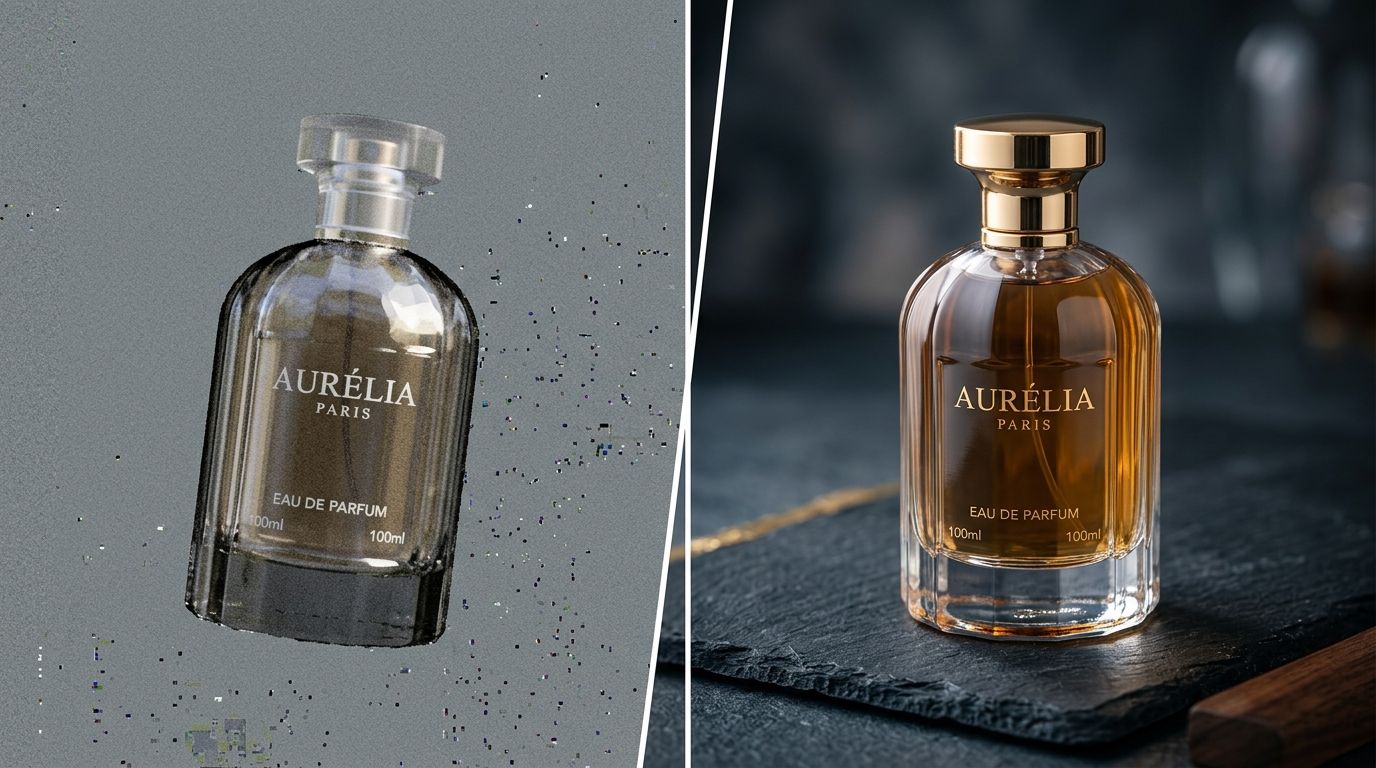
How Credit Systems Actually Function
When you sign up for free AI product photography, you are almost always handed a set number of credits. A platform might advertise "50 free images." The reality is far less straightforward. Fifty credits rarely equals fifty usable, publishable photos for your website.
Anyone who runs an ecommerce brand knows that the first shot is never the final shot. You upload a reference image of a sneaker. You ask the AI to place it in an urban environment. The first output might have the lighting completely wrong. The second output might feature a weird artifact in the background. By the time you get the exact lighting, shadow accuracy, and background texture you need, you have burned through five credits for a single SKU.
Feature gating and locked aesthetics
Another major hurdle is feature gating. The free version might give you access to standard solid color backgrounds or generic studio lighting. If you want specialized visual modes like Loud Luxury, Magazine, or Avant Garde, those require a paid subscription. You are essentially given the tools to make basic catalog shots, but restricted from generating the eye-catching hero imagery that actually stops someone scrolling on social media.
There is a distinct line between when DIY product photography makes sense and when you need serious tools. Free AI tools sit directly on that line. They are better than a poorly lit photo taken on a kitchen table, but they fall short of what a serious brand needs to scale.
The Hidden Cost of Commercial Rights
This is the trap that catches most early stage founders. They sign up for a no cost AI product photography tool, generate thirty decent images, and upload them directly to their Amazon storefront or Shopify site. They skip reading the terms of service. A significant number of free tools explicitly state that images generated on a non-paying plan cannot be used for commercial purposes.
If you put those images on your product pages or run them in paid Meta ads, you are technically violating the software license. Competing brands have been known to report these violations on major marketplaces. Having a core product listing removed due to a copyright strike because you wanted to save a few dollars on photography is a catastrophic error.
Who actually owns the output?
When comparing AI photography free vs paid, ownership is the defining factor. Paid plans typically transfer full commercial rights to the user. You own the image. You can print it on a billboard, run it in a national magazine, or use it for packaging design. Free plans often retain the rights, meaning the platform can use your generated images in their own marketing materials without asking.
(Worth noting: some open source models technically offer unlimited generation and commercial rights for free, but you need a high-end local GPU and significant technical knowledge to run them. That completely defeats the purpose of saving time and streamlining your operations.)
Testing Concepts Versus Launching Campaigns
We need to be clear about the actual utility of these platforms. To admit a genuine trade-off, free AI background generator products are excellent for internal mood boards. If you are just pitching a visual concept to your creative team or testing how a product might look against different color palettes, paying for high-end generation is a waste of money. The free tiers serve a vital purpose during the brainstorming phase.
The problem arises when brands try to stretch that brainstorming tool into a production asset. You cannot build a premium brand aesthetic using watermarked, low-resolution files. You will spend hours trying to upscale the images through other free tools, resulting in an overly smoothed, artificial look that alienates buyers.
| Feature | Free AI Photography Tier | Paid AI Photography Subscription |
|---|---|---|
| Export Resolution | 512px - 1024px (Blurry zoom) | 2048px+ (Crisp e-commerce zoom) |
| Commercial Rights | Retained by platform (Personal use only) | Full ownership transferred to brand |
| Image Output | Aggressive watermarks & compression | Clean, unbranded, high-fidelity files |
| Styling Options | Basic solid colors & generic studios | Specialized aesthetics (Loud Luxury, etc.) |
Exactly When to Upgrade to Paid AI Product Photography
The decision to move from a free tier to a paid subscription comes down to simple math. How much is your time worth? If you spend three hours a week jumping between different free AI product photography tools, managing multiple burner email accounts just to get fresh credits, and fighting with low-resolution upscalers, you are severely undervaluing your own labor.
You should upgrade the moment you launch a live product page. You should upgrade when you need images to look identical across fifty different SKUs. You should upgrade when you need commercial rights guaranteed in writing. Mastering the art of prompting for professional AI results is completely useless if the tool caps your resolution before you can export the file.
Volume breaks the freemium math
Free tiers work when you have one product. When you have ten products, each requiring four distinct angles and three lifestyle variations, the math shatters. Paid tools are built for volume. They allow you to define a specific visual style and apply it consistently across hundreds of images in an afternoon. That kind of operational speed is what actually moves the needle for an ecommerce business.
Key Takeaways
- Free AI product photography tools exist but are designed as trial mechanisms for paid software.
- Expect low resolution outputs and watermarks that make free images unsuitable for live ecommerce stores.
- Many platforms prohibit commercial usage on their free tiers entirely.
- Upgrading to a paid plan is required for high fidelity zoom, legal safety, and bulk generation.
Frequently Asked Questions
Is there a free AI product photography tool?
Multiple free AI product photography platforms exist on the market for users looking to test the technology. These tools operate on freemium models that offer a restricted allocation of generation credits so brands can experiment with basic background replacements. You will typically encounter strict resolution limits, forced watermarking, and restricted commercial licensing that prevent using the final images on live storefronts until you purchase a premium subscription.
What do free AI photography tiers actually include?
Free photography tiers provide entry-level background generation, standard lighting models, and a limited monthly allocation of testing credits. Platforms design these basic plans specifically for visualizing prompt concepts rather than producing final, high-fidelity campaign assets. You can expect standard square crops restricted to 1024 pixels, while bulk processing features and specialized visual aesthetics remain entirely locked behind a premium paywall.
Can I use free AI product photography for my online store?
Uploading images generated on free tiers directly to your commercial storefronts violates the terms of service of most major image generation platforms. Non-paying plans typically retain the copyright for the software provider rather than transferring full commercial ownership rights to the merchant. A competitor identifying and reporting this specific copyright infringement on marketplaces like Amazon or Shopify will often result in your core product listings being permanently removed.
When should I upgrade from a free AI photography plan?
You must upgrade to a paid plan the moment you launch a live product page or run paid social advertisements. Operating an active ecommerce brand requires high-resolution zoom capabilities, guaranteed commercial rights, and consistent styling across multiple products. Managing multiple burner email accounts to secure free credits rapidly becomes more expensive in lost labor than simply paying a standard monthly subscription.
What are the limitations of free AI product photography?
The primary constraints of unpaid AI photography plans include aggressive watermarking, heavy file compression, and an inability to use outputs commercially. Generating realistic shadows and accurate reflections requires significant server power that software companies refuse to give away indefinitely. You will rapidly deplete your initial free credit allocation just trying to fix minor lighting errors or strange background artifacts on a single product shot.
Stop fighting with trial credits and blurry exports when you are ready to actually sell products. Professional presentation requires professional tools. CherryShot AI starts at $10 for 50 images, giving you full commercial rights, high resolution, and access to premium visual modes in minutes.
Audit your current product page images for pixelation
Open your top-selling product listing on a mobile device and zoom in on the core image. If you see blurry edges or heavy compression artifacts from free generation tools, your perceived brand value is suffering. Secure high-resolution assets and full commercial rights for your next campaign using CherryShot AI.
Try CherryShot AI