Checkout Conversion Rate Optimization: Why Fixing the Checkout Will Not Help
Every brand eventually hits a revenue plateau and decides the checkout is broken. You install three different apps to optimize the checkout conversion rate. You test single-page versus multi-page flows. You change the button color from black to green. Thirty days later, your conversion rate has moved by a fraction of a percent. The brutal reality of ecommerce checkout optimization is that fixing your checkout will not help if your product page already lost the sale.
Definition
Checkout conversion rate measures the percentage of users who successfully complete a purchase after initiating the checkout process. In modern ecommerce, a low rate often signals weak product presentation rather than a broken payment gateway.
The buyer did not abandon the cart because the forms were too long. They abandoned it because they arrived at the checkout page without enough conviction to hand over their money. You are treating a symptom of low trust as a technical failure of your website.
If you want to actually push more users through the final payment step, you have to look further upstream. You have to evaluate the specific moment the buyer made the psychological decision to purchase. That decision does not happen at the credit card field. It happens on the product page.
The illusion of the broken checkout
Founders obsess over checkout metrics because the data is easy to track. You can see exactly how many people clicked the cart icon and exactly how many people completed the order. When the gap between those two numbers is wide, the natural instinct is to assume the bridge between them is broken.
The commodity of the modern checkout
Ten years ago, a bad checkout could actually kill a business. Forms were clunky. Mobile optimization was terrible. Payment gateways declined valid cards for no reason. In that era, checkout conversion rate optimization was a technical necessity. You had to actively remove friction from the keyboard strokes of your user.
That era is over. If you are running on a major platform like Shopify, your checkout is already heavily optimized by default. You have access to Shop Pay, Apple Pay, and Google Pay. The basic friction of typing out a shipping address has been entirely eliminated by digital wallets. If your customers are bouncing at a high rate, they are not bouncing because the UX confused them. They are choosing to leave.
Why the add to cart button is just a bookmark
We need to rethink what an initiated checkout actually represents. We assume clicking the checkout button signals a definitive intent to buy. It rarely does. For modern shoppers, adding an item to the cart is a bookmarking behavior. They want to see the final price with shipping. They want to compare your total against a competitor open in another tab. They want to save the item for payday.
If your product page imagery is mediocre, they will still add the item to the cart. But they will do it purely out of curiosity. They will stare at the final total, look back at your sterile white background product shot, and decide the risk is too high. If you are seeing a massive drop off early in the funnel, exploring how product images cause low add-to-cart rates is a better use of your time than moving trust badges around your footer.
| Optimization Focus | Typical Actions | Expected Impact |
|---|---|---|
| Checkout Page | Changing button colors, shortening forms, adding badges | Fractions of a percent (Micro-optimizations) |
| Product Page | Upgrading lifestyle imagery, clarifying scale, showing context | Massive gains (Doubling high-intent buyers) |
Visual trust before checkout
I remember sitting in a windowless studio in 2019, four hours behind schedule, arguing with a freelance photographer about whether the angle of a leather tote bag looked expensive enough. I paid an invoice two weeks after the campaign was supposed to go live. We launched with mediocre photos because we were completely out of time and budget. Our checkout abandonment immediately spiked.
We blamed our payment gateway. We blamed our shipping thresholds. It took three months of wasted agency fees to realize the truth. The photos simply did not justify the $240 price tag. The visual trust was entirely missing.
The product page is where the sale actually happens
A customer buys a product the moment they feel the value of the item exceeds the price you are asking. That emotional tipping point is visual. It relies on seeing the texture of the fabric, understanding the scale of the object, and projecting themselves into the lifestyle the product represents.
When you run Instagram ads featuring rich, highly stylized lifestyle content, you set an expectation. If that ad points to a product page featuring one blurry, badly lit catalog image, you instantly break that expectation. It is this specific visual gap costing sales when the customer transitions from discovery to consideration. They might still click through to the checkout just to see the shipping cost, but their conviction is already dead.
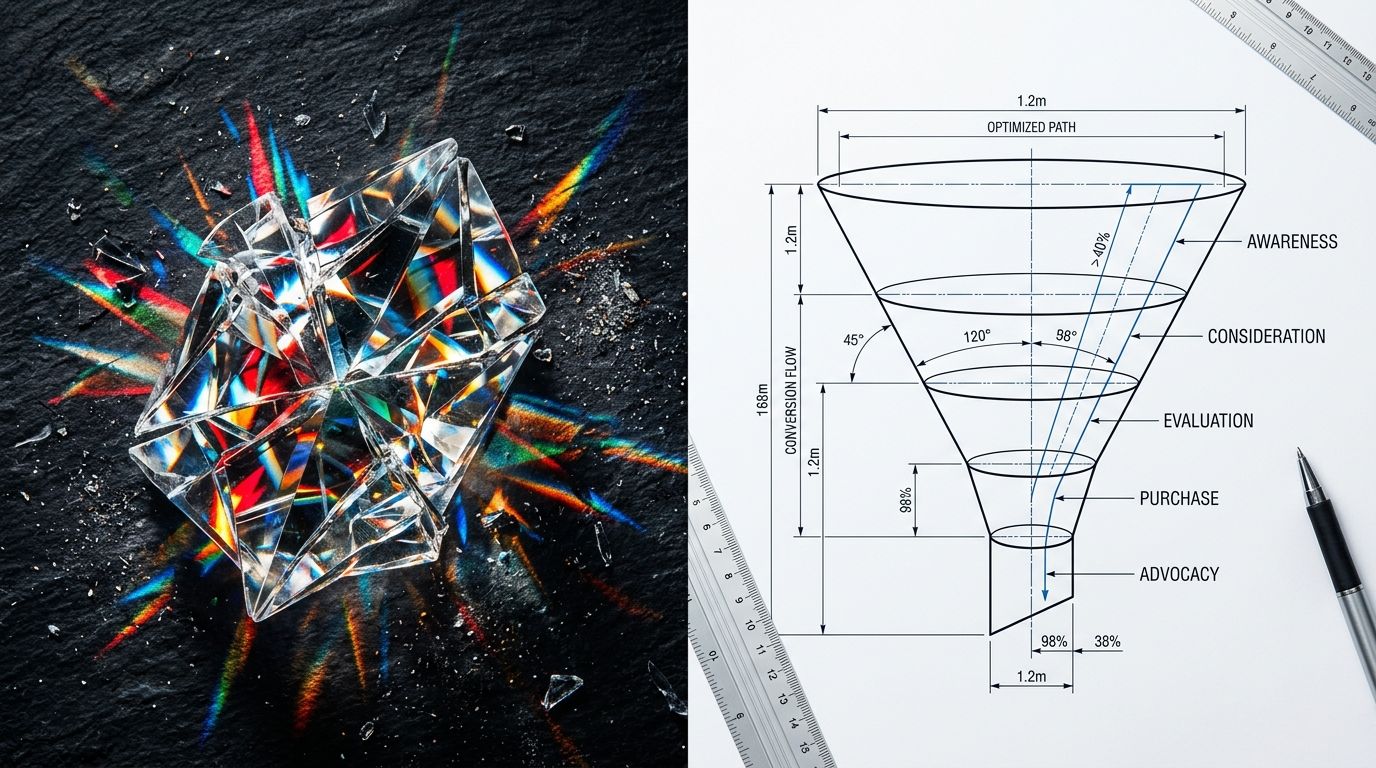
A hyper-optimized checkout page cannot save a sale if your product photography failed to convince the buyer the item is worth the asking price.
The cost of failing to prove value
Any brand still running a full studio shoot for standard catalog images in 2026 is paying for logistics, not quality. The invoice is not just the photographer. It is studio rental, the stylist's half-day, the art director's back-and-forth, and the three weeks between brief and delivery. Most founders I have talked to cannot name the actual per-image cost of their last shoot. When they calculate it, the number is usually somewhere between $80 and $200 per finished image.
Because traditional photography is so expensive, brands compromise. They shoot three angles on a white background and call it a day. They leave the buyer guessing about the details. This is why the connection between visual trust and checkout abandonment remains the most misunderstood metric in ecommerce. You are asking the customer to take a financial leap of faith based on limited visual evidence.
Fixing the conviction gap, not just the UX
To fix your checkout conversion rate, you must flood your product page with undeniable visual proof. The modern buyer expects to see the product in multiple environments. They expect lifestyle context. They expect editorial quality.
How AI product photography shifts the math
AI product photography changes that math completely. Upload a product image, pick a visual mode, and CherryShot AI generates campaign-ready photos in minutes. You can take a flat product shot and run it through the Loud Luxury mode for high-end positioning. You can run it through the Influencer mode to build social proof. You can use the Minimalist mode to keep the focus entirely on the product silhouette.
The per-image cost drops to under $5. The turnaround goes from weeks to an afternoon. You no longer have to compromise on the amount of visual context you provide the buyer.
(Worth noting: this is less about replacing photographers entirely and more about eliminating the scheduling dependency that adds three weeks to every product launch. A good photographer still makes sense for hero imagery. For catalog volume, the math simply does not work anymore.)
Stop tweaking buttons and start telling better visual stories
The brands getting the most out of this are not the ones with the biggest budgets. They are the ones launching the most SKUs per quarter. When you can generate imagery for a new colorway in twenty minutes instead of booking another shoot day, the bottleneck shifts from production to ideas.
To be fair, incredibly crisp product photography will not save a bad product with zero market demand. But it absolutely removes the friction of doubt for a good product. It gives the buyer the conviction they need to navigate your checkout without second-guessing their decision. If you want a better checkout conversion rate, stop staring at the checkout. Look at what you are asking people to buy, and ask yourself if the images actually prove the price tag.
Key Takeaways
- A low checkout completion rate usually indicates a failure to build conviction on the product page.
- Modern platform checkouts are already optimized for low friction and keystroke reduction.
- Adding an item to the cart is often a bookmarking behavior driven by curiosity rather than pure purchase intent.
- Replacing sterile catalog shots with AI-generated lifestyle imagery directly improves bottom-funnel conversion.
Frequently Asked Questions
What is a good checkout conversion rate for ecommerce?
A healthy ecommerce checkout conversion rate hovers between 40 and 50 percent of users who initiate the process. Falling below the 30 percent threshold usually indicates weak buyer conviction established on the product page rather than technical errors. Audit your visual assets to ensure high-resolution lifestyle images clearly justify the price before the customer even clicks the cart button.
How do I reduce checkout abandonment?
Stop treating checkout abandonment as a technical error and focus on building visual trust on the product page instead. Customers typically abandon carts when sudden price anxiety outweighs the perceived value of the item right before payment. Replace basic white-background catalog photos with detailed macro shots, alternate angles, and rich lifestyle contexts to definitively prove the quality of your goods.
Does the product page affect checkout conversion rate?
The product page dictates the checkout conversion rate almost entirely. Buyers who arrive at the transaction terminal with high conviction from premium imagery will easily tolerate minor friction during the final steps. Ensure your product page acts as a compelling sales floor by providing diverse angles, clear scale, and environmental context that eliminates doubt before the cart icon is ever clicked.
Should I fix my product page or checkout first?
Always fix your product page first. Modern ecommerce platforms already provide universally trusted checkout flows out of the box, meaning technical tweaks there only yield fractions of a percent in improvement. Focus your immediate effort on upgrading hero images and demonstrating clear product value through diverse visual assets, which can effectively double your conversion rate by generating high-intent buyers.
What causes checkout abandonment that is not a checkout problem?
The primary non-technical cause of abandonment is shoppers using the cart as a temporary bookmark. Users frequently add items just to check total pricing with shipping or to save them for later without any immediate intent to purchase. Combat this post-click regret by ensuring your product imagery is compelling enough to justify the premium price tag and survive the final moment of payment.
The next time you find yourself staring at an analytics dashboard wondering why your checkout completion rate is stuck, close the settings tab. Open your product page on a mobile phone. Look at your imagery through the eyes of a skeptical buyer and ask yourself if you would hand over your credit card. If the answer is no, fixing the checkout will not save you. Head over to CherryShot AI to start building the visual trust your products actually deserve.
Audit your product page images before your next campaign
Stop treating your checkout as the bottleneck and start building genuine visual trust. Generate high-end lifestyle images for your catalog to clearly prove your product's value before the buyer ever reaches the cart.
Try CherryShot AI