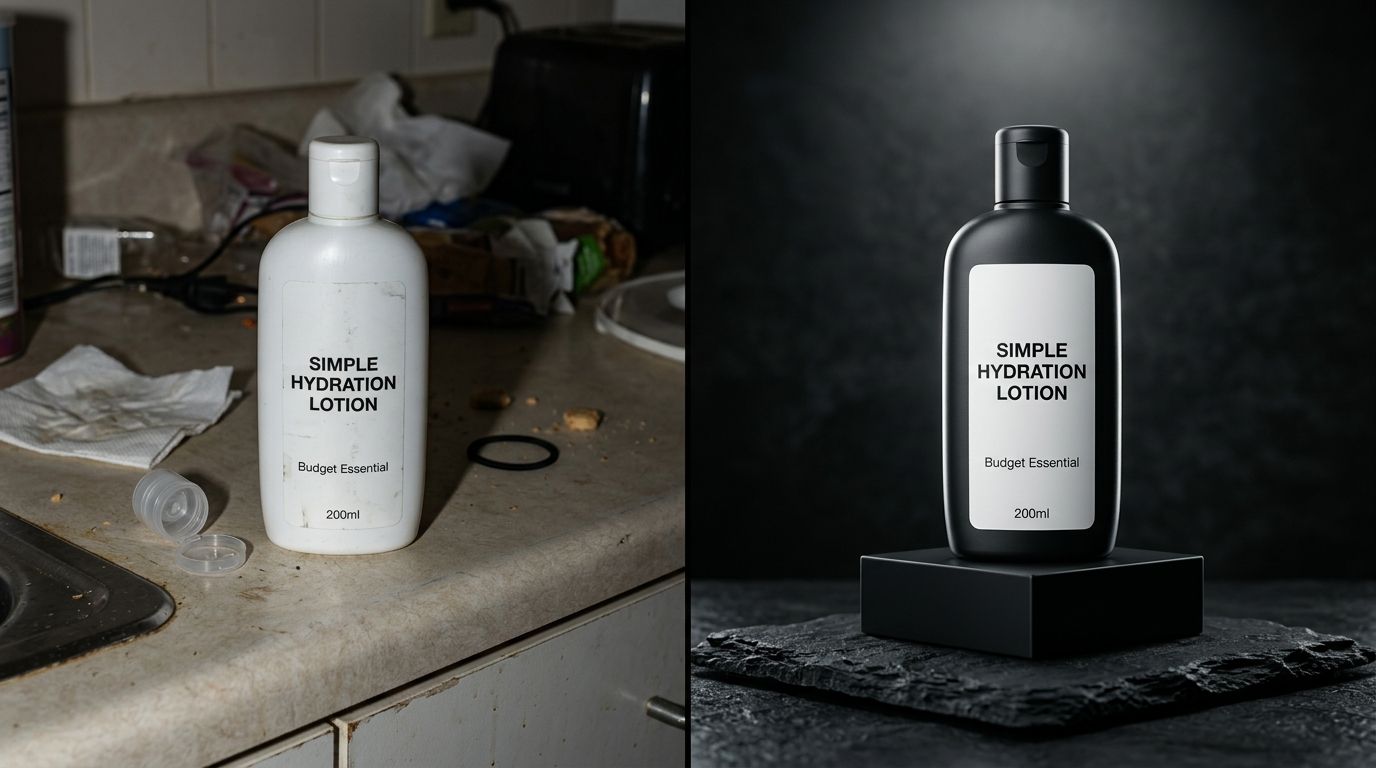
You can execute high-end cosmetics product photography on a budget by replacing expensive studio sets with AI generation and controlled DIY lighting. You place your foundation bottle or lipstick on a neutral surface, capture a cleanly lit base image, and apply digital environments to create luxury staging. This modern approach eliminates the need for expensive physical props and complex multi-strobe lighting setups while delivering campaign-ready assets for your beauty ecommerce photography setup in minutes.
Professional cosmetics product photography requires soft, diffused lighting to control reflections on glossy packaging and a stable camera to capture exact pigment textures. The most cost-effective method for small beauty brands is shooting a flatly lit base photo in-house and using AI tools to generate the final luxury aesthetic. By separating the image capture from the image styling, you drastically reduce production costs.
Any beauty founder still paying thousands of dollars for physical prop styling in 2026 is burning capital that should be spent on customer acquisition. Consumers do not care if the marble slab under your serum bottle is geological or digital. They only care about the visual signaling of quality. Upgrading your visual content is the fastest lever to pull when trying to increase conversion rates on a Shopify store.
Key Takeaways
- Diffused lighting is mandatory for cosmetics to prevent harsh glare on glossy plastics.
- Reflective packaging is managed by controlling the environment the product reflects.
- AI photography tools allow brands to generate luxury lifestyle sets from plain background images.
- Accurate color representation requires careful white balance during the initial shoot.
of online consumers consider visual appearance to be the key deciding factor in a purchasing decision. Justuno Consumer Trust Survey
The Core Principles of Luxury Cosmetics Photography
High-end beauty product photography guide materials always emphasize one critical rule above all others. You must control your light. Unlike clothing or matte cardboard packaging, beauty products are inherently reflective. Serums come in glass dropper bottles. Compacts feature mirrored finishes. Lipsticks are housed in metallic tubes. If you point a bare lightbulb at these items, you will ruin the shot entirely.
Mastering Cosmetics Photography Lighting
Soft light is the foundation of the beauty industry. When you photograph a human face, you use large softboxes to wrap the light and hide imperfections. The exact same principle applies to a plastic compact or a glass bottle. Direct, hard light creates blown-out highlights that obscure your label and cast ugly, distracting shadows across your set. By placing a diffusion layer between your light source and your product, you scatter the light rays. This creates a gentle gradient across curved surfaces that signals high-end luxury to the consumer. You can achieve this effect on a tight budget by hanging a white shower curtain or specialized diffusion fabric between a standard LED panel and your shooting table.
Harsh shadows instantly cheapen a beauty product.
To fill in the shadows on the opposite side of your main light, you do not need a second expensive light source. Simply place a piece of white foam core board just outside the camera frame to bounce the primary light back onto the dark side of the product. This creates a balanced, three-dimensional look that elevates the perceived value of your cosmetics line.
Managing Reflections on Glass and Plastic
The secret to foundation bottle photography lies in understanding the angle of incidence. The angle at which light hits a reflective surface is the exact angle at which it bounces off. If you place your camera directly in the path of that bounce, all you will capture is a blinding white glare. You must position your lights at oblique angles to the packaging.
Furthermore, reflective metallic caps or shiny black plastics do not just reflect light. They reflect the entire room. If you are wearing a red shirt while shooting a glossy black mascara tube, the product will have a red tint. Professional photographers use white cards and black cards to control the environment. Positioning a black card near a clear glass bottle adds striking dark outlines that define its shape. Positioning a white card near a metallic cap creates a clean, bright highlight that reads as premium metal.
Building a Beauty Ecommerce Photography Setup
You do not need an extensive studio to produce exceptional catalog images. The average DTC brand launches new inventory three to four times a year. Building a permanent set for this volume is inefficient. Instead, you can create a modular setup that packs away into a closet when not in use. Your goal is to capture technically sound, cleanly lit base photos that can be manipulated later.
Essential Gear for Foundation Bottle Photography
Start with a sturdy tripod. When shooting cosmetics, you are working with macro focus ranges where even the slightest camera shake will blur your product label. A tripod allows you to lower your shutter speed and let more light into the lens without introducing blur. For backgrounds, avoid distracting textures during the base capture phase. Stick to seamless white paper or matte gray vinyl. You want the camera sensor focused entirely on capturing the sharpness of the bottle and the clarity of the liquid inside.
(Worth noting: capturing exact pigment matches on camera is nearly impossible without a calibrated monitor, so plan to adjust your hues in post-production regardless of how perfect your lighting is.)
Lipstick Photography and Color Accuracy
Lipstick photography presents a unique challenge because the consumer is buying a highly specific shade. If the coral lipstick looks orange on your product page, your return rates will skyrocket. To maintain color accuracy, lock your camera white balance manually. Do not rely on auto white balance, as the camera will attempt to neutralize vibrant shades. When lighting lipsticks, twist the bullet up just enough to show the angled tip and use a small, direct light to create a subtle specular highlight on the wax. This highlight proves to the customer that the product has moisture and texture.
Using AI to Scale Your Beauty Visuals
Once you have mastered capturing a clean base photo with accurate lighting, you can entirely skip the expensive prop styling phase. Traditional luxury cosmetics photography requires sourcing marble slabs, importing exotic botanical shadows, and building custom acrylic risers. This physical set building takes days of labor and costs a fortune in material fees alone.
This single workflow shift saves thousands of dollars per product launch.
Generating Luxury Cosmetics Photography Instantly
By adopting CherryShot AI, beauty brands can upload their clean base images and generate endless lifestyle environments in seconds. If you want your night cream sitting on wet stones with water ripples, you simply select that environment. If you want your lipstick staged in the Minimalist mode with soft peach tones and harsh architectural shadows, the tool generates it flawlessly. CherryShot AI preserves the accurate lighting and text on your original product while building a photorealistic, campaign-ready background behind it. You get editorial quality outputs without leaving your desk.
Styling the Makeup Product Flat Lay
When you want to show a complete collection or a bundled kit, the makeup product flat lay is the industry standard format. Flat lays perform exceptionally well on social media platforms because they organize visual information clearly. To succeed here, you must shoot straight down from above, ensuring the camera sensor is perfectly parallel to the shooting surface to prevent perspective distortion.
Choosing the Right Backgrounds and Arrangements
The most successful beauty flat lay photography relies on negative space. Do not cram every product tightly together. Leave breathing room around the compacts, brushes, and tubes. This space signals elegance. You can organize items in a strict geometric grid for a modern, clinical skincare aesthetic, or scatter them organically for a vibrant makeup brand vibe. If you plan to run these images through CherryShot AI later, simply shoot them on a flat white table. The AI will effortlessly drop in premium textures like terrazzo, frosted glass, or silk underneath your arranged items.
Frequently Asked Questions
What is the best lighting for cosmetics product photography?
The best lighting for cosmetics product photography is heavily diffused, continuous light or studio strobes paired with large softboxes. This soft lighting wraps around curved surfaces like foundation bottles and lipstick tubes to create smooth gradients rather than harsh, blown-out highlights. Bouncing light off white foam core boards is a highly effective and budget-friendly way to achieve this look without expensive modifiers.
How do you photograph shiny or reflective beauty packaging?
Photographing reflective beauty packaging requires controlling what the product sees in its reflection rather than just lighting the product itself. You must position white cards around the item to create clean, bright reflections on the glass or glossy plastic. Conversely, placing a black card just out of the frame will add deep, defining contrast to the edges of clear bottles. Managing the angle of your camera ensures you do not capture your own reflection or the reflection of your light stands in the packaging.
What background works best for cosmetics product photos?
Neutral tones like soft gray, cream, or pure white work best for cosmetics product photos because they prevent unwanted color casts from reflecting onto your packaging.
How do small beauty brands create professional product photography?
Small beauty brands combine simplified DIY shooting techniques with AI photo generation tools to create professional imagery on a budget. Instead of renting a studio and buying physical props, founders shoot their products against a plain, well-lit background using a smartphone or entry-level camera. They then upload those flat base images into an AI platform to automatically generate complex styling, such as marble surfaces, water ripples, or high-end lifestyle environments.
If you want to see how easily your basic packaging shots can transform into high-end editorial assets, CherryShot AI starts at $10 for 50 images at cherryshot.ai.