Home Decor Product Photography: How to Show Scale, Style, and Room Context to Convert Interior Shoppers
Home decor product photography fails when it treats a $400 ceramic table lamp like a toaster. A flat white background works perfectly for electronics where the buyer only cares about the buttons. It is a disaster for interior product photography ecommerce. When someone buys decor, they are buying an aesthetic transformation for their living space. You have to show them room context, accurate scale, and distinct style, or they will simply click away.
Definition
Room context product photography is the practice of capturing home goods and furniture within styled, realistic living environments. This approach visually communicates the exact scale, mood, and aesthetic compatibility of an item to potential buyers.
The brands moving serious volume in the home and furniture space do not sell products. They sell completed rooms. They sell the feeling of a sunlit Sunday morning in a well-curated living space. If your catalog consists entirely of items floating in a white void, you are forcing the customer to do all the imaginative heavy lifting. Most customers will not do it.
We are going to break down exactly how to shoot home products so they actually convert. We will cover how to visually anchor scale so you stop paying for returns, how to light for texture, and how AI has completely destroyed the old economics of building expensive physical room sets.
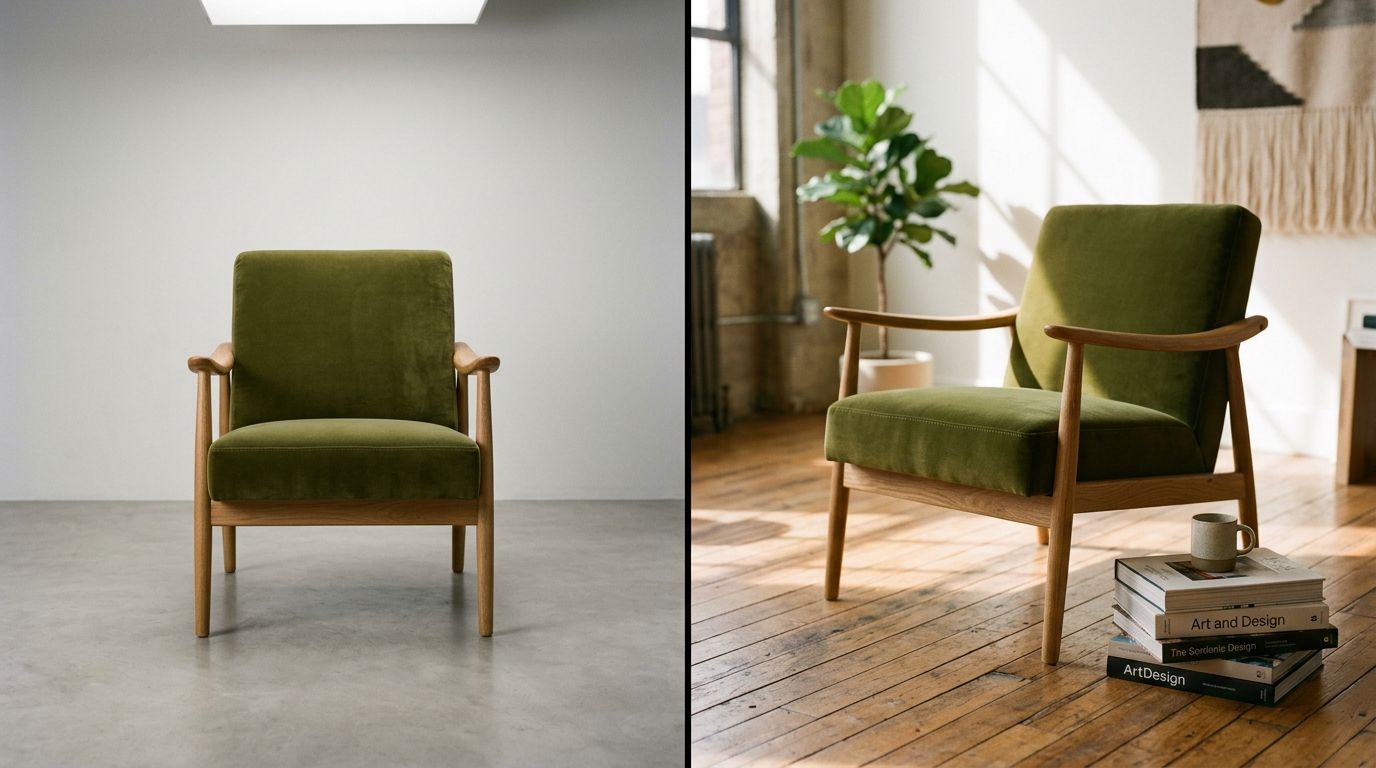
Placing a product in a realistic environment does more to sell the piece than any bulleted list of dimensions ever will.
Why the white background trap kills home decor sales
I have seen countless home goods founders spend their entire visual budget on a massive warehouse studio day. They line up sixty products. They blast them with flat, even strobe lighting. They shoot them against a seamless white paper backdrop. The resulting images are perfectly exposed, incredibly sharp, and utterly soulless.
When you strip a chunky knit throw blanket of its surroundings, it just looks like a textured square. When you isolate a velvet accent chair on pure white, it looks like a dollhouse miniature. The buyer has zero emotional reaction.
Proper home products photography requires shadows. It requires a floor. Evaluating the best background for your product pages is entirely different in this vertical. You are not trying to isolate the object. You are trying to contextualize it. A jute rug looks completely different when photographed against a warm oak floor than it does floating in a void.
The psychology of the interior shopper
People who shop for home decor online are inherently nervous. They are making a significant financial commitment to an item they cannot touch, sit on, or hold up to their living room wall. Your photography must alleviate that anxiety. The moment they cannot figure out if a side table will clash with their existing sofa, they abandon the cart.
Scale reference: The silent conversion killer
Customers do not read dimensions. They might glance at them, but they do not actually process what "18 inches tall" looks like in the real world. They look at your main product photo, they take a mental guess at the size, and they click buy. When that product arrives and it is half the size they imagined, they initiate a return immediately. You lose the sale and you eat the shipping cost.
You have to show scale without being obvious about it. Do not use those terrible graphic overlays with arrows and inch markers as your primary image. They look cheap. You need visual anchors.
How to anchor scale naturally
The human brain calculates scale based on known objects. If you place a standard coffee cup on a side table, the buyer instantly knows exactly how big that table is. They do not have to think about it. The math happens in milliseconds.
Understanding strategic prop placement to anchor scale will save you thousands in return shipping. For a large area rug, place a standard armchair on the corner of it. For a desk lamp, place a standard-sized laptop next to it. For a decorative planter, put a recognizable plant species in it. These items provide instant, effortless context.
The logistical nightmare of physical room sets
Historically, the only way to get true room context product photography was to build a set. I have paid these invoices. They are brutal. You rent a studio. You hire a set carpenter to build fake walls. You pay a stylist to source twenty different props. You paint the walls a specific shade of sage green. You spend four hours trying to rig lighting that looks like sunlight coming through a fake window.
By the time you actually place your product on that set, you have spent $5,000. And you only have that set for the day. If you launch a new colorway of that same product next month, you cannot afford to rebuild the entire room just to shoot it. So you settle for a flat white background shot for the new color, and sales suffer.
(To be fair, renting a breathtaking location house still makes sense for a massive, multi-channel annual brand campaign. But for launching weekly SKUs and maintaining catalog volume, the traditional physical set model just bleeds your margin dry.)
Furniture photography AI changes the math entirely
Any brand still physically moving drywall to shoot catalog images is paying for logistics instead of quality. The modern workflow completely bypasses the set build. You shoot your product once. You can shoot it in your warehouse against a blank wall as long as the lighting is decent.
Then you upload that image into CherryShot AI. You select a visual mode like Lifestyle, Minimalist, or Loud Luxury. The AI reads the contours of your furniture or decor piece and builds a hyper-realistic room around it. The shadows map correctly to the floor. The ambient light reflects correctly on the surface. You get the exact aesthetic of a $5,000 room set in about three minutes, for less than $5.
When you remove the scheduling bottleneck of set builds, your output skyrockets. You can place the same mid-century armchair in an airy Scandinavian living room for one ad set, and a moody Brooklyn loft for another. You are finally testing aesthetics at scale.
| Production Method | Context & Scale Quality | Cost Profile |
|---|---|---|
| Physical Room Sets | Excellent (True to life) | High (Expensive studios, props, and crew) |
| White Background | Poor (Zero visual context) | Low (Standard isolation shot rates) |
| AI Room Generation | Excellent (Hyper-realistic) | Extremely Low (Pennies per image) |
Lighting home decor to show texture
If scale is the most important functional element of your photography, lighting is the most important emotional element. The lighting tells the shopper who this product is for.
A living room does not look like an operating theater. You want soft, directional light. Imagine a single large window on the left side of the room. That directional light casts soft shadows across the ridges of a corduroy pillow. It creates a gentle specular highlight on a brass lamp base. It reveals the weave of a linen bedsheet.
When you understand the exact elements that drive conversions on modern product pages, you realize that texture equals trust. If your lighting flattens the texture of a premium material, the customer assumes the material is cheap. Directional, window-style lighting proves the quality of the item before the customer ever reads the product description.
Matching lighting to the product mood
Different products demand different emotional responses. A dark velvet sofa benefits from moody, dramatic shadows that make it look rich and exclusive. A set of organic cotton bath towels needs bright, airy, overexposed morning light to feel clean and refreshing. You have to adapt the environment to the promise of the product.
Frequently Asked Questions
How do I photograph home decor for ecommerce?
Capture home decor using both a clear neutral background image and a fully styled room environment. Environmental photography acts as the primary sales driver because it allows hesitant shoppers to visualize the physical piece within their own living spaces. Position directional lighting to mimic natural window illumination, which accurately highlights specific material textures like tufted velvet, glazed ceramic, or heavy woven linen.
Should I show home decor products in room settings?
Showing home decor products in room settings is mandatory to maintain high conversion rates and minimize expensive returns. Flat white backgrounds strip away all emotion and context, leaving buyers unable to gauge how the item fits into real life. Place items within relatable room environments to provide instant visual scale, establish a clear aesthetic lifestyle, and answer subconscious questions about furniture compatibility.
How do I show scale for large home products?
Anchor visual scale by placing relatable everyday objects naturally within the photographic frame. Buyers rarely read text dimensions and often ignore ugly graphic overlays, making visual context the only reliable way to communicate size. Rest a standard coffee cup on a side table, drape a throw blanket over a sofa arm, or set a hardcover book next to a desk lamp to trigger instant mental calculations.
Can AI create room context for home decor photography?
AI product photography tools entirely replace the need to build expensive physical room sets for decor. The software reads the contours of an unstyled, isolated furniture image and generates a hyper-realistic living space around the exact dimensions. Upload your base image into a platform like CherryShot AI, select a Mid-Century Modern aesthetic, and let the system automatically map accurate floor shadows and lighting reflections.
What lighting works best for home decor photography?
Soft, directional lighting that replicates natural illumination from a large living room window produces the best results for home decor. This specific lighting style allows shadows to fall naturally across the product, revealing its precise three-dimensional shape and true surface texture. Avoid flat strobe setups entirely, as direct flash flattens the spatial depth and makes premium interior products look cheap and sterile.
Key Takeaways
- Flat white backgrounds destroy the emotional appeal and perceived scale of premium home decor products.
- Always include relatable, everyday props in your lifestyle shots to anchor the dimensions naturally.
- Directional lighting that mimics natural window light is essential for revealing high-end material textures.
- AI product photography allows you to generate realistic room settings for pennies on the dollar without ever touching a physical set build.
Selling home decor online will always be a visual battle. The brand that provides the clearest, most aspirational context wins the checkout. Stop pouring your margin into carpenters and location rentals. Upload your catalog to CherryShot AI and start generating the room context your buyers actually need to make a decision.
Generate room context for your decor catalog
Stop losing checkout conversions because buyers cannot visualize your products in their homes. Upload your flat studio images to CherryShot AI to instantly render them in hyper-realistic, styled room environments without a physical set.
Try CherryShot AI