How Do I Brief a Product Photographer?
How to brief a product photographer comes down to one absolute rule. You must eliminate interpretation. A creative brief for product photography is not a mood board of vibes. It is a technical document that dictates exact lighting, specific angles, required props, and the final aspect ratios for your ecommerce platform.
Definition
A product photography brief is a structured instruction manual provided to a photographer to ensure visual consistency and technical accuracy. It defines the specific lighting, camera angles, styling, and file requirements necessary for brand imagery.
Most expensive reshoots are not the photographer missing the mark. They happen because founders submit a mood board of six different lighting styles and say "make it look premium." When you leave visual decisions to the day of the shoot, you get inconsistent lighting and missing details.
A vague brief leads to unusable assets. The financial drag of bad imagery is relentless. Poorly planned shoots inflate your production budget and eventually hurt your conversion rate. Exploring the hidden costs of bad product photography reveals exactly why you need to lock down your brief before anyone picks up a camera.
It is worth noting that even the best photography brief cannot save a shoot if you hire a lifestyle photographer to execute a highly technical macro product shoot. You must match the talent to the brief.
If you want campaign-ready assets on time, you need a strict product photography brief template. Here is exactly how to build a document that guarantees results.
**The anatomy of a perfect brief**
To get what you need, your photography direction brief must cover brand aesthetics, execution logistics, and an exact shot list. Do not assume the studio knows what your standard catalog images look like.
**Brand identity and visual guidelines**
Start with the immovable rules of your brand. A photographer needs to know your brand colors, your core demographic, and the technical mood of your visual identity. Do not use words like "clean" or "fun." Those mean entirely different things to different people.
Instead, define the lighting. Do you want hard shadows that look like direct, midday sunlight? Do you need soft, diffused lighting that eliminates all reflections on your glass packaging? Specify the exact background colors using hex codes.
Include a visual reference for what you do not want. Showing a photographer a lighting style you hate is often more effective than showing them ten things you like. This sets clear boundaries.
**The shot list template**
This is the most critical part of your ecommerce brief. A shot list template is a spreadsheet that tracks every single image you expect to receive.
For each row, list the SKU, the product name, the exact angle required, the required props, and the styling notes. If you need a straight-on shot of the front label, write "0-degree angle, straight on, front label perfectly legible." If you need a texture shot, write "45-degree macro top-down, showing product texture, no props."
This spreadsheet becomes your checklist on set and your audit tool when the final gallery arrives. If an image is missing from the final delivery but was on the shot list, the photographer owes you a reshoot. If you forgot to put it on the shot list, you owe the photographer another day rate.
Creating a structured spreadsheet guarantees that every product in your catalog gets the exact same treatment. Nailing this formatting is the secret to crafting an effective brief for consistent results across your entire site. When a customer clicks from a hero banner to a category page, the lighting must match perfectly.
| Approach | Primary Benefit | Best For |
|---|---|---|
| Studio Shoot | Custom control | Hero brand campaigns |
| AI Photography | Cost and scale | Catalog and colorway updates |
**Logistics, formatting, and deliverables**
Photographers need to know where these images will live before they set up the shot. An image shot for an Instagram story needs negative space at the top and bottom for native text overlays. A hero banner on your homepage needs horizontal negative space on the left side for your headline.
List your exact crop requirements. Tell the studio if you need 4:5 ratios for social media, 16:9 for desktop banners, and 1:1 squares for your Shopify product page. Specify the file formats. Request high-resolution TIFF files for print campaigns and web-optimized JPEGs for immediate upload to your store.
**Common mistakes in a photographer brief guide**
Founders often ruin perfectly good shoots by introducing chaos at the briefing stage. Avoiding these specific errors will save you thousands of dollars.
**Overloading the mood board**
More references do not equal a better brief. If you include twenty inspiration images with completely different lighting setups, the studio has to guess which one you actually want them to execute. Pick three to five strong references that align perfectly with your technical goal.
**Ignoring aspect ratios**
Shooting a tight, close-up square image makes it impossible to crop into a wide banner later. You cannot invent a background that was not captured in the camera. State your formatting needs clearly. If the photographer knows you need a wide crop, they will back the camera up and light a wider surface area.
**Delegating prop sourcing at the last minute**
If your brief calls for lifestyle elements, you must define who is buying them. If you expect the studio to source fresh ingredients or specific stylistic props, note this in the brief. If you show up to the shoot expecting marble slabs and the photographer thought you were bringing them, the shoot comes to a hard stop.
**The production math shift**
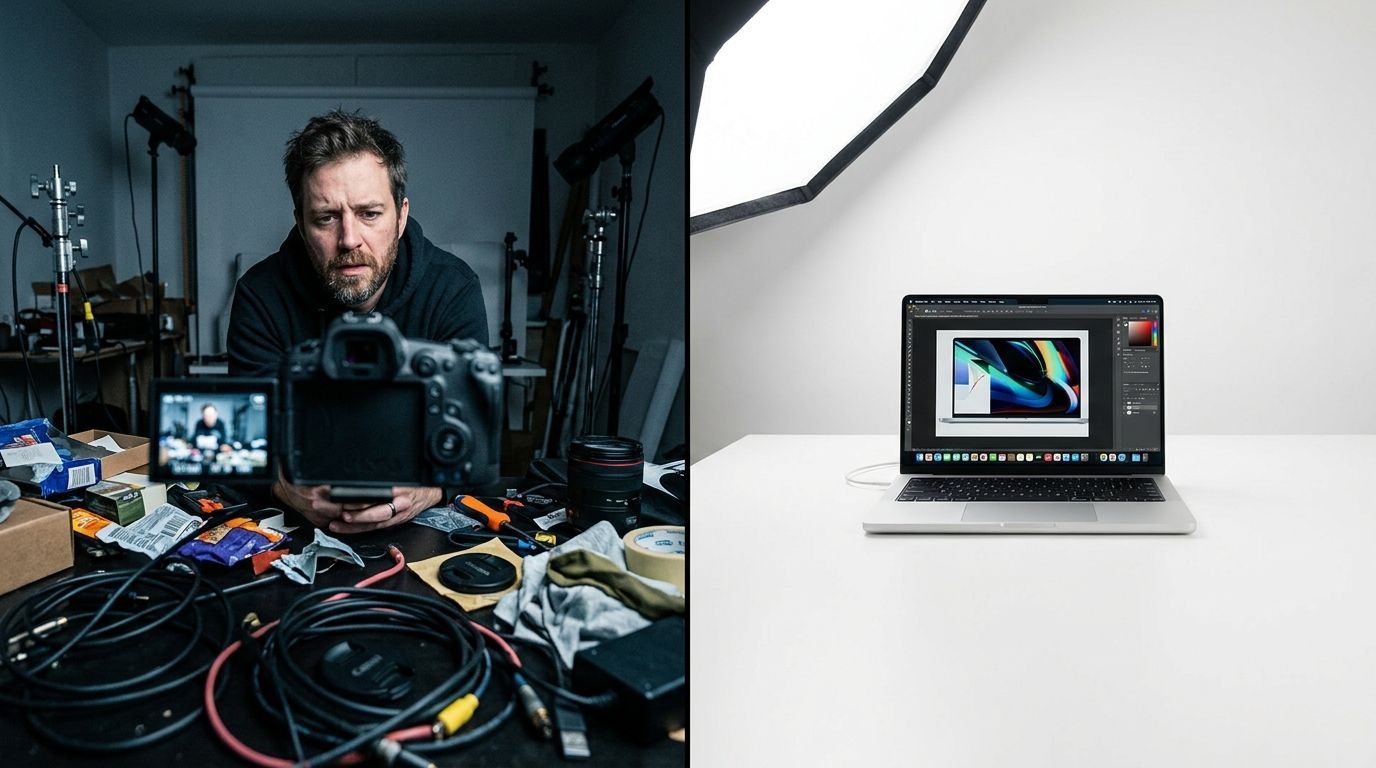
Writing a comprehensive brief for product photo shoot campaigns takes hours. Managing the logistics takes days. Traditional shoots require shipping physical product, booking a studio, paying a stylist, and hoping the final gallery matches your vision.
Most brands never calculate the total time their team spends building mood boards, packing boxes, and reviewing galleries. The invoice from the studio is just one part of the equation. Breaking down the true production timeline is critical to understanding the real cost of product photography and protecting your margins.
For highly conceptual hero images with live models, this traditional process is completely necessary. There is no replacing human art direction for a massive brand launch. A good photographer brings a level of creative intuition that sets your core identity apart.
But for high-volume catalog work and rapid colorway updates, the math no longer works. When you need a hundred images for a new seasonal catalog, writing a traditional creative brief document becomes a massive bottleneck.
AI product photography eliminates the staging logistics. You upload a flat image of your product into CherryShot AI, select a visual mode like Minimalist or Avant Garde, and get polished imagery back in minutes. The per-image cost drops to under $5. You still need to know what you want visually, but you bypass the three-week waiting period and the four-hour studio overruns. Shifting your volume work to AI lets you reserve your heavy briefing process for the hero campaigns that truly need human execution.
Audit your product page images before your next campaign
Review your current product catalog to identify inconsistent lighting or missing angles that confuse customers. Using CherryShot AI, you can generate the missing shots for your existing products in minutes without scheduling a new studio shoot.
Try CherryShot AIFrequently Asked Questions
What should I include in a product photography brief?
Your brief must include visual guidelines, precise lighting directions, specific background colors using hex codes, and a comprehensive shot list. Documenting these technical requirements ensures the studio captures exactly what your brand demands for your product pages. Include file type specifications, aspect ratios, and the exact dimensions required by your ecommerce platform to prevent any scaling issues during your final website upload.
How do I write a creative brief for a product photographer?
Start by defining your brand aesthetic without using vague adjectives. Provide three to five clear reference images for lighting and composition. Build a spreadsheet that lists every single SKU, the exact angle required for each shot, and any necessary props. Concluding the document with delivery logistics and deadline expectations keeps the production team focused on the specific visual outcomes your marketing strategy requires for a successful product launch.
What is a shot list for product photography?
A shot list is a detailed spreadsheet tracking every image you expect the photographer to capture. It serves as an execution checklist on set and a deliverables checklist when the gallery is handed over. Mapping out each row by product name, camera angle, lighting notes, and styling instructions removes guesswork and keeps the photography team efficient during the limited time booked in a studio setting.
How detailed should a photography brief be?
It needs to be technical enough to eliminate all guesswork. If you need a label to be perfectly legible without glare, write that down clearly. Requiring specific horizontal negative space on the left side of the image for website copy means you must specify the exact crop requirements before the shoot begins. Providing this level of granular detail prevents costly misinterpretations and ensures the final assets integrate perfectly with your web design.
Does a good brief prevent reshoots?
Yes, a clear document stops most preventable errors. Brands relying on vague instructions instead of specific directives often find themselves paying for duplicate studio time. A structured brief holds both the brand and the studio accountable for the final output. If an image was on the shot list and the studio missed it, they owe you a reshoot because your written instructions serve as the project contract.
Key Takeaways
- A photography brief must eliminate guesswork by defining exact lighting and angles.
- Shot lists are non-negotiable spreadsheets that track every required image and prop.
- Deliverables and crop ratios must be stated before the shoot begins to ensure usability.
- High-volume catalog imagery can bypass traditional briefing logistics entirely by utilizing AI generation.
A flawless brief is the best insurance policy you can buy for a commercial shoot. It turns subjective art direction into a measurable process.
When you are ready to eliminate the logistical bottleneck entirely, test your next catalog run through CherryShot AI. You will get the campaign-ready assets you need in minutes, allowing your team to focus on launching products instead of managing studio schedules.