How to Photograph Large and Oversized Products: The Scale Challenge Solved
Photographing large and oversized products requires solving for logistics long before you solve for lighting. To capture furniture and appliances effectively, you need a shooting space at least three times the footprint of the object. You need massive modifiers to wrap light around vast surface areas. Most importantly, you need physical anchor objects to communicate exact scale. If you skip any of these steps, a three thousand dollar sectional sofa looks exactly like a dollhouse miniature on a plain white background.
Definition
Large product photography is the specialized process of capturing high-quality images of oversized items like furniture, appliances, or industrial equipment. It focuses on maintaining correct perspective, managing complex lighting over large surface areas, and providing visual scale references to help customers understand the true dimensions of the product.
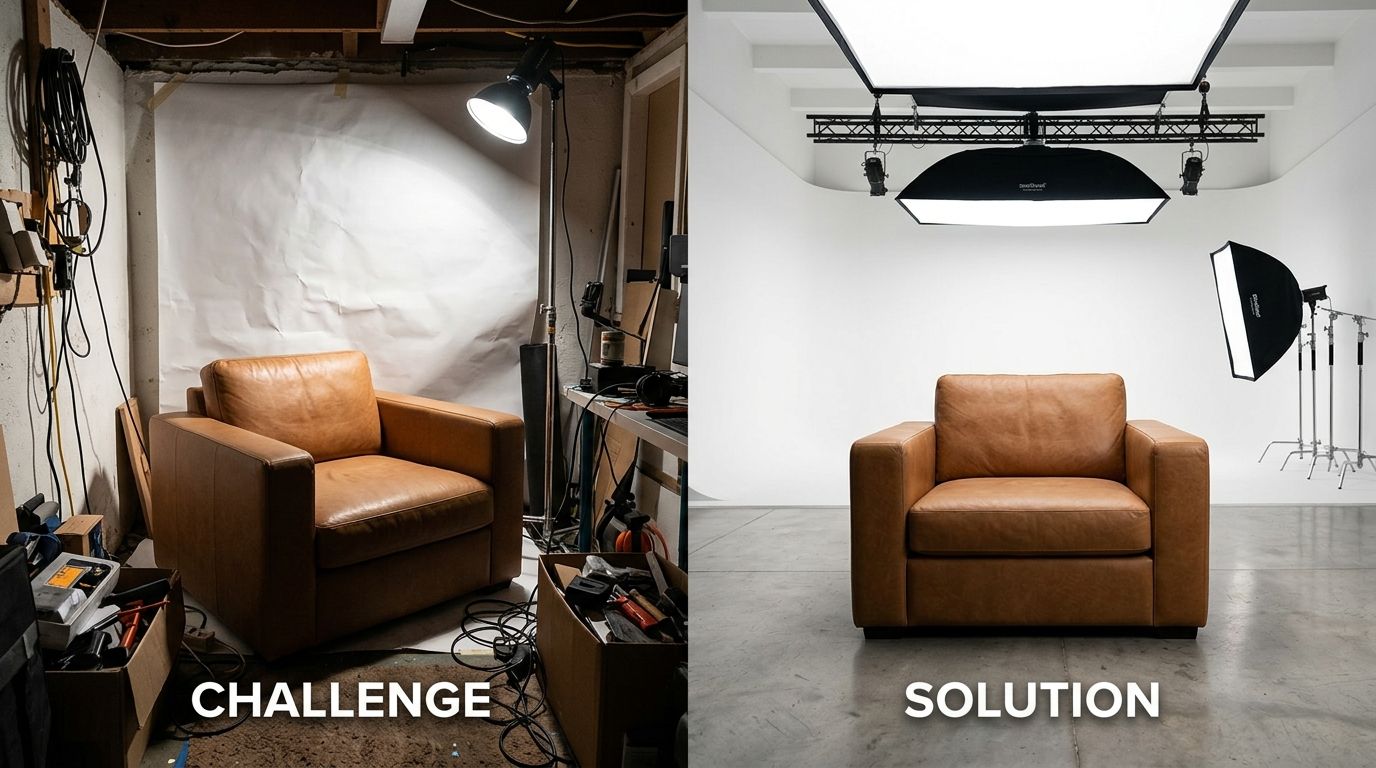
Any brand shipping physical beds or large appliances to a warehouse just to photograph them against a white cyclorama wall is burning margin on pure friction. I have personally sat through studio shoots where four grown men spent an hour sweating over a solid oak dining table just to rotate it forty five degrees for a new angle. We paid the photographer, the grip crew, the truck driver, and the studio owner. The final image was technically perfect, but the actual cost per photo was entirely unsustainable for a fast moving catalog.
Worth noting, custom fabrication and high ticket bespoke furniture still demand physical detail shots of the wood grain and hand carved joinery. But for standard lifestyle variations and new colorways, shipping heavy goods to a studio makes zero sense anymore.
Why furniture product photography breaks standard studio workflows
Most commercial photography studios are built for items you can hold in your hands. When you transition into oversized product photography, the entire operational playbook falls apart. You can no longer place the item on a standard tabletop. The moment the product touches the floor, the floor itself becomes a critical part of your composition. You now have to manage shadows that stretch for six feet across the room.
Shooting furniture in context provides immediate visual scale, but building physical room sets requires massive budget and floor space.
The logistics of studio space for large products
Space is the absolute hardest constraint in large item product photos. If you want to photograph a king size mattress, you cannot shoot it in a room that is only slightly larger than the bed. You need distance between the camera and the product to avoid severe lens distortion. You also need distance between the product and the back wall to separate the subject from the background.
This reality forces appliance and furniture brands into massive warehouse rentals. The invoice scales directly with the square footage required. You are no longer paying for a photographer's eye. You are paying for real estate. This is precisely why many brands rethink their essential product photography setup to focus on modularity over sheer space.
| Feature | Traditional Studio Shoot | AI Photography |
|---|---|---|
| Logistics | Heavy shipping required | Digital upload only |
| Timeline | Days or weeks | Minutes |
| Cost | High overhead/crew | Software subscription |
| Environment | Physical set build | Generated backgrounds |
How to photograph large products without losing scale
A refrigerator on a pure white background looks identical in size to a mini fridge on a pure white background. The camera strips away all relative dimensions when you isolate the product perfectly. Customers cannot measure inches with their eyes on a smartphone screen. They require visual context.
Scale reference photography techniques
The human brain determines size by comparing unknown objects to known objects. If you sell large format DTC products, you have to engineer these reference points into every single shot. Place a standard hardcover book on the coffee table. Lean a known acoustic guitar against the corner of the media console. Put a universally recognized coffee cup on the kitchen island next to your new appliance.
When you establish scale immediately, the buyer stops guessing. You drastically cut down the customer service emails asking if the sectional will fit in a small apartment. Scale reference photography builds immediate trust because the customer can instantly project their own physical space into the image.
Context photography for large items
White background product photos are mandatory for your primary catalog grid, but context photography is what actually closes the sale. Buyers need to see the large item occupying physical space. Leveraging lifestyle photography for scale transforms a heavy piece of hardware into a believable part of a home.
Staging oversized pieces in real homes provides unmatched context for buyers. The clear trade-off is that you surrender total control over ambient lighting and make background isolation nearly impossible. You have to accept whatever natural light the location gives you, which often means mixed color temperatures and inconsistent shadows across different angles.
Camera and lighting setups for oversized product photography
You cannot light a three seater sofa with the same softbox you use for a pair of sneakers. The physics of light dictate that your light source must be larger than your subject to create soft, wrap around illumination. For furniture ecommerce photography, this means investing in massive lighting modifiers.
Lighting strategies for massive footprints
Most studio photographers rely on bouncing strobes off massive V flats or firing through eight foot diffusion scrims. The goal is to create a wall of light that gently illuminates the entire side of a wardrobe or a treadmill. Hard, small light sources will create hot spots on the center of the product while the edges fall into deep, muddy shadows.
If you lack a twelve foot ceiling, bouncing light off the overhead surface is a standard workaround. Just ensure the ceiling is painted pure neutral white, otherwise you will cast an uncorrectable color tint across the entire product.
Managing distortion in wide angle product photography
When a room is too small, photographers naturally reach for a wider lens. This solves the space problem but introduces a massive new issue. Wide angle lenses stretch the corners of the frame. The front armrest of a chair will look comically large while the back legs taper off into the distance.
To avoid this perspective distortion, you must back up physically and use a lens in the 50mm to 85mm range. If you absolutely must shoot wide, keep the camera perfectly level with the exact center of the product. Tilting the camera up or down even slightly will cause vertical lines to converge, making a perfectly square bookcase look like a leaning pyramid.
Staging and logistics: The hidden costs of large item product photos
Moving large goods around a studio destroys shoot momentum. Every time the art director wants to see the product from a different angle, four people have to step in, lift the piece, reset the rug, adjust the side tables, and reposition the main light.
The reality of lifestyle staging large products
Building physical room sets inside a warehouse is the traditional solution to this problem. Brands build faux living room walls on casters and roll them into place behind the product. This approach yields fantastic results but demands a staggering budget. You have to hire set builders, source massive amounts of prop styling decor, and dedicate entire days just to painting fake walls.
When to bypass the physical shoot completely
This is where the math on traditional studio shoots breaks down entirely for oversized goods. Generating these images digitally has become the only logical move for catalog volume. With an AI powered photography platform like CherryShot AI, the logistics evaporate. You take one basic flat photo of the desk or sofa in your own warehouse under flat lighting. You upload it, select the Lifestyle or Luxury mode, and the software generates the physical room around the product.
The AI understands the scale of the original upload. It places the heavy furniture on a realistic floor, casts accurate long shadows based on the window light in the scene, and adds the surrounding context automatically. You skip the grip crew, the freight truck, and the studio rental entirely. What used to take three weeks of coordination now takes roughly ten minutes.
Key Takeaways
- Large items require studio space at least three times their physical footprint to manage lens distortion and shadows.
- Always include recognizable objects like coffee mugs or standard books to establish instant visual scale for the buyer.
- Never use ultra wide lenses on furniture close up, as they severely distort the physical dimensions of the product.
- Replacing physical shoots with AI visualization completely eliminates the massive logistical costs of moving heavy goods.
Audit your product page images before your next campaign
Check if your current gallery includes a clear lifestyle shot that establishes scale for your customers. If your product pages feel flat, try generating a high-quality lifestyle room set using your existing warehouse photography to add depth and context instantly.
Try CherryShot AIPhotographing oversized items has always been a battle against gravity, space, and budget. By focusing on scale references and leveraging modern visual tools, you can present large goods with perfect clarity without destroying your margin.
If you are tired of paying freight charges just to get your products into a photography studio, upload your latest piece to CherryShot AI and generate your next campaign from your desk.