How Do I Make My Products Look More Expensive in Photos?
You make products look expensive in photos by controlling lighting to create shadows, maximizing negative space, and using textured backgrounds that signal luxury rather than utility. Most brands fail here because they shoot for clarity instead of desire. They blast the item with flat light to show every detail. That approach makes a $200 handcrafted handbag look like a $20 knockoff from a discount marketplace.
Definition
High-end product photography is a visual technique designed to increase perceived value by using deliberate lighting and composition. It moves away from purely functional utility toward lifestyle aspirational cues.
I see this disconnect every single week. A founder builds a genuinely premium product. They use high-grade materials, invest in custom packaging, and build a brand story centered on quality. Then they launch the campaign with visual assets that actively suppress their price point.
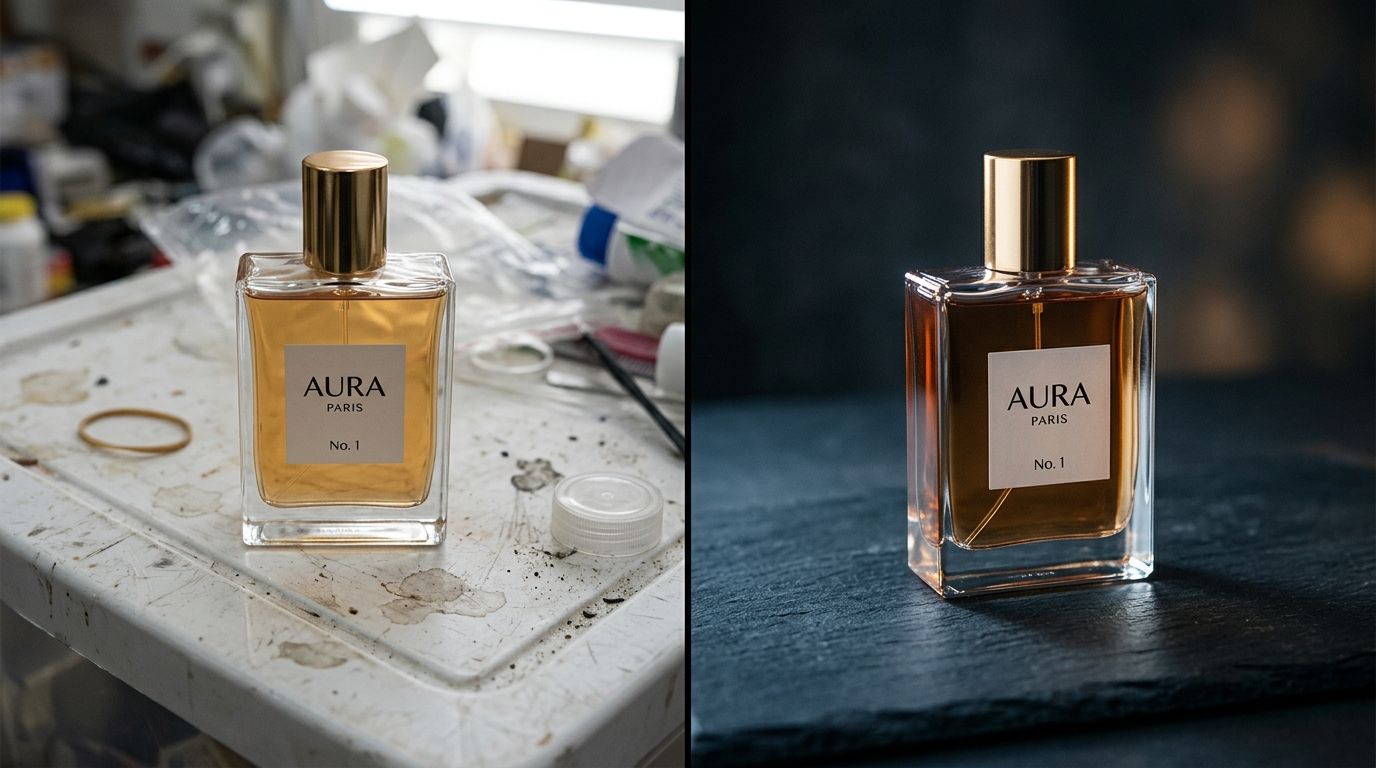
Premium product photography relies on shadows and context to communicate material quality.
When photography makes a product look cheaper than it actually is, consumers immediately anchor to a lower perceived value. They look at your price tag and feel friction. You are asking them to pay a premium based on text descriptions while your images communicate budget quality. To fix this, you have to stop thinking about your photos as simple catalog entries. You must treat them as value indicators.
The 8 Visual Signals Framework
Luxury is not just a price point. It is a visual language. If you want to know how to make products look more expensive in photos, you need to understand the eight specific cues that tell a customer an item is worth paying full price for.
1. Directional Lighting Over Flat Illumination
Utility brands use flat, even lighting. Their goal is to eliminate shadows so the customer can see every inch of the item clearly. Premium brands use directional lighting. They intentionally cast shadows across the product.
Shadows give an object physical weight and dimension. When a subtle shadow falls across the curve of a glass bottle or the fold of a leather wallet, it tells the human brain that this object exists in the real world. It highlights the contour. Flat lighting destroys contour. If your photos look like they belong in a sterile laboratory, your perceived value will drop.
2. Aggressive Use of Negative Space
Take a look at a mass-market retail flyer. Every square inch of the page is packed with product images and text. Now look at a campaign from a high-end fashion house. The product might only take up twenty percent of the frame.
Negative space signals confidence. It tells the viewer that the item is so important it deserves room to breathe. When you crop tightly around your product so it touches the edges of the image, you create a sense of claustrophobia and cheapness. Pull the camera back. Let the environment surround the product.
3. Intentional Background Textures
Pure white backgrounds are necessary for Amazon listings. Everywhere else, they are a missed opportunity. A stark white void communicates nothing about your brand identity or the lifestyle of the buyer.
Replacing a white void with a physical texture instantly elevates the shot. Concrete, marble, brushed steel, or heavy velvet provide context. They give the eye something to contrast the product against. When you are choosing the right background for your campaign, look for materials that echo the core promise of your item. If you sell a heavy-duty men's grooming tool, rest it on dark slate.
| Feature | Budget Approach | Premium Approach |
|---|---|---|
| Lighting | Flat, shadowless | Directional, high-contrast |
| Composition | Tight, full-frame | Spacious, negative space |
| Background | Pure white, sterile | Textured, lifestyle-driven |
4. Macro Detail Shots That Prove Quality
Anyone can make a product look decent from ten feet away. Premium quality reveals itself up close. If you want to justify a high price tag, you have to prove the craftsmanship.
You need macro photography showing the stitching on a seam, the grain of the leather, or the precise milling of a metal dial. For ecommerce brands selling intricate items, capturing fine details is non-negotiable. If you do not show the customer the micro-level quality, they will assume it does not exist.
5. Restrained Color Palettes
Cheap photography often features oversaturated colors. The grass is neon green, the sky is unnatural blue, and the product glows like a radioactive object. Premium product photography looks expensive because it exercises restraint.
Muted color grading feels sophisticated. This does not mean you have to shoot in black and white or desaturate your actual product. It means the supporting elements in the frame should follow a tight, intentional color scheme. A monochromatic setup where the product and background are slightly different shades of the same color always looks more expensive than a chaotic mix of primary colors.
6. The Illusion of Density and Weight
Cheap things feel flimsy. Expensive things feel substantial. Your photography must communicate how heavy the item is.
You achieve this through camera angles and styling. Shooting slightly upward from below the product gives it a heroic, imposing stature. Propping a bag so it stands upright on its own suggests thick, rigid materials. If an item looks like it would blow away in a stiff breeze, no one will pay a premium for it.
7. Minimal Prop Interference
A common mistake novice art directors make is trying to tell too big of a story. They surround a coffee bag with raw beans, a grinder, a steaming cup, a newspaper, and reading glasses. The frame becomes a mess.
Props should support the product, never compete with it. If you look at luxury product photo styles, you will notice they rarely use more than one or two supporting elements. A perfume bottle sitting next to a single, beautifully lit stone is far more powerful than a bottle buried in a pile of flower petals.
8. Flawless Post-Production
Dust, fingerprints, and crooked labels kill the illusion of luxury instantly. You can have perfect lighting and a beautiful composition, but if there is a massive spec of lint on your velvet background, the shot is ruined.
High-end photography requires rigorous cleanup. Edges must be sharp. Stray reflections must be managed. When founders rush this step, the resulting images make the avoid looking cheap impossible. Attention to detail in post-production separates the amateurs from the professionals.
Generating Luxury Imagery Without the Studio Cost
Historically, achieving these eight visual signals required a massive budget. You had to hire a specialized photographer, rent a studio, buy expensive props, and wait weeks for retouching. The cost per image easily surpassed $150.
AI product photography has effectively removed that barrier to entry. General-purpose AI image tools struggle with product accuracy, but purpose-built tools like CherryShot AI are designed specifically for this workflow. You upload a flat product image and select a visual mode like Luxury, Magazine, or Minimalist. The engine automatically generates the directional lighting, negative space, and premium background textures we just discussed.
Instead of paying $150 per image and waiting three weeks, you pay under $5 and get campaign-ready assets in minutes.
There is a genuine trade-off here. AI requires a clean, in-focus base image to do its job well. If you upload a blurry cell phone photo taken in a dark basement, the AI cannot magically fix the resolution of your actual product. You still have to provide a sharp input.
When you remove the friction of expensive studio days, you can finally align your visual presentation with the actual quality of your goods. You can test different premium aesthetics for the same product. You can launch a new colorway with high-end imagery the same afternoon the prototype arrives at your desk.
Audit your product images today
Review your top three sellers and check if your current lighting or background is failing to communicate the actual quality of your goods. You can quickly generate professional alternatives with the right environmental context using our platform.
Try CherryShot AIKey Takeaways
- Directional lighting creates shadows that give products physical weight and perceived value.
- Aggressive negative space communicates confidence and allows the product to breathe.
- Restrained color palettes and minimal props keep the focus entirely on the item.
- AI tools can now generate these luxury visual signals for a fraction of the cost of a studio shoot.
Stop letting bad photography drag down the perceived value of your inventory. Your products deserve to look as good on screen as they feel in the customer's hands. Try running your catalog through CherryShot AI to see how much more expensive your items look when paired with the right lighting and context.