Photoroom Alternative for Ecommerce: When You Need More Than Background Removal
If your only goal is stripping the background off a product photo so you can upload it to an Amazon listing, you do not need an alternative to Photoroom. It is an exceptional utility tool built for exactly that job. But ecommerce brands eventually hit a point of diminishing returns with pure isolation. A white background proves that your product exists. Context is what proves your product is worth buying. When you are ready to stop pasting cutouts onto flat colors and start building campaign-ready environments, you need a different kind of tool entirely.
Definition
A generative AI photography platform replaces basic background removal by building complete three-dimensional scenes around a product. Instead of simply cutting out an object and pasting it onto a flat color, the software calculates actual light physics to cast realistic shadows and reflections. This technology allows merchants to produce campaign-ready lifestyle visuals without renting physical studio space or hiring set designers.
There is a fundamental difference between editing an image and generating a scene. Post-production apps act like digital scissors. They are fast, reliable, and fundamentally limited by the lighting of your original photo. If you want to build a brand that commands a premium price tag, you have to upgrade your visual standard. You have to move from isolated assets to integrated storytelling.
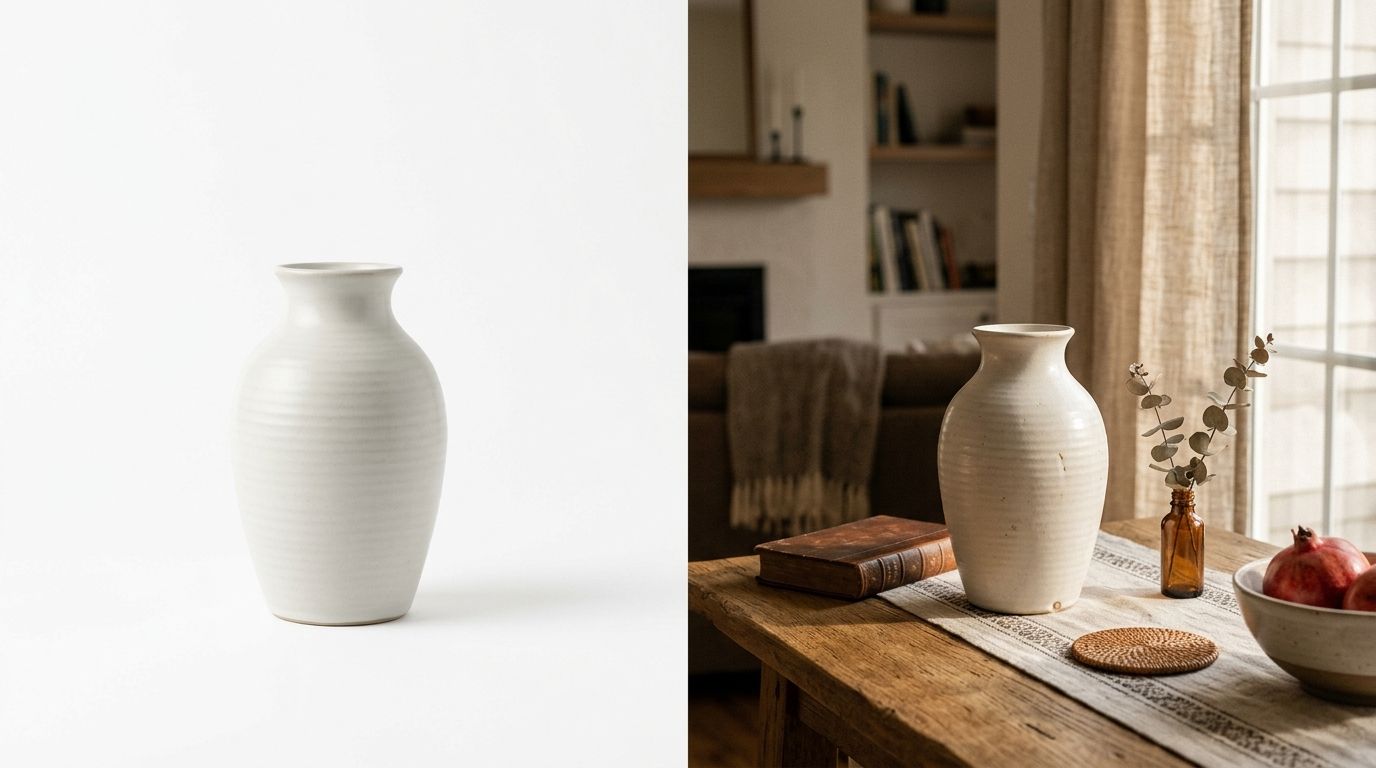
Basic cutouts lack the environmental lighting required to look natural in a generated scene.
The breaking point of the white background
Most brands start with basic flat imagery because platform requirements force them to. Marketplaces mandate pure white backgrounds for their primary listing images. This creates a terrible habit where founders begin treating all brand photography as a clinical catalog exercise.
The problem arises when you take that catalog mindset into paid social and your own storefront. Flat images do not stop a scrolling thumb on Instagram. They do not communicate scale, texture, or lifestyle. When a potential buyer sees a skincare serum floating in an empty void, they have to do the mental heavy lifting of imagining how it looks on their bathroom counter. Most buyers will not do that work for you.
The moment you try to take a standard product cutout and place it into a stock photo, the illusion breaks. The lighting on your product reflects the sterile warehouse where you shot it. The lighting in the stock photo is a warm, sunlit living room. The mismatch is jarring. Buyers might not know the technical terms for global illumination or shadow mapping, but their brains instantly register the image as cheap.
If you are trying to convince a customer to pay eighty dollars for a moisturizer, your photography cannot look like it was assembled in a mobile app in three minutes. You need realistic staging. Understanding AI for lifestyle product photography is how brands break out of the catalog trap and start building visual equity.
Where simple utility tools fail in ecommerce
I have spent years managing ecommerce photoshoots and reviewing creative assets. I love utility apps for what they are. They replaced the tedious process of paying offshore retouchers to draw clipping paths around thousands of products. But a clipping path is just step one.
The mismatch of shadows and reflections
When you use a basic background remover, the software isolates the pixels of your product and deletes the rest. If you then tell the software to put your product on a marble table, it simply layers the isolated pixels over a flat texture. It might add a generic drop shadow.
Real objects do not behave like that. If you place a glass perfume bottle on a real marble table, the table reflects the glass. The glass refracts the environment around it. The light hitting the left side of the bottle casts a specific, elongated shadow to the right. General-purpose apps do not calculate these physics. They just paste and blur. This is why generated ad creatives from basic tools often look like bad collages.
Photoroom is undeniably faster and cheaper if your only goal is producing thousands of pure white Amazon catalog images on a shoestring budget. That is a genuine limitation of higher-end tools. But when you need visuals that drive conversions on premium storefronts, you need software that understands spatial logic.
What a true Photoroom alternative looks like
A platform built for campaign generation approaches the problem entirely differently. Instead of just cutting out the object, a tool like CherryShot AI maps the geometry of your product. It understands that a box is a three-dimensional object with distinct planes, while a bottle is a cylinder that bends light.
When you upload a product image and select a visual mode like Classic, Loud Luxury, or Avant Garde, the AI does not just swap the background. It builds a virtual set. It calculates how the ambient light in that specific set should interact with the materials of your product. If you choose the Minimalist mode with a concrete floor, the shadow cast by your product will be sharp and the reflection will be matte.
This leap in technology effectively replaces the physical studio. You no longer have to compromise between the cheap look of a pasted cutout and the massive expense of a traditional photographer. Reviewing AI photography cost vs. studio logistics reveals just how much margin brands waste on location fees and lighting rentals when the software can now render identical results.
The apparel problem: Why clothing needs models
The limitations of background removal become painfully obvious if you sell apparel. You can cut a t-shirt out of a flat lay photo perfectly. It will still look like a lifeless piece of fabric. Fashion requires human context to sell.
Shoppers need to see how a garment drapes across shoulders, where the hemline hits the waist, and how the fabric moves. You cannot generate that from a flat cutout. A basic utility app will just give you a t-shirt floating on a colored square. A true AI photography platform bridges this gap.
The ability to show clothing on models with AI completely changes the production calendar for fashion brands. Instead of waiting for a seasonal shoot to photograph every new colorway on a live model, you can map your garments onto generated humans that fit your target demographic perfectly. The bottleneck shifts from scheduling agency models to simply designing better clothes.
Feeding the ad algorithm
Paid social platforms have a voracious appetite for creative. The days of running the same static ad for six months are over. Ad fatigue sets in rapidly, and Meta demands constant visual variety to keep your customer acquisition costs stable.
If you rely solely on isolated product shots, your creative testing is limited to changing the background color from blue to yellow. The algorithm sees right through that. Users scroll right past it. You need fundamentally different scenes. You need a shot of your product in a high-end bathroom, another shot on a sunlit kitchen counter, and a third shot in an editorial magazine layout.
Producing that level of variety through physical shoots would bankrupt most scaling brands. It would require multiple sets, different lighting rigs, and extensive prop styling. (This is exactly why most founders I talk to hate the production process. The logistics ruin the creative energy.) By using an AI tool designed for full scene generation, you can generate an entire quarter's worth of campaign testing material in a single afternoon.
Comparing your options
Understanding what tool to use comes down to acknowledging what phase of growth your brand is in. Not every company needs a virtual studio. But every company trying to scale past its first million in revenue eventually outgrows utility apps.
| Feature | General Utility Tool | Campaign AI Platform |
|---|---|---|
| Primary Use Case | Fast background removal and pixel cleanup | Full lifestyle scenes and campaign generation |
| Lighting Logic | Retains original flat lighting from source photo | Maps environmental light and casts accurate shadows |
| Apparel Requirements | Basic ghost mannequin features | Photorealistic human model generation |
| Best Suited For | Amazon listings and massive bulk catalogs | Shopify hero banners and paid social ads |
The defining line is integration. If you are uploading a photo of a shoe just to erase the floor beneath it, stick to the basics. If you want that shoe to look like it was professionally photographed on a neon-lit city street or a minimalist stone pedestal, you need a platform that understands how to build that world around your product.
Frequently Asked Questions
Is Photoroom good for ecommerce product photography?
Photoroom excels at rapidly stripping backgrounds for standard marketplace product catalogs. It reliably removes original background pixels to produce the clean, pure white isolation images strictly mandated by massive vendor platforms like Amazon. The basic software falls short when fast-growing brands need spatial lighting logic or complex shadow physics to build convincing environmental lifestyle sets that drive profitable conversions on custom Shopify storefronts.
What can CherryShot do that Photoroom cannot?
CherryShot AI maps accurate three-dimensional lighting and material physics to build complete virtual sets around your existing merchandise. Basic removal tools isolate the subject without understanding how that specific item should interact with light in a completely new scene. The generative platform analyzes the complex geometry of a glass bottle or metal watch to calculate precise reflections and directional shadows within any selected background setting.
When should I use Photoroom vs CherryShot?
Deploy a basic removal application when your warehouse team must quickly process hundreds of incoming SKUs daily strictly for flat white catalog compliance. Switch to full scene generation when you need high-end creative assets for paid social campaigns and custom storefront hero sections. Generating a dimensional environment with proper spatial shadows directly replaces the massive expense of booking a traditional physical studio location.
What is the best Photoroom alternative for ecommerce?
Generative campaign platforms serve as the correct upgrade path for merchants who have outgrown simple flat visual aesthetics. While standard graphic design suites handle basic batch editing well, they still require users to manually paste isolated items onto static stock photos. Migrating to a specialized virtual studio maps the exact lighting of a new environment directly onto your products for immediate social media deployment.
How does Photoroom compare to full AI photography platforms?
Simple editing applications function entirely as fast post-production utilities focused on isolating existing pixels from unappealing warehouse backgrounds. A complete generative system operates as a comprehensive virtual studio that constructs completely new three-dimensional staging areas from scratch. The advanced software physically analyzes specific material properties to render accurate apparel models and calculate realistic ambient light bouncing directly off your distinct merchandise.
Key Takeaways
- Basic background removal tools are excellent for marketplace compliance but fail to generate compelling lifestyle imagery.
- Slapping isolated product cutouts onto flat textures creates mismatched lighting that buyers instinctively recognize as cheap.
- Campaign-level AI tools replace the studio by mapping environmental lighting, shadows, and reflections to integrate the product naturally.
- Apparel brands must graduate past flat lays and utilize AI model generation to show how garments fit on real human bodies.
Stop paying for logistics and start generating environments that actually sell your product. When flat white backgrounds are no longer enough to grow your brand, upload a product shot to CherryShot AI and get campaign-ready imagery in minutes.
Review the lighting in your active ad campaigns
Pull up the highest-spending ads in your Meta account right now. If your product looks like a flat sticker pasted over a background, the lack of realistic shadows is likely hurting your conversion rate. Run those same raw product images through a generative platform to build completely integrated scenes.
Try CherryShot AI