Photography Equipment for Product Photography
Founders often think buying photography equipment is a smart way to cut marketing costs. They calculate the invoice from their last freelance photographer, look at the price of a mid-range mirrorless camera, and decide to bring everything in-house. That math is fatally incomplete. A functional studio requires lenses, strobes, modifiers, heavy grip gear, and dedicated floor space. You are not just buying a camera. You are committing to becoming a production company. Before you spend a single dollar on photoshoot equipment, you need to calculate the true cost of ownership over a three-year timeline compared to modern software alternatives.
Definition
Product photography equipment refers to the physical hardware required to capture professional catalog images, including camera bodies, macro lenses, strobe lighting, softboxes, and heavy-duty grip gear. This equipment is designed to control light and perspective to display merchandise with maximum clarity for digital marketplaces.
I have authorized the purchase orders for complete in-house setups for ecommerce brands. The camera body is always the cheapest part of the equation. The hidden costs lie in the required accessories to make that camera actually capture commercial-grade imagery. Let's break down what building an essential photography setup actually entails, piece by piece.
The comprehensive product photography equipment list
When you attempt to shoot standard catalog imagery on a conference room table with overhead fluorescent lights, the results look amateur. Correcting this requires specific photography tools designed to control light and scale perfectly. If you are going to build it, you have to build it right.
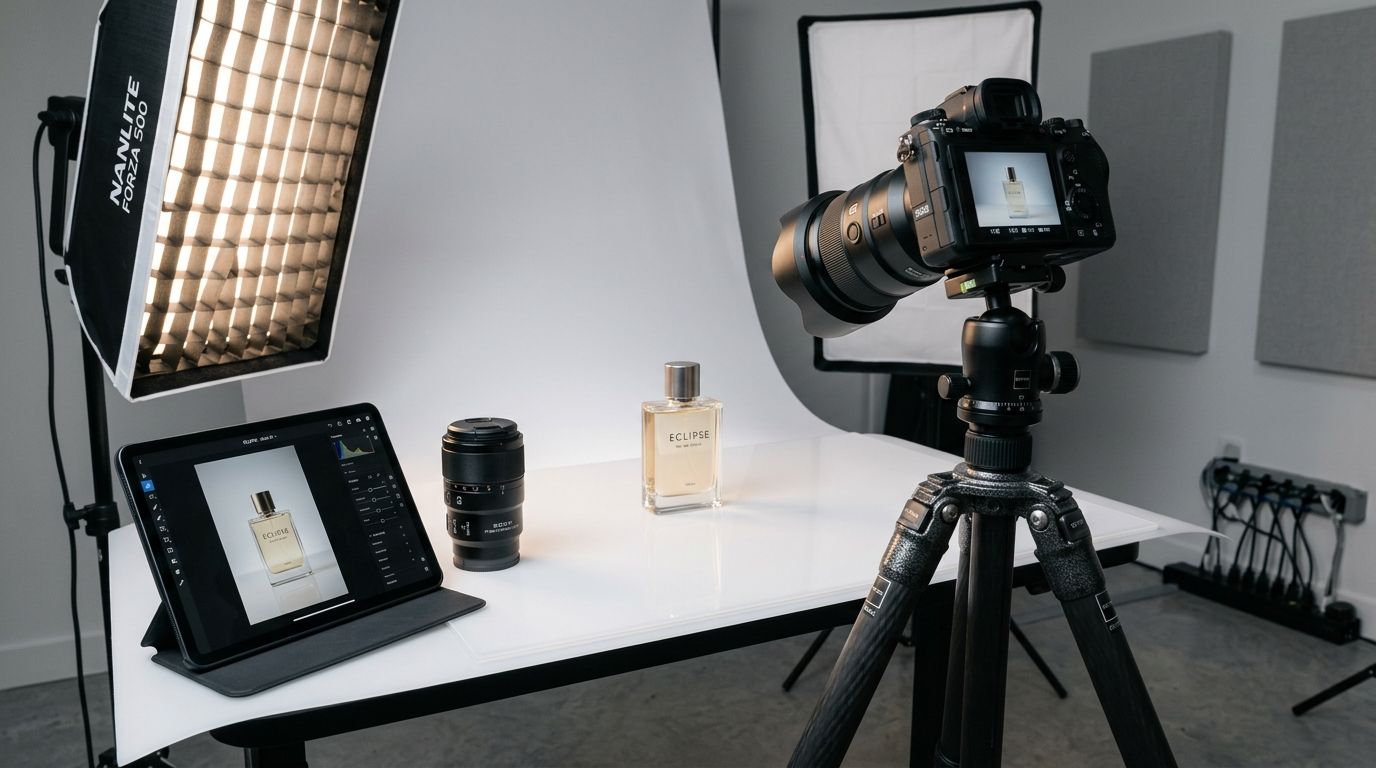
Camera equipment for product photography
You do not need a $5,000 medium format camera to shoot standard products. A mid-range full-frame mirrorless camera for product photography is the baseline standard today. The Sony A7IV or Canon R6 will serve you perfectly. They provide enough resolution for deep cropping and tether seamlessly to capture software like Capture One.
(To be clear: if you are selling highly technical jewelry that requires macro focus stacking to show micro-textures on a diamond, building a heavy-duty studio is mandatory. For standard apparel, cosmetics, or consumer packaged goods, owning the gear quickly becomes an operational liability.)
The critical requirement for professional lenses
The camera body simply records the light. The lens determines how your product is rendered. You cannot use the kit lens that comes in the box. Wide-angle lenses distort geometry, making the front of a sneaker look massive while the heel tapers away to nothing.
A dedicated lens for product photography must compress the image to show accurate proportions. You need a prime lens, typically a 90mm or 100mm macro. These lenses allow you to get incredibly close to the product while keeping the physical lines straight. A high-quality macro lens will cost between $1,000 and $1,500. It is a non-negotiable expense.
Lighting equipment ecommerce brands actually need
Natural window light is completely unreliable for scaling a catalog. It changes color temperature every ten minutes. If you want a consistent look across forty SKUs, you need controlled strobes. To get an entire product in focus from front to back, photographers shoot at very narrow apertures, typically f/11 or f/16. This requires an immense amount of light output.
Investing in a reliable ecommerce lighting setup means buying at least two 400-watt studio strobes. You also need wireless triggers to fire them, plus modifiers. Modifiers shape the light. Bare strobes create harsh, ugly shadows. You need large softboxes, grids to direct the beam, and bounce cards to fill in the dark spots. Lighting is heavily reliant on physics. You cannot cheat the requirement for power and diffusion.
Grip, tripods, and photography backdrop equipment
This is the category founders always forget to budget for. Product photography gear is heavy. You cannot put a $1,000 strobe and a heavy modifier on a cheap aluminum light stand from Amazon. It will tip over and shatter your equipment. You need steel C-stands. You need sandbags to weigh them down.
Tripod product photography demands rigid stability. If the camera moves even one millimeter between shots, you cannot effectively composite images in Photoshop later. A geared tripod head and heavy carbon fiber legs are required. Furthermore, photography backdrop equipment requires serious floor space. A standard roll of seamless paper is nine feet wide. You need heavy-duty stands to hold it up. This physical footprint is exactly why the debate between a home vs. studio setup often ends the moment someone tries to deploy a full seamless backdrop in a spare bedroom.
The Total Cost of Ownership: Build vs. Buy
We need to frame photography tools as an investment with a specific depreciation schedule. Camera gear loses value. Studio space costs rent every month. Below is the realistic three-year view of setting up an internal studio versus utilizing AI image generation.
| Comparison Metric | Traditional Studio | CherryShot AI |
|---|---|---|
| Initial Capital | $4,500+ | $0 |
| Physical Space | 150+ sq ft | None |
| Production Speed | Hours per batch | Minutes per batch |
| Operating Cost | Staff + Depreciation | Low Monthly Subscription |
Why AI product photography changes the math
Any brand still running a full studio shoot for standard catalog images in 2026 is paying for logistics, not quality. When you maintain a physical product photography equipment list, you manage firmware updates, broken sync cables, dust on camera sensors, and dead batteries. You pay an employee to stand in a room adjusting light stands instead of working on growth strategies.
AI software completely bypasses the hardware bottleneck. Instead of researching which macro lens has the least barrel distortion, you simply snap a clear reference photo of your product. Upload that image to CherryShot AI, select a visual mode like Classic, Luxury, or Magazine, and the platform generates campaign-ready photos in minutes.
There is a trade-off. If you have a proprietary metallic fabric weave that bends light in a way the world has never seen, an AI model might not capture the exact microscopic physics of that thread. You still need a human photographer for that hyper-specific hero shot. But for the other 90% of your visual assets, the daily social posts, the catalog variants, the email headers, owning physical gear is financial dead weight.
When you eliminate the cost and physical bulk of a full equipment closet, the bottleneck shifts from production scheduling directly to creative ideas. You can test ten different backgrounds in an afternoon for the cost of a cup of coffee.
Streamline your product imagery production today
Audit your existing product page images and consider how much time your team spends on manual studio tasks. Moving to an AI-based workflow reduces overhead and speeds up the time it takes to get products online.
Try CherryShot AIKey Takeaways
- The camera body is only a fraction of studio costs; lenses, strobes, and grip gear represent the real financial burden.
- Kit lenses distort product dimensions; a professional 90mm or 100mm macro lens is essential for accurate representation.
- Continuous window light is inconsistent; commercial photography requires high-powered strobes to shoot at narrow apertures.
- AI product photography eliminates physical hardware costs entirely, dropping the per-image production rate to under $5.
Frequently Asked Questions
What camera do I need for product photography?
A mid-range mirrorless camera like the Sony A7 series or Canon R series is the current industry standard. These camera bodies are significantly less critical than the lens and lighting. Any modern digital camera with interchangeable lenses, manual exposure settings, and raw image capture capabilities will produce sharp results for standard ecommerce requirements. Dedicated settings provide the level of control necessary for high-quality product assets.
Do I need a professional lens for product photos?
Yes, specialized optics are required. Basic kit lenses introduce chromatic aberration and barrel distortion, which subtly changes the shape of your product. High-end product photography requires crisp edges and highly accurate dimensional proportions. A 50mm prime lens or a 90mm macro lens ensures consistent sharpness across the entire frame. These lenses maintain accurate product representation without distorting the actual geometry of your items.
What lighting equipment is best for product photography?
High-powered strobes paired with large diffusion modifiers are the industry standard. While continuous LED lighting is popular for video content, it often lacks the sheer power needed to shoot at narrow apertures like f/11. This depth of field is required for keeping a product entirely in focus. A proper setup necessitates at least two lights, professional softboxes, and bounce reflectors to manage light quality effectively.
How much does a product photography setup cost?
A functional basic setup runs between $3,000 and $5,000. This baseline includes a mid-range camera body, one professional macro lens, two studio strobes, heavy-duty light stands, light modifiers, a highly stable tripod, and seamless paper backgrounds. High-end setups for complex product reflections scale past $15,000 very quickly. Initial investment in physical equipment remains high regardless of the specific brand names you choose for your studio.
Can I do product photography with a smartphone?
Yes, but only under highly controlled lighting conditions. Modern smartphones possess excellent sensors, but computational photography algorithms often create artificial depth of field that blurs critical product edges. It functions well for casual social media content, but struggles to produce the pure white backgrounds required for standard catalog marketplace listings. Professional results require the hardware controls found in dedicated mirrorless or DSLR camera systems.
Speed is the ultimate advantage in modern retail. Building a massive studio creates a rigid process that slows down every launch. By replacing your physical photography equipment list with CherryShot AI, you remove the heavy lifting of logistics and get back to selling.