Product Image Quality as a Trust Signal
Shoppers do not read your about page to decide if they trust you. They look at your hero image. If the lighting is flat and the edges are blurry, they assume the product is cheap and your customer service is nonexistent. Product image quality is the fastest trust signal in ecommerce. It proves you have the resources to present your brand professionally before the customer even scrolls down to the reviews.
Definition
Product image quality refers to the clarity, lighting, and consistency of the photos used to sell items online. In ecommerce, these visuals act as a proxy for physical inspection, helping buyers assess the legitimacy of the brand and the value of the goods. When photos look professional, customers naturally assume the business operations and product materials meet the same high standard.
Visual credibility is the hardest trust signal to fake. You can install a secure checkout widget in thirty seconds. You can write a compelling brand story in an hour. You cannot easily fake the crisp lighting, perfect shadows, and high image resolution that define a premium brand.
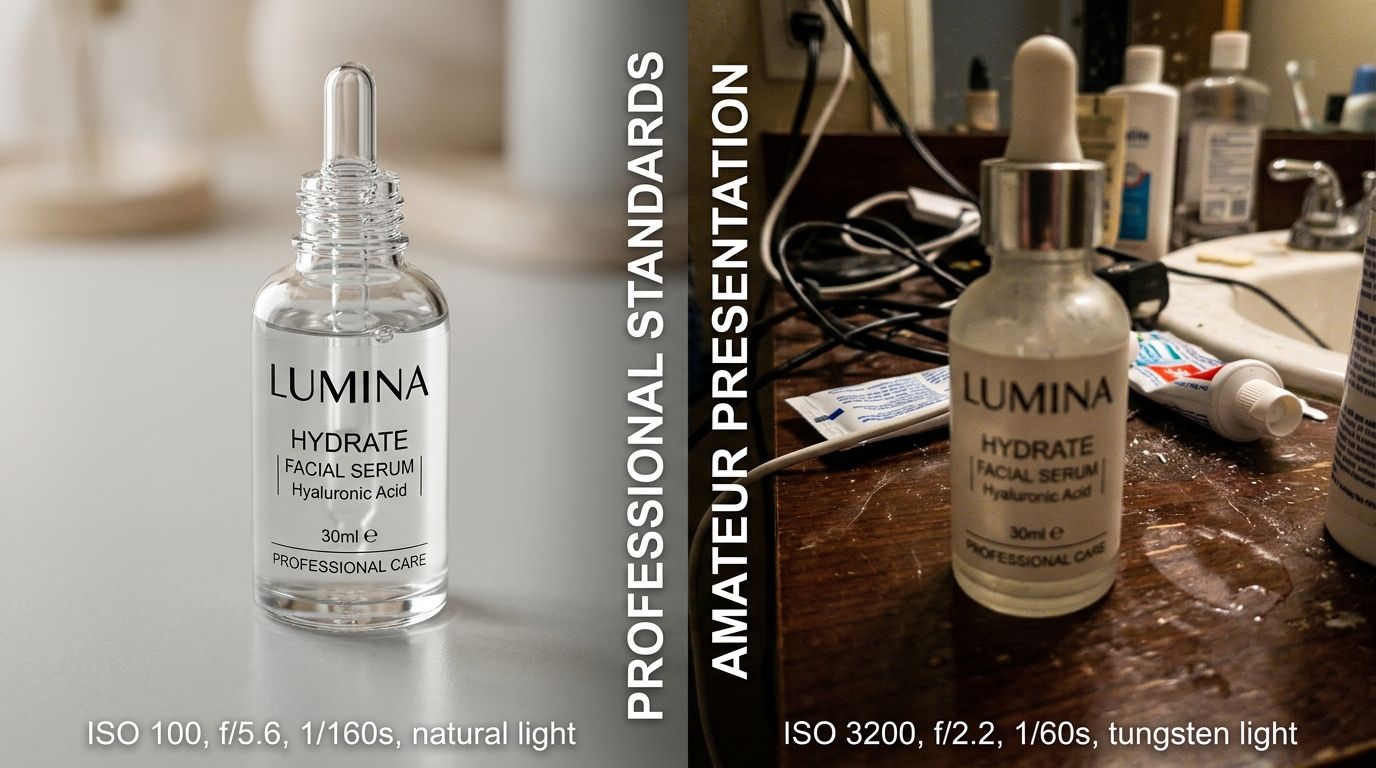 High-quality lighting tells shoppers you run a legitimate business before they read a single word of copy.
(Worth noting: high quality product photos will not save a bad product. If the actual item falls apart after one use, your return rate will bury you regardless of how beautiful the lifestyle shots look.)
Why your photos speak louder than your trust badges
When I ran my first apparel brand, we obsessed over secure checkout badges. We added guarantee icons under the add-to-cart button. We wrote lengthy policies about our hassle-free returns. None of it moved the needle until we finally stopped shooting flat lays on an iPhone and invested in proper lighting.
Shoppers tie product images to brand credibility within milliseconds. They have been trained by years of online shopping to recognize the subtle visual cues that separate a real company from a fly-by-night operation. When someone clicks on your ad and lands on your product page, they are silently looking for a reason to leave. A poorly lit, grainy photo gives them that reason instantly.
If you want to fix a cheap-looking brand, you have to start with your visual assets. You cannot convince a customer you sell premium goods if your photography looks like a garage sale listing.
The psychology of a visual first impression
We rely heavily on visual shortcuts to make decisions. In a physical retail store, those shortcuts are the window display, the flooring, and the lighting. If a store has flickering fluorescent lights and items piled randomly on plastic tables, you adjust your price expectations downward. You expect a discount.
In ecommerce, the photo is the store window, the flooring, and the lighting combined. The relationship between high quality product photos and conversion is linear. When the image is perfectly crisp, professionally styled, and generously sized, the customer subconsciously assumes the back-end operations are equally polished. They assume the item will ship on time. They assume the fabric will feel soft. They assume the company will answer their emails.
This is exactly why using product image quality as a trust signal in ecommerce works. The shopper extends the quality of the image to the quality of the entire business.
The dropshipping aesthetic is killing your conversion rate
Over the last decade, consumers have been burned by social media ads selling cheap products using stolen or generic photos. They order a beautiful jacket they saw on Instagram, and three weeks later, they receive a plastic-feeling replica in a crushed mailer.
Because of this, buyers have developed an intense, subconscious filter. They look for the "dropshipping aesthetic." This aesthetic is characterized by inconsistent background grays, unnatural drop shadows, and low image resolution. If your catalog page features twenty items and they all look like they were photographed in different rooms under different light bulbs, the customer assumes you do not actually hold your own inventory.
Lighting quality tells the truth
Lighting is the biggest differentiator. Flat, direct flash washes out texture and makes materials look like cheap plastic. Professional lighting creates depth. It highlights the grain of leather, the weave of cotton, and the curve of glass.
Building professional product photography trust starts with eliminating those harsh, amateur shadows. When a customer sees soft, directional lighting that gives the product three dimensions, they relax. The hidden costs of bad photography stretch far beyond a low add-to-cart rate. Bad photography forces you to spend more on customer acquisition just to convince skeptical buyers that your brand is legitimate.
Breaking down the core elements of brand credibility in imagery
Not all photos are created equal, even if they are technically in focus. To truly leverage product image quality as a trust signal, you have to nail three specific elements on every single product page.
First is the hero image. The hero image carries the majority of the conversion weight. It is the thumbnail in the catalog, the preview in the cart, and the first thing the user sees above the fold. It needs to be distraction-free.
Second is the contextual lifestyle shot. A white background shot tells the buyer exactly what they are getting, but a lifestyle shot proves the product exists in the real world. A coffee mug on a plain background shows the shape. A coffee mug on a marble counter bathed in morning sunlight creates desire.
Image resolution and the zoom test
The third element is image resolution. We call this the zoom test. Most mobile shoppers will instinctively pinch to zoom on your hero image. They want to inspect the stitching. They want to read the tiny text on the label.
If they zoom in and the image immediately blurs into a mess of pixels, trust vanishes. The customer assumes you are hiding poor craftsmanship. High image resolution tells the buyer you have nothing to hide. It is a bold statement of confidence in your own product. Once a customer makes a purchase, they compare the physical item to the digital promise. We have seen exactly how photos affect returns when that promise is broken by blurry, inaccurate imagery.
The modern cost of professional product photography
For years, founders were stuck between two terrible options. They could either shoot everything themselves on a phone and suffer the conversion penalties of looking cheap, or they could spend thousands of dollars on a traditional studio shoot.
I have personally sat through studio shoots that ran four hours over schedule. I have argued with freelance photographers about whether the angle on a sneaker was close enough to match the rest of the catalog. When you factor in studio rentals, stylist day rates, and post-production retouching, the cost of a finished image easily climbs past $100. For a brand launching twenty new SKUs a month, the math simply does not work anymore.
| Production Method | Average Turnaround | Per-Image Cost |
|---|---|---|
| Traditional Studio Shoot | 2 to 3 weeks | Over $100 |
| AI Photography Generation | Same day | Under $5 |
Shifting from logistics to strategy
AI product photography changes that math completely. You no longer have to delay a product launch by three weeks just because your photographer got sick.
Upload a product image, select a visual mode like Minimalist or Magazine, and CherryShot AI gives you campaign-ready photos in minutes. The per-image cost drops to under $5. Instead of fighting over a slightly underexposed hero image, you just generate a new one. The turnaround goes from weeks to an afternoon.
This is less about replacing photographers entirely and more about eliminating the scheduling dependency that strangles ecommerce growth. A brilliant photographer still makes sense for major seasonal brand campaigns. For standard catalog volume and colorway updates, paying for logistics instead of quality is a massive waste of margin.
When you can generate high-end imagery on demand, the bottleneck shifts from production to ideas. You can split-test different lifestyle backgrounds to see which one converts better. You can finally present your brand with the visual credibility it deserves, without burning through your entire marketing budget before the product even goes live.
Key Takeaways
- Your hero image is the fastest and most critical trust signal on your website.
- Inconsistent lighting and low resolution immediately trigger skepticism in modern consumers.
- High image resolution proves you have nothing to hide from your buyers.
- AI tools eliminate the massive logistical costs of professional catalog photography.
Frequently Asked Questions
Does product image quality really affect customer trust?
Yes, product image quality acts as the primary trust signal for any ecommerce store. Shoppers who cannot physically touch an item rely entirely on visual cues to evaluate both the merchandise and the legitimacy of the business behind it. Poor lighting and low resolution immediately suggest a lack of professionalism, prompting potential buyers to exit the page before they even read your product description.
How much does product photo quality affect ecommerce conversion?
Photography quality serves as the single largest variable you can control to influence add-to-cart rates. Many brands experience double-digit conversion increases simply by replacing flat, amateur shots with properly lit, professional assets. The main hero image carries the majority of this weight because its clarity dictates whether a skeptical browser decides to scroll down and explore the rest of your product page.
What is the minimum product photo quality needed for ecommerce trust?
Your visual assets must maintain a crisp resolution that survives the mobile pinch-to-zoom test without any visible pixelation or artifacting. Accurate color representation and deliberate background choices are necessary to set correct expectations for the buyer and prove your operational competence. A clean, well-lit white background shot provides far more commercial credibility than a cluttered lifestyle photograph suffering from harsh, distracting flash shadows.
How do shoppers use product image quality to judge brand credibility?
Shoppers actively scan visual assets for consistency and polish to verify they are buying from a real company. Catalogs featuring dozens of items with varying background shades or inconsistent lighting angles immediately look like a disjointed dropshipping operation. Standardized lighting, uniform image resolution, and cohesive styling reassure the buyer that a dedicated team is managing the brand and handling the inventory.
Stop losing margin to easily preventable trust issues. Once your photos accurately reflect the quality of your brand, the rest of your marketing funnel actually gets a chance to do its job.
Audit your current catalog images against the zoom test
Open your product page on a mobile device right now and pinch to zoom on your main hero image. If the fabric or materials blur into pixels, you are actively losing skeptical buyers. Use AI generation to replace those assets with crisp, campaign-ready visuals before your next major traffic push.
Try CherryShot AI