Product Photography Angles for Ecommerce: 6 Essential Shots
Every successful ecommerce product page answers the exact same set of unspoken questions. A buyer needs to know what the item looks like, how big it actually is, and whether the material feels cheap. The best product photography angles for ecommerce do not exist just to make the page look pretty. They exist to systematically dismantle hesitation. If your product gallery only features two front-facing shots on a white background, you are forcing the customer to guess. Guessing kills conversion.
Definition
Product photography angles refer to the specific camera positions and perspectives used to capture an item for online sale. An effective ecommerce gallery uses a strategic sequence of these viewpoints to communicate size, texture, and function, entirely replacing the physical experience of holding an item in a store.
Most brands waste valuable real estate in their image carousel on repetitive variations of the exact same perspective. Six unique product photography angles that provide completely different information will always outsell twelve photos that show the exact same front view.
I have sat in dark studios for hours arguing with freelance photographers about whether a rotation was fifteen degrees or forty-five degrees. We were not being pedantic. We knew the data. When a customer cannot understand the depth or physical footprint of a product, they either bounce or they buy it just to see it in person. Both outcomes destroy your margin.
The Anatomy of a High-Converting Product Gallery
A product gallery is a sequence. The customer clicks the main image from the category page, lands on the product detail page, and immediately starts swiping through the carousel. Each image needs to do a specific job. If you just dump six random freelance photos into the listing, you break the sequence.
Understanding what makes product photos convert requires looking beyond simple exposure and lighting. It is about information architecture. The sequence below outlines the exact six essential product photography shots every physical product needs to maximize trust and minimize returns.
1. The Straight-On Front Angle
This is the anchor. The front angle is almost always your hero image on the collection page grid. It needs to be perfectly centered, evenly lit, and free from heavy shadows. Its entire job is to earn the click. The customer is scanning a grid of thirty products, and your front angle needs to communicate the silhouette and core colorway in less than half a second.
Do not get creative here. A clean white or light gray background works best. Let the product do the talking. Creativity in the hero shot usually just creates visual clutter that confuses the eye when scaled down on a mobile screen.
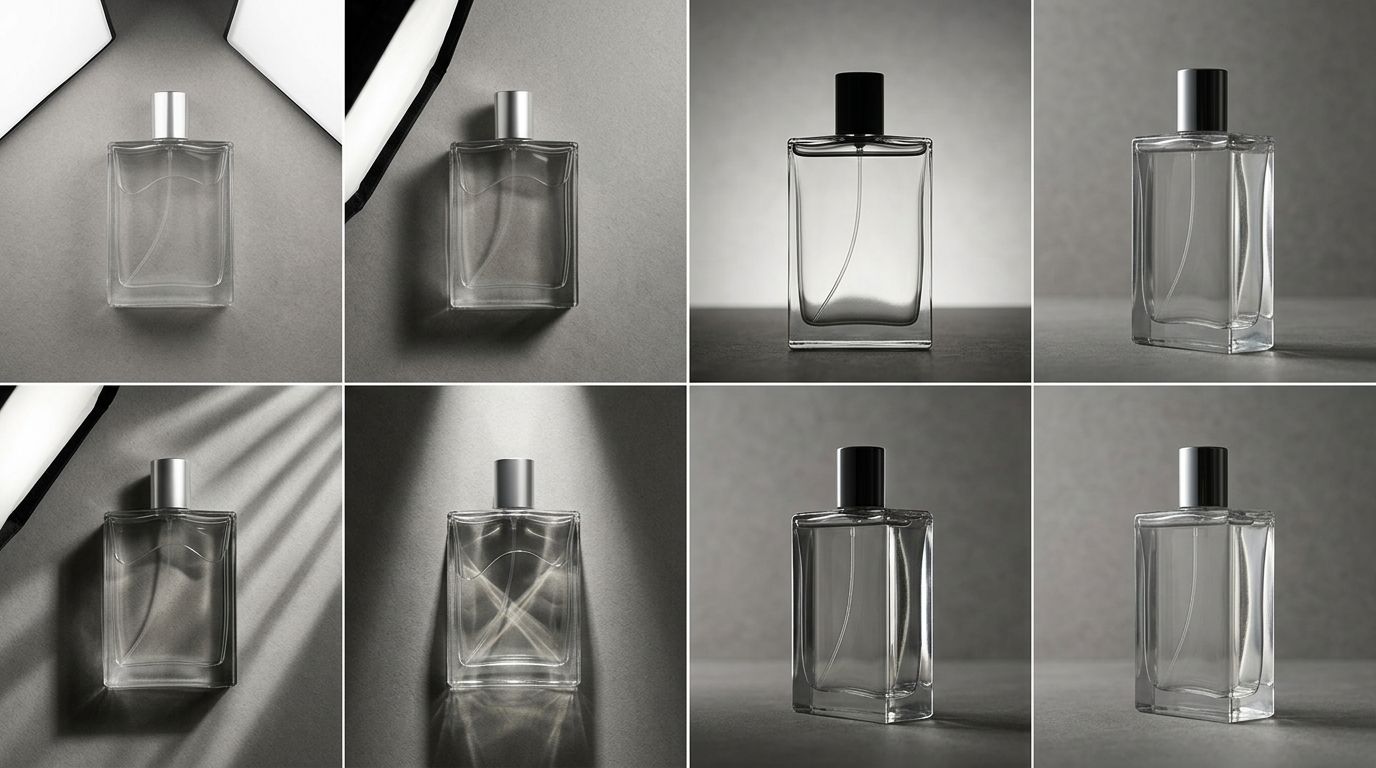
A diverse six-image sequence answers the buyer's unspoken questions faster than a block of copy ever could.
2. The 45-Degree Angle
If the front angle earns the click, the 45-degree angle earns the comprehension. A straight-on photo flattens an object. It removes depth entirely. The 45-degree angle shows the front and the side simultaneously, instantly communicating the volume and shape of the item.
For footwear, this angle shows the toe box and the profile at the same time. For furniture, it shows the seat depth and the armrest construction. You will find that customers frequently pause on this image longer than the hero shot because it provides the most three-dimensional understanding of what they are about to buy.
3. The Extreme Detail and Texture Shot
In a physical retail store, a customer picks up a shirt and rubs the fabric between their fingers. They inspect the stitching on a leather bag. They look closely at the matte finish of a ceramics piece. Online, your detail shot replaces that tactile experience.
You need to move the camera uncomfortably close. Show the grain of the leather. Show the metallic sheen of the zipper. Show the actual texture of the face cream. When you skip the texture shot, the buyer assumes you are hiding cheap manufacturing. An extreme close-up acts as a subtle proof of quality.
4. The Real-World Scale Shot
You can list the dimensions in the product description all day long. Nobody reads them. Customers are remarkably bad at estimating size from a white background photo. If you sell a ceramic mug, a buyer might open the box and feel disappointed that it looks tiny, even if the ounce capacity was clearly stated in the bullet points.
The scale shot is the ultimate expectation setter. Show a hand holding the bottle. Place a standard smartphone next to the handbag. Put the desk lamp on an actual desk next to a laptop. This visual context single-handedly prevents a massive category of negative reviews.
Poor imagery is the leading driver of preventable returns. How product photos affect your ecommerce return rate is a topic every operations team should review, because the lack of a simple scale shot often hides right in the middle of your margin erosion.
5. The Lifestyle In-Use Shot
The first four angles prove the product is real. The lifestyle shot proves the product is desirable. This is where you inject brand identity. A premium coffee machine looks great on a white backdrop, but it looks irresistible sitting on a marble countertop with morning light streaming through a window.
The in-use shot provides the aspirational context that pushes a rational browser into an emotional buyer. They project themselves into the scene. They imagine their own life looking just a bit more polished if they own the item.
6. The Packaging Shot
Many brands completely ignore the packaging shot, considering it a waste of a gallery slot. This is a mistake, especially for products frequently given as gifts. A clean photo showing the product resting next to its premium unboxing experience validates the price tag.
It tells the customer exactly what will show up on their porch. It removes the final layer of uncertainty right before they click the checkout button.
The Financial Reality of Capturing Every Angle
Knowing you need six unique product photography angles is easy. Paying for them is hard. A traditional studio shoot charges by the hour or by the finished image. When you multiply six distinct setups across fifty new SKUs, the logistics become a nightmare. The invoice is not just the photographer. It is the studio rental, the prop stylist, the lighting changes between the macro texture shot and the wide lifestyle shot, and the three weeks of waiting.
Most founders eventually calculate the true cost of studio photography per SKU and realize they are paying somewhere between $80 and $200 per finished image. To get a full six-image gallery for a single product, you are looking at hundreds of dollars in visual production costs before you even sell a single unit.
| Production Method | Cost per SKU (Full Gallery) | Turnaround Time |
|---|---|---|
| Traditional Studio Shoot | $80 - $200+ | 2 to 3 weeks |
| CherryShot AI Generation | Under $5.00 | Under 10 minutes |
(Worth noting: this traditional approach is absolutely still required for high-end fashion hero campaigns where you need specific human models moving in very specific ways. For standard ecommerce catalog volume, however, the old agency model simply does not make mathematical sense anymore.)
This bottleneck is exactly why we built CherryShot AI. Brands should not have to compromise on their gallery completeness just because a studio day ran over schedule. You upload a basic product image, select a visual mode like Lifestyle or Minimalist, and CherryShot AI generates campaign-ready photos in minutes. The per-image cost drops from eighty dollars to under five dollars. You can generate the front angle, the 45-degree angle, and the in-use context shot before your afternoon coffee gets cold.
When you remove the scheduling friction of a freelance photographer, you can finally build out the full gallery your product actually deserves. You can even run tests to see which angles hold attention longest. When brands A/B test product photos against each other, they almost always find that galleries featuring a clear scale shot and a distinct 45-degree angle drive significantly higher add-to-cart rates.
Stop publishing lazy product galleries. Every empty image slot is a missed opportunity to answer a customer objection. Get the six essential shots, put them in front of your buyers, and watch your conversion rate stabilize.
Frequently Asked Questions
What photography angles should every product have?
Every ecommerce product requires a straight-on front angle, a 45-degree depth view, a macro texture shot, a real-world scale reference, an in-use lifestyle scene, and a packaging view. This specific sequence anticipates the primary visual information gaps a buyer experiences online. Capturing these exact six frames ensures customers never have to guess about dimensions or material quality before they click the checkout button.
What is the best angle for ecommerce product photos?
The straight-on front angle shot against a pure white background serves as the most effective primary listing image. A clean front view communicates the core silhouette and colorway faster than any other perspective. Use this angle exclusively for your hero image to secure the initial click from a crowded category page, relying on your supplementary gallery images to handle the complex work of final conversion.
Why do multiple photography angles increase conversion?
Presenting multiple unique photography angles systematically eliminates the hesitation caused by shopping exclusively through a digital screen. A prospective customer cannot physically pick up your item to inspect its weight, feel, or construction quality. Publishing a diverse image gallery that explicitly includes depth variations, macro texture views, and concrete scale references provides the exact visual proof required to confidently replace the traditional retail evaluation process.
Which product photography angle is most important for conversion?
The scale shot often acts as the single most critical angle for finalizing conversions and preventing post-purchase returns. Consumers consistently fail to accurately estimate physical dimensions when looking at an isolated object on a blank background. Placing your product directly next to a universally recognizable item or within a human hand provides the immediate spatial context needed to align expectations with reality.
Key Takeaways
- A complete six-image gallery sequences visual information to eliminate buyer guesswork.
- The front angle earns the initial click, but the 45-degree angle builds shape comprehension.
- Scale shots provide necessary visual context that prevents negative reviews regarding product size.
- AI product photography reduces the per-image cost of building a full catalog gallery from hundreds of dollars to under five dollars.
If you are still waiting weeks for a freelance photographer to deliver basic catalog angles, you are wasting time and burning cash. Give CherryShot AI a try, upload a basic product image, and generate the full suite of angles your product page needs to actually perform.
Audit your product page galleries today
Open your top three best-selling products on your phone right now and count the unique angles. If you are missing scale shots or macro texture details, you are losing sales to preventable hesitation. Use CherryShot AI to instantly generate those missing shots without booking another expensive studio day.
Try CherryShot AI