Skincare Packaging Photography: Standards That Sell Premium Brands
If you are charging eighty dollars for a vitamin C serum, your product photography needs to look like it costs eighty dollars. Too many independent skincare brands formulate an incredible product, source custom heavy-base glass packaging, and then launch with photos that make it look like a drugstore knockoff. Skincare packaging photography is the only translation of your brand's physical weight, texture, and prestige into a digital environment. When your visuals look cheap, your customer immediately assumes the formula is cheap.
Definition
Skincare packaging photography is the specialized practice of capturing bottles, jars, and tubes to accurately communicate their physical weight, texture, and price point. It relies heavily on precise light manipulation, shadow control, and contextual styling to differentiate premium formulas from mass-market cosmetics in a digital environment.
The gap between the physical reality of a premium skincare line and its digital representation is where margin goes to die. You can spend twelve months perfecting a frosted glass bottle with a custom weighted pump. When a customer holds it in a boutique, the heft of the glass does the selling for you. Online, light and shadow have to do that exact same job. If your photographer uses flat catalog lighting that strips away the shadows, that custom glass suddenly looks identical to hollow plastic.
If your traffic is high but your conversion rate is abysmal, your visuals are likely communicating the wrong price tier. Seeing how product images losing conversion interact with buyer psychology helps diagnose exactly where the drop-off happens. Usually, it happens the second the customer looks closely at the hero image and sees a sloppy reflection or a lack of sharp contrast.
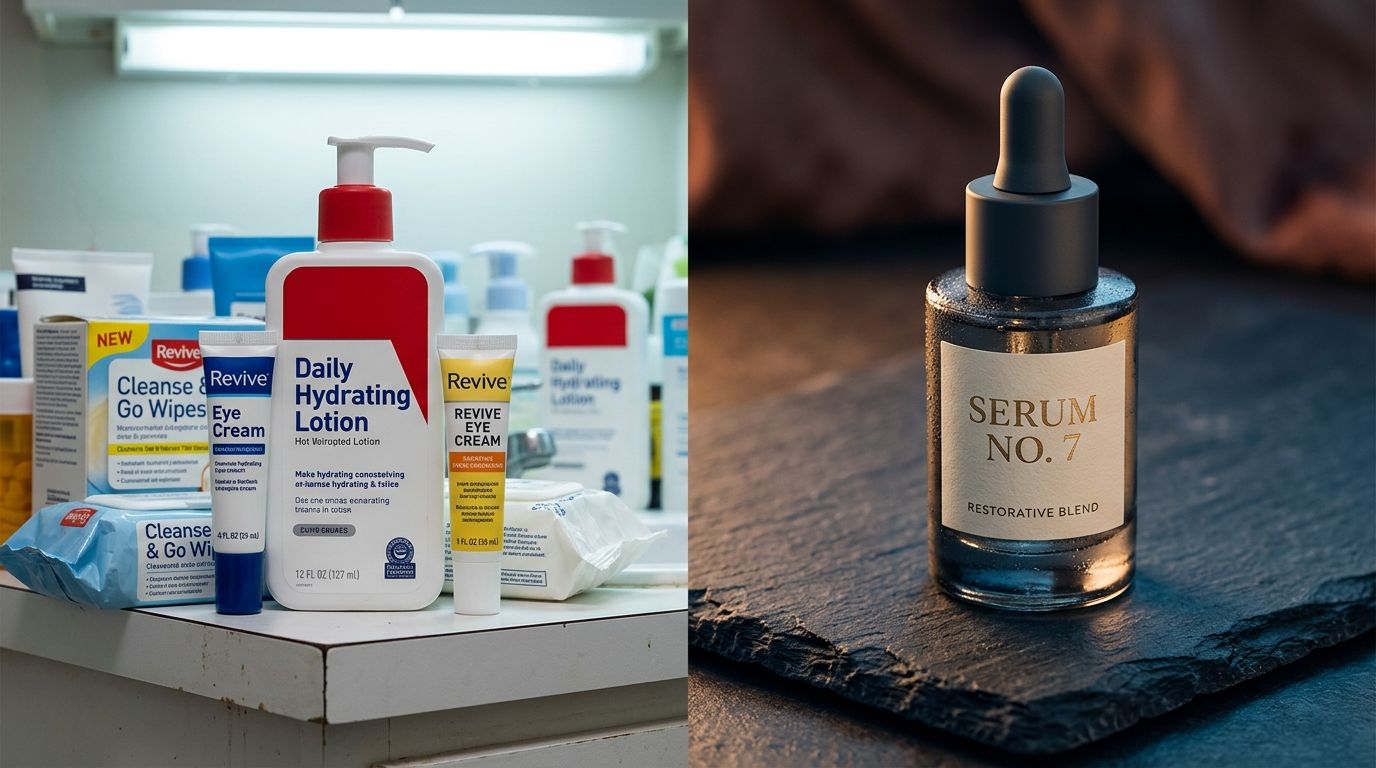
The Disconnect Between Price Tags and Pixels
The luxury perception gap
Premium skincare product photography is an exercise in manipulation. The goal is not just to document what the product looks like, but to dictate how the product feels. The moment you place a product on a pure white background and blast it with two softboxes, you remove all context. You remove the environment. You remove the mood. You are left with a sterile record of a container.
Luxury relies on context. It requires environments that look expensive. Dark stone, brushed metals, shallow pools of water, acrylic blocks catching the light. These elements tell the brain that the item sitting on top of them is valuable. When a brand attempts to sell a high-ticket item using budget photography techniques, the friction is immediate. The customer looks at the eighty-dollar price tag, looks at the flat lighting, and decides the brand is not authentic.
Glass bottle photography skincare: Taming the reflections
Glass bottles and glossy plastic tubes are notoriously difficult to shoot. A glass bottle is essentially a curved mirror that reflects the entire room. If you do not control the light perfectly, the bottle will reflect the camera lens, the photographer, the windows, and the ceiling tiles.
To capture glass correctly, you have to light the environment around the bottle rather than pointing lights directly at the bottle itself. You use large white panels to create smooth, bright gradients that define the edges of the cylinder. Then you bring in black foam core boards just out of the frame to cut the light and create dark, crisp reflections that give the glass its characteristic sharp look. Getting this right requires a masterclass in light manipulation, and understanding the essential lighting setups is non-negotiable if you are running a physical studio.
Mastering Cosmetic Photography Light and Shadows
Cosmetic photography light for texture and weight
The biggest mistake in skincare brand photography is trying to eliminate all shadows. Shadows are what give an object volume. Without them, a round jar looks like a flat circle on a screen. Premium brands use hard, directional light to create distinct shadow lines that anchor the product to the surface it is resting on.
This is especially true for cosmetic packaging photography ecommerce grids. While hero images get the big budgets and creative direction, the catalog grid is where the actual purchasing decision happens. If your catalog grid consists of products floating in an unnatural white void without a drop shadow, the perceived value plummets. A subtle, realistic shadow cast to one side grounds the product in reality.
There is a specific luxury product photography technique called edge lighting. By placing a strobe behind and slightly to the side of the bottle, you carve out the silhouette of the packaging against a dark background. This makes the contours of the bottle snap into focus. It is aggressive, it is moody, and it looks highly expensive. It separates the premium tier from the mass market brands playing it safe with soft frontal lighting.
The Economics of High-End Skincare Brand Photography
The physical studio bottleneck
Any brand still running a full physical studio shoot for standard catalog images in 2026 is paying heavily for logistics. The invoice is not just the photographer. It is the studio rental, the prop stylist charging a day rate to source travertine slabs, the agonizing back-and-forth over exactly where a water droplet should sit on the bottle, and the heavy retouching bill. The final stage of professional product photo retouching can easily double the invoice because removing dust specks from macro glass photography takes hours of manual labor.
We need to admit a genuine trade-off here. A traditional studio shoot is still the absolute best option if you need highly bespoke physical interactions, like dropping a heavy glass bottle into a real tank of water to capture the exact physics of a splash at 1/8000th of a second. But for catalog volume, lifestyle scenes, and standard ecommerce grid imagery, the traditional model is too slow and too expensive. The math does not scale when you are launching three new SKUs every quarter.
AI product photography changes that dynamic. Upload a flat product image, select a visual mode like Luxury or Magazine, and CherryShot AI generates campaign-ready photos in minutes. The AI understands specular highlights. It understands how light wraps around a cylinder. The per-image cost drops to under $5, and the turnaround goes from three weeks to an afternoon.
| Production Method | Best Used For | Primary Constraint |
|---|---|---|
| Traditional Studio Shoot | Highly bespoke physical interactions like real water splashes | Expensive physical logistics and extensive manual retouching |
| AI Photography Generation | High-volume catalog grids and lifestyle environments | Requires a clean, well-lit flat product image as input |
(Worth noting: this is less about replacing your creative director and more about removing the execution bottleneck. When you can generate twenty concepts before lunch, your team spends more time refining the visual strategy and less time managing freelancer invoices and arguing about studio schedules.)
What Backgrounds Work for Luxury Skincare Photography?
The role of negative space
When you look at top-tier skincare brands, their visual standard is defined by what is missing. There is no clutter. There are no overly complex prop arrangements fighting the product for attention. The backgrounds used in luxury skincare photography are highly textured but minimal in composition. Travertine, raw concrete, dark slate, and rippled water are the standards because they offer rich organic texture without distraction.
Negative space is a luxury signal. Packing the frame tightly with props feels frantic and commercial. Leaving the product small in the frame, surrounded by expansive, beautifully lit stone or a deep shadow gradient, feels confident and premium. The styling choices directly impact perceived value. For most brands trying to level up, the solution is usually a matter of subtracting elements rather than adding them.
Frequently Asked Questions
How do I photograph skincare packaging for ecommerce?
Photographing skincare packaging requires prioritizing dimensional shape and surface texture over pure, flat brightness. Standard pure white background setups flatten the visual depth and destroy the perceived physical weight of custom premium materials. You must position hard directional light to cast sharp, anchoring shadows while simultaneously using large diffusion panels to wrap clean, defined specular highlights around cylindrical glass bottles for catalog grids.
What makes skincare photography look premium?
Premium skincare photography relies heavily on intentional contrast, sharp focus, and textured styling materials. Budget visuals wash out the product with flat lighting, whereas luxury aesthetics require hard, directional beams to cast dramatic, defined shadows across the frame. Photographers achieve this elevated look by incorporating significant negative space alongside architectural props like raw travertine, brushed steel, or thick acrylic blocks.
How do I photograph glass skincare bottles?
Photographing glass skincare bottles requires complete environmental control because the curved surface acts as a mirror for the entire room. Uncontrolled studio lighting results in distracting reflections of camera lenses, windows, or ceiling tiles across the packaging. You must position large diffusion panels to create soft white edge gradients, while placing black foam core boards just outside the frame to carve out dark, sharp edge reflections.
What backgrounds work for luxury skincare photography?
High-end skincare photography demands backgrounds that are either intensely textured or completely seamless with deep, rich tonal values. These organic surfaces create necessary friction and contrast against the highly polished, sterile look of glass or thick plastic packaging. You can elevate perceived brand value by placing products on raw travertine slabs, dark marble, brushed steel, or rough concrete while leaving plenty of negative space.
Can AI create luxury skincare product photography?
Artificial intelligence tools can now accurately replicate complex light interactions and reflections on glass and glossy plastics. Generating images synthetically removes the physical studio bottleneck and drastically reduces the cost of producing high-volume catalog assets. Brands upload a flat product photo into the software to automatically place their packaging onto marble countertops or water scenes with physically accurate shadow mapping.
Key Takeaways
- Your digital imagery must translate the physical weight and texture of your packaging to justify a premium price tag.
- Glass bottles require specific gradient lighting and negative fill to avoid looking like cheap hollow plastic.
- Premium positioning relies on high contrast, hard directional shadows, and intentional negative space.
- AI generation can replace traditional catalog shoots and reduce high-end image production costs to under $5 per asset.
If your formula belongs on the top shelf, your imagery cannot afford to look like the bargain bin. Upgrading your visual standards is the fastest way to eliminate price objections before the customer even reads your product description. To see how fast you can elevate your own catalog without booking a physical studio, explore CherryShot AI and generate your next campaign today.
Audit your product page lighting before your next launch
Evaluate your current ecommerce grid to see if flat lighting is actively destroying your perceived brand value. Upload a standard packaging photo to instantly generate high-contrast, premium lifestyle variations and test the difference in visual weight.
Try CherryShot AI