360 Product View for Ecommerce: How It Works & Production Cost
Any brand still paying for a 360 product view ecommerce setup for basic catalog items is prioritizing novelty over profit margin. You do not need a fully interactive product view to sell a standard cotton t-shirt. The production cost for a complete 360-degree spin often exceeds the lifetime profit of that specific SKU. Interactive product spins make sense for highly complex items where every viewing angle hides a crucial technical detail. For everything else, high-quality standard photography gets the job done faster and significantly cheaper.
Definition
A 360 product view is an interactive ecommerce feature that stitches together dozens of sequential photographs, allowing shoppers to manually rotate an item on their screen. This technique requires specialized turntable equipment and heavy post-production editing to create a smooth, continuous spinning effect.
Key Takeaways
- A 360 product view only increases conversion on complex items like watches, technical footwear, and premium hardware.
- The production cost per SKU for a full spin ranges from $80 to $250 due to specialized turntable logistics and frame stitching.
- Native support for 360 product images on Shopify is limited, often requiring third-party apps that can bloat your page load time.
- Generating standard catalog images through AI is faster and protects your profit margins on high-volume product launches.
What exactly is a 360 degree product photography setup?
You cannot just walk into a studio and shoot a product spin animation. It requires a specific workflow that traditional studios charge a massive premium to execute. The core of this process is the 360 photography turntable. The product is placed precisely in the center of an automated rotating platform. The camera is locked onto a heavy-duty tripod.
As the platform rotates, the camera fires automatically. A standard setup captures either twenty-four, thirty-six, or seventy-two distinct photos for a single rotation. Once the raw images are captured, the real bottleneck begins. A retoucher must ensure the lighting is perfectly even across every single frame. If a tiny spec of dust is visible in frame one, it must be removed from the subsequent thirty-five frames. Finally, specialized software stitches these flat images together into an interactive product view ecommerce shoppers can manipulate.
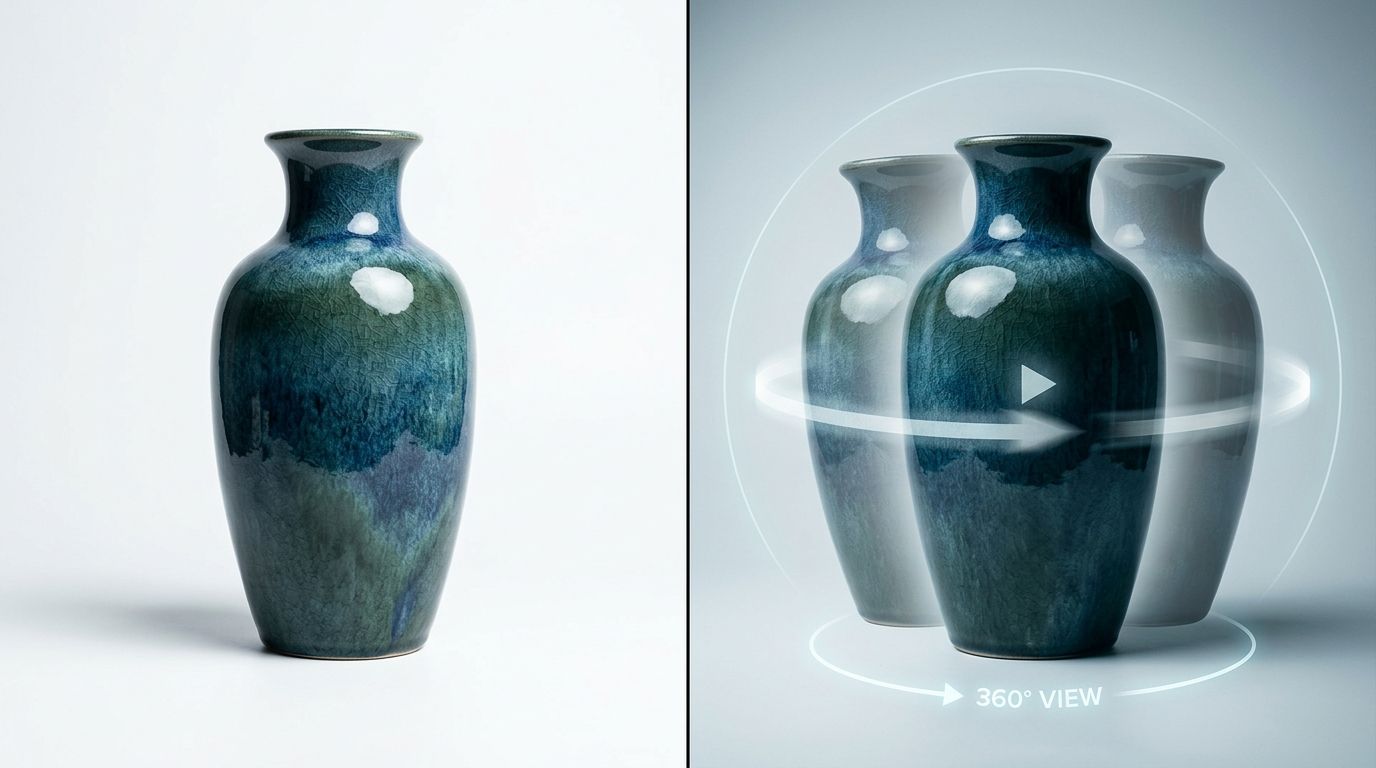
Interactive views require specialized turntable setups that heavily inflate the production timeline for standard catalog launches.
The friction of physical execution
This process is deeply fragile. A slight wobble of the table ruins the sequence. If the product has a glossy surface, the studio lights will reflect differently as the item spins. This creates blinding hotspots that the retoucher has to paint out manually. You are paying hourly for all of this manual correction. The invoice reflects the friction of the process rather than the value of the final asset.
Does a 360 product spin ecommerce feature actually increase conversion?
Yes. But the lift is highly dependent on what you are actually selling. Brands often make the mistake of treating their entire catalog equally when allocating photography budgets.
The product categories that justify the cost
Interactive spins excel when the viewing angle determines the purchase. Look at mechanical watches. A collector dropping a thousand dollars needs to see the thickness of the case, the finishing on the lugs, and the precise grip texture on the crown. Look at technical footwear. A runner needs to evaluate the aggressive tread pattern and the drop of the heel counter.
In these specific scenarios, a product 3d view ecommerce integration reduces buyer hesitation. If a customer cannot visually verify the construction of a high-ticket item, they will initiate a return the moment they open the box. Poor imagery is the leading driver of preventable logistics overhead. Exploring the connection between high return rates and product photography breaks down exactly where that cost hides in your margin.
The categories that do not
Now look at basic apparel. A 360 view of a standard crewneck sweater tells the buyer absolutely nothing they did not already gather from a single front-facing shot and a back shot. The side profile of a standard tote bag is just a thin seam. Paying a studio to document that seam in seventy-two frames is an absurd waste of capital.
Adding 360 product images to Shopify and other platforms
Getting the files from the retoucher is only the first hurdle. Deploying them effectively on your storefront is the second.
Native support versus third-party apps
Shopify natively supports 3D models and basic video files. However, deploying a true photographic product spin often requires leaning on the app ecosystem. These third-party applications host your image sequence on external servers and inject an iframe or JavaScript block directly into your product template.
This introduces a massive performance risk. A standard product image is roughly two hundred kilobytes. A seventy-two frame product spin is effectively forcing the browser to load seventy-two separate images simultaneously. This destroys your mobile load times. Heavy scripts delay the time to first byte, causing shoppers on cellular networks to abandon the page before the add-to-cart button even renders. Learning to optimise Shopify product page images for conversion is a required step before you ever consider adding heavy interactive elements.
The production math: 360 views versus high-quality flat photography
This is where the argument for widespread interactive photography falls apart entirely. You pay the studio day rate. You pay a specialized operator to run the hardware. You wait two weeks for the retoucher to clean up the sequence. The true cost usually lands around $150 per product. If you have three hundred SKUs launching next month, that is forty-five thousand dollars just to let a customer spin a shoe on their phone.
Most founders underestimate their actual visual content spend until they write the check. Calculating the real cost of product photography per SKU usually reveals a much bleaker picture than the original marketing budget suggested.
Shifting the workflow
AI product photography completely rewrites this formula. Instead of booking a studio and waiting three weeks for a spinning asset, you can upload a single flat product image into CherryShot AI. You select a visual mode, such as Classic or Minimalist, and generate campaign-ready photos in minutes. The per-image cost drops to under five dollars. The turnaround shifts from the end of the month to this afternoon.
(Worth noting: a full 360 spin still makes sense for a flagship hero product launching a new category. For the remaining ninety-five percent of your catalog volume, the math for traditional shoots simply does not work anymore.)
| Production Method | Cost Per SKU | Turnaround Time | Best Use Case |
|---|---|---|---|
| Traditional 360 Spin | $80 to $250+ | 2 to 3 weeks | High-ticket technical items |
| Standard Studio Shoot | $40 to $100 | 1 to 2 weeks | Apparel on models |
| CherryShot AI | Under $5 | Under 5 minutes | Catalog volume and staging |
When standard product photos convert better than a spin
Interactive features give complete control to the user. This sounds great in theory, but it often fails in practice. Sometimes you need to force the user to view the product exactly how the designer intended. A curated gallery of five static, perfectly lit images controls the pacing of the visual story.
Controlling the visual narrative
A buyer casually swiping through a spinning animation might miss the reinforced stitching entirely. A static macro shot forces them to look right at it. You dictate what is important. Speed and clarity win online. A fast-loading gallery that systematically answers common objections will routinely outperform a heavy interactive feature that the customer barely knows how to navigate.
Frequently Asked Questions
What is a 360 product view?
A 360 product view is an interactive digital element that lets online shoppers rotate a product on their screen. This visual feature mimics the physical experience of inspecting an item in a retail store. Studios capture this effect by mounting the item on a specialized automated turntable, shooting seventy-two sequential photographs at precise angles, and stitching the frames together using dedicated imaging software.
Does 360-degree product photography increase conversion?
Interactive spins only generate a meaningful increase in conversion rates for highly complex or expensive inventory. Shoppers require multiple viewing angles to build purchasing confidence when evaluating items with technical features hidden on the sides or back. A potential customer expects to closely inspect the heavy lug tread pattern and reinforced heel construction of a two hundred dollar hiking boot before completing checkout.
How do I add 360 product views to my Shopify store?
Adding a true photographic spin to Shopify requires installing a dedicated third-party application from the platform app store. Native platform tools only handle static images and 3D models, so external software is necessary to host the heavy sequential image files. Store owners must upload their final stitched photo sequences directly to the app dashboard and embed the generated Javascript snippet into their active theme files.
How much does 360 product photography cost?
Ecommerce brands typically spend between eighty and two hundred fifty dollars per finished interactive product spin. This expensive per-item rate covers the specialized commercial photographer, automated turntable equipment rental, active studio space, and significant manual post-production editing time. Skilled retouchers must carefully remove all surface dust particles and guarantee a pure white background across up to seventy-two individual image frames to prevent visual glitches during user rotation.
What products benefit most from 360 views?
Footwear, mechanical watches, luxury handbags, technical backpacks, and detailed hardware benefit the most from interactive product views. These specific product categories contain hidden spatial relationships and structural details that static front-facing photographs simply cannot capture. Customers need the ability to manually inspect complex metal clasps or verify the grain texture on the back of a premium leather item to finalize their purchase decision.
Visual interactivity should serve your conversion rate, never drain your production budget. Save the heavy logistics for the flagship items that demand them. For the rest of your catalog, CherryShot AI lets you generate the exact assets you need without paying for a studio you do not need.
Audit your product page visual strategy
Identify the complex, high-margin items in your inventory that truly justify the cost of interactive spinning assets. For the rest of your standard catalog, use CherryShot AI to rapidly generate clean static images that protect your margins.
Try CherryShot AI