Amazon Product Photography Requirements 2026: The Complete Compliance and Conversion Guide
Every time Amazon updates its seller guidelines, thousands of listings disappear overnight. If you want to know the core amazon product photography rules for 2026, the baseline is straightforward. Your main image must be on a pure white background. The product must fill exactly 85 percent of the frame. The file must be at least 1000 pixels on its longest side. You cannot use props, text, badges, or watermarks in that critical first slot.
Definition
Amazon product photography requirements are a strict set of technical specifications governing how items must be visually presented on the marketplace. These rules dictate everything from image resolution and background color to product-to-frame ratios. Compliance is mandatory for all sellers to maintain active listings and participate in search results.
I have watched brands lose tens of thousands of dollars during peak season because a freelance photographer thought an off-white background looked more natural. The algorithm does not care about art. The algorithm cares about compliance. If your hex code is #F8F8F8 instead of #FFFFFF, you are out of the search results.
I will readily admit that pure white backgrounds are rarely the most flattering way to present a product. It can feel clinical and stripped of context. But on Amazon, you optimize for the marketplace rules first and buyer psychology second. Getting this right used to require tedious clipping paths in Photoshop and expensive studio hours. Now, the tools have caught up to the problem.
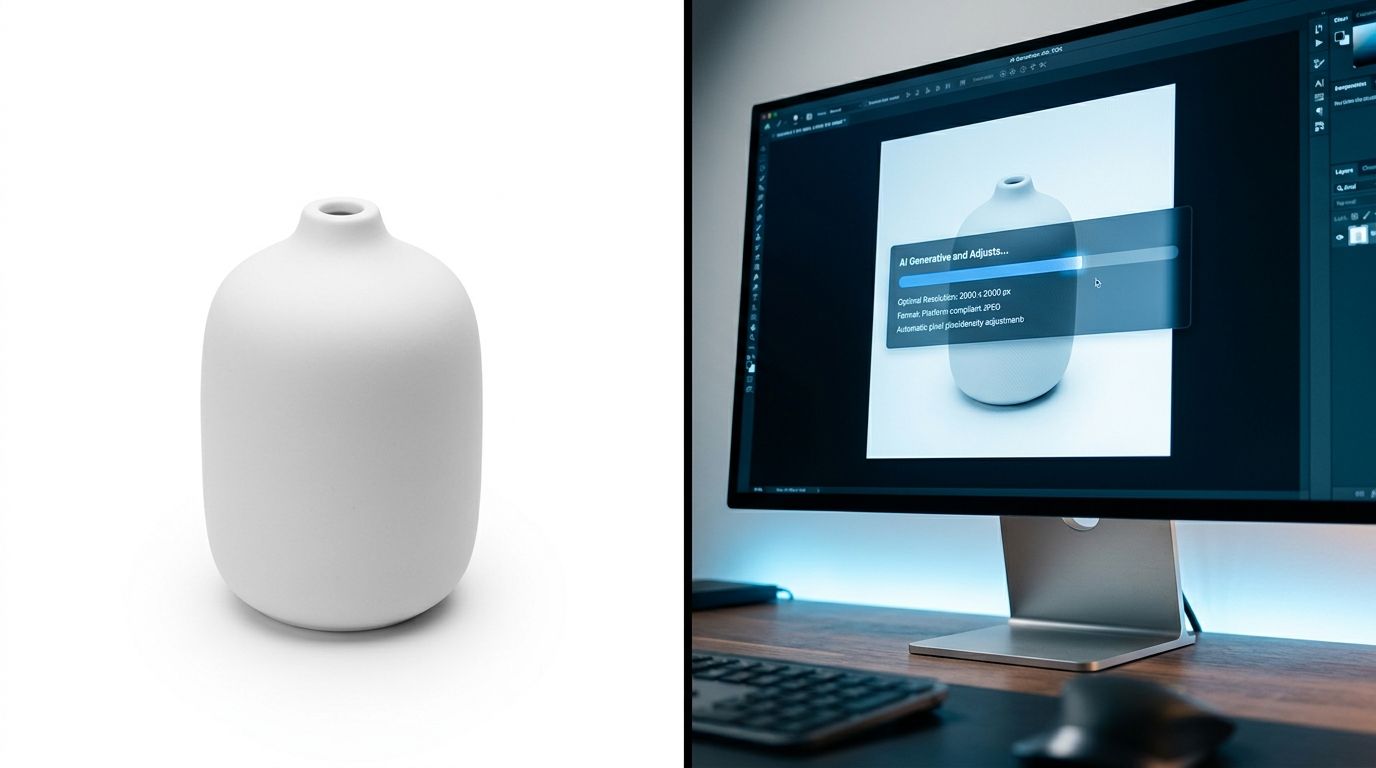
Amazon main image compliance requires absolute adherence to the pure white background rule to avoid listing suppression.
The Non-Negotiable Main Image Rules
The main image is the single most important asset in your ecommerce business. It determines your click-through rate. If nobody clicks from the search page, the rest of your listing optimization does not matter. Amazon strictly polices these main images using automated bots that scan every upload.
Pure White Means RGB 255
The amazon white background requirement is the leading cause of suppressed listings. When Amazon says pure white, they mean the absolute maximum brightness an RGB monitor can display. The color values must be exactly 255 for Red, 255 for Green, and 255 for Blue.
You cannot achieve this straight out of a camera. Even a brightly lit white sweep in a million-dollar studio will register as light gray in the corners. Every single main image must undergo post-processing to drop out the background entirely. If you are constantly fighting automated takedowns, reviewing main image compliance to avoid suppression is the fastest way to get your revenue flowing again.
Frame Constraints and Dimensions
Your product must fill a minimum of 85 percent of the image frame. Amazon instituted this rule to create a uniform visual experience on mobile devices. If you upload a tiny product floating in a massive sea of white space, mobile shoppers cannot see what they are buying.
For resolution, Amazon requires a minimum of 1000 pixels on the longest side to activate the hover-to-zoom feature. However, uploading exactly 1000 pixels is a mistake in 2026. High-density displays on modern phones demand better quality. You should be uploading images that are 1600 to 2000 pixels square. This provides the crispest zoom functionality, allowing buyers to inspect the physical texture of your product. You can dive deeper into the mathematics of these specs in our guide on complete image size specifications to ensure you never upload a blurry file again.
Secondary Images Where Conversions Actually Happen
Once a buyer clicks your main image, they enter your listing. The compliance rules loosen up entirely here. Secondary images do not need a white background. In fact, using white backgrounds for all your image slots is a massive missed opportunity. This is your visual sales pitch.
(Worth noting: Amazon allows up to nine images per listing, but only the first seven display on the main product page without requiring the user to click a gallery button. You need to pack your most persuasive arguments into those first seven slots.)
Building Trust with Lifestyle Context
Buyers need to see your product in the real world. If you sell a coffee maker, your secondary images should show it sitting on a modern kitchen counter with steam rising from a mug. If you sell hiking boots, the customer needs to see them covered in dirt on a mountain trail.
This is typically where traditional photography budgets explode. Renting a kitchen studio, hiring a hand model, and booking a stylist for a half-day shoot can easily run five thousand dollars. This exact bottleneck is why smart sellers are leveraging AI for product images. You can upload a flat product image and generate a highly realistic kitchen or outdoor scene in seconds. The cost drops from thousands of dollars to literal pennies per image.
Infographics and Scale
Shoppers do not read bullet points anymore. They scan images. At least two of your secondary images should be infographics. Add text overlays that highlight your top three features. Create a scale image that shows the product next to a recognizable object, like a hand or a smartphone, so buyers understand the actual size before it arrives at their door. Poorly communicated size is a leading driver of ecommerce returns.
The Hidden Costs of Staying Compliant
Operating an Amazon storefront means accepting that their rules dictate your operations. When you rely on traditional photography, compliance is expensive. You pay the photographer's day rate. You pay for the retoucher to clip out the background. You wait two weeks for the files. Then you upload them to Seller Central, only to have a bot reject them because the crop is sitting at 82 percent instead of 85 percent.
Why Traditional Studios Drain Your Margin
Most founders I have talked to cannot name the actual per-image cost of their last studio shoot. When they sit down and calculate the logistics, the studio rental, the shipping of product samples, and the back-and-forth emails, the number is usually somewhere between $80 and $200 per finished image.
If you are launching a new product with four color variants, and you need seven images per variant, that is twenty-eight photos. At traditional studio rates, you are looking at thousands of dollars before you have even run a single Amazon PPC ad. The math simply does not work for high-volume sellers anymore.
| Production Method | Average Cost Per Image | Typical Turnaround Time |
|---|---|---|
| Traditional Photography Studio | $80 - $200+ | 1 to 3 Weeks |
| DIY Smartphone Setup | $0 (Plus editing time) | Hours of manual clipping |
| AI Image Generation | $0.20 - $0.50 | Under 5 Minutes |
If you are selling a highly complex technical component with minute details that dictate compatibility, you might still need a specialized macro photographer. For the vast majority of consumer goods, a general studio shoot is paying for a workflow that belongs in the past.
AI and Amazon Compliance in 2026
AI product photography changes the math on Amazon listing creation. Tools like CherryShot AI are built specifically to solve the massive pain points of ecommerce visuals.
Instead of shipping physical inventory to a studio across the country, you take a clear photo of your product with your phone. You upload it. You select a Classic white background mode, and within minutes, you have a perfectly compliant main image. The background is exactly RGB 255. The crop is perfectly optimized.
Then, you switch to Lifestyle or Minimalist mode to generate your secondary images. You get campaign-ready visual assets for a fraction of the cost of traditional photography. CherryShot AI pricing starts at just $10 for 50 images. Your turnaround time goes from three weeks to a Tuesday afternoon. Your listings stay compliant, your conversion rates climb, and you can focus your time on supply chain and marketing rather than fighting with Photoshop clipping paths.
Frequently Asked Questions
What are Amazon's product photography requirements?
Amazon dictates that main listing images must present the product on a pure white background with exact RGB color values of 255, 255, 255. This strict policy ensures uniform catalog appearance and prevents visual clutter across search results. Sellers must fill 85 percent of the frame with the item and upload files measuring at least 1600 pixels on the longest side to activate the mobile zoom function.
Does Amazon require a white background?
Amazon mandates a pure white background exclusively for the primary image of every single catalog listing. Automated bots constantly scan the marketplace to immediately suppress any ASINs that fail to meet the precise #FFFFFF hex code standard. Secondary gallery slots remain completely exempt from this restriction, giving sellers the freedom to incorporate diverse lifestyle settings, dimensional infographics, and situational props to drive conversions.
How do I make my product photos Amazon compliant?
Sellers achieve compliance by completely isolating the product subject from its original environment and substituting a pure white digital background. This extraction prevents distracting shadows from triggering automated listing suppressions during catalog scans. You must then crop the item to occupy exactly 85 percent of the canvas before exporting the final asset as an sRGB JPEG file measuring 1600 pixels across the longest edge.
Can I use AI to create Amazon product photos?
Amazon permits synthetic imagery provided the final asset accurately depicts the physical item buyers will receive in the mail. This technology significantly reduces the overhead costs associated with traditional studio rentals and extensive location scouting. Merchants routinely deploy generation tools to instantly replace non-compliant backgrounds with pure white or to place their items into highly realistic kitchen and outdoor environments.
What happens if my Amazon product images are not compliant?
Automated marketplace bots will instantly suppress your listing upon detecting any primary image violations regarding background color or crop margins. This punitive action removes your specific ASIN from all customer search results, stopping your organic sales entirely until you upload a corrected file. Merchants who repeatedly ignore these core dimensional requirements risk severe catalog restrictions, stranded inventory fees, or permanent account suspension from Seller Central.
Key Takeaways
- Main images require a pure white background at exact RGB 255 values to avoid automatic bot suppression.
- Your product must occupy 85 percent of the frame to ensure mobile visibility.
- Upload images at 1600 pixels or larger to activate the high-resolution zoom feature.
- AI tools eliminate the heavy costs of studio rentals and manual clipping paths for ecommerce sellers.
Navigating Amazon's visual guidelines does not have to be an expensive battle against compliance bots. If you are tired of waiting weeks for studio deliveries only to spend hours adjusting background colors, it is time to upgrade your workflow. Start generating compliant, conversion-ready images today at cherryshot.ai.
Audit your main image compliance right now
Pull up your top-selling Amazon listing on a mobile device and check if your product fills 85 percent of the frame. If your current images are non-compliant or costing too much to produce, you can generate new primary assets instantly. Upload a raw photo to CherryShot AI to automatically isolate the subject and drop it onto a perfect RGB 255 white background.
Try CherryShot AI