Beauty and Skincare Product Photography: The Visual Standards That Build Trust in a Skeptical Category
Trust in ecommerce beauty products is entirely visual. If you are selling an $80 vitamin C serum but your product photo looks like a $12 pharmacy brand, you will not convert the skeptical shopper. Beauty product photography ecommerce standards demand that you visually prove efficacy, texture, and luxury before a customer ever unscrews the cap.
Definition
Ecommerce beauty photography is the technical process of lighting and shooting cosmetics to accurately communicate texture, viscosity, and packaging quality. It relies heavily on micro-shadows and controlled reflections to visually prove a formulation's physical properties before purchase. The objective is to bridge the gap between a digital screen and a tactile sensory experience.
Most skincare brands fail at this because they mistake technical accuracy for premium appeal. A perfectly lit white background shot is technically correct, but it does absolutely nothing to justify a premium price point.
(Worth noting: you do still need a few basic white background shots for marketplace compliance, but those will not be the images that actually sell your product to a discerning customer.)
While highly stylised custom prop photography is unbeatable for massive billboard campaigns, it is entirely unsustainable for an ecommerce catalog that updates every single quarter. You cannot spend two weeks planning a physical shoot every time a new lip tint colorway drops. The visual standards in this industry are ruthless, and meeting them requires a strategy that scales without burning through your entire marketing budget.
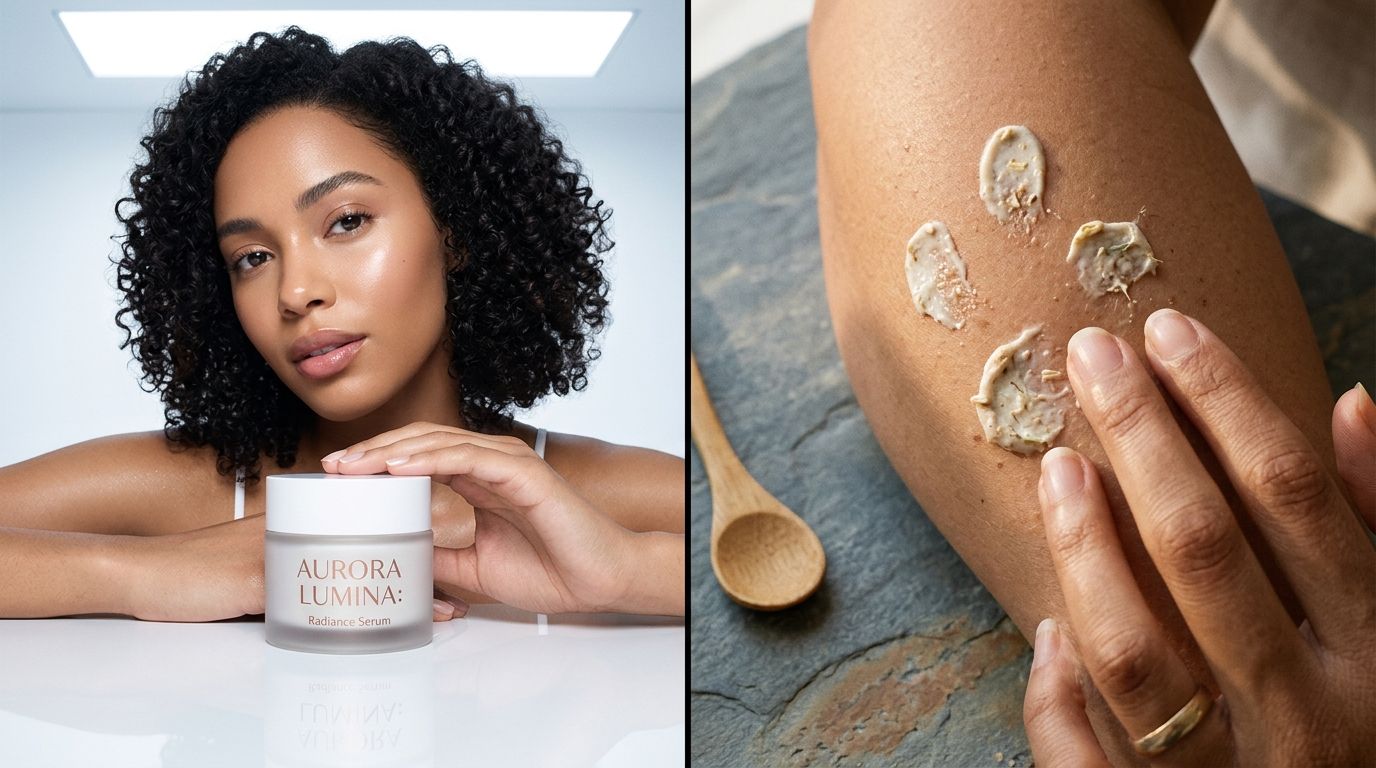
High-end beauty images communicate texture and weight, signaling a premium formulation before the customer reads the ingredients.
Why beauty product photography ecommerce standards are ruthless
Consumers in the beauty and cosmetics space have been burned before. They have bought serums that felt sticky, moisturisers that broke them out, and foundations that oxidized into an entirely different shade by noon. Every time a shopper lands on your product page, they are looking for reasons to leave. Your photography is the first line of defense against that inherent skepticism.
This is exactly why understanding the nuances of product photo conversion factors is mandatory for survival in this category. You are not just showing them a bottle. You are making a promise about how that product will feel on their skin.
The skepticism tax in skincare
I call this the skepticism tax. To overcome it, your visual assets have to work twice as hard as they would in apparel or electronics. The bottle needs to look heavy. The glass needs to reflect light in a way that suggests thickness and quality. The label needs to be perfectly legible so they can verify your clinical claims.
When a shopper looks at a product image, they are subconsciously judging the density of the plastic, the precision of the pump, and the clarity of the liquid. If you blast a glass dropper bottle with flat, front-facing light, you strip away all the micro-shadows that give the object volume. Suddenly, your heavy frosted glass looks like cheap acrylic. You have just lost the sale, and you will likely blame your pricing instead of your lighting.
Mastering texture photography skincare and serum visuals
Beauty customers do not just buy ingredients. They buy the sensory experience of applying the product. This means you must master texture photography skincare techniques. You have to visually answer the question of whether a product is sticky, watery, dense, or airy.
A common mistake is treating all formulations the same under the camera. The lighting setup required for a sheer facial oil will ruin a matte clay mask. You have to light for the specific physical properties of the formula.
Serum photography and liquid light
Serum photography is incredibly difficult because you are essentially photographing water. To make a serum look expensive, you have to capture refraction. You need backlighting to illuminate the liquid from within, giving it a glowing, potent appearance.
When you see those beautiful macro shots of a single drop falling from a glass pipette, you are looking at hours of meticulous lighting work. The drop has to catch a hard specular highlight to prove it is wet, while casting a soft shadow to prove it has viscosity. If the light is too soft, the drop blends into the background. If it is too hard, the image looks clinical and harsh.
Moisturiser photography and density
Moisturiser photography requires an entirely different approach. Here, you want to show density, richness, and blendability. Photographers and stylists use specialized spatulas to create the perfect "swoosh" or smear of product.
To make a cream look thick and luxurious, you need sharp, directional side lighting. This raking light catches the peaks of the smear and casts tiny shadows in the valleys. This interplay of light and shadow is what tells the human brain that a cream is rich and hydrating. If you want to know how to make skincare look premium, it always starts with mastering these micro-shadows.
The logistics of shooting beauty product images at scale
Understanding how to light a product is only half the battle. The real challenge for modern ecommerce brands is paying for it and scheduling it. A single physical shoot for a new skincare line involves an absurd amount of moving parts.
You are not just paying a photographer. You are paying a prop stylist to source exact shades of marble and fresh botanicals. You are paying a texture stylist whose entire job is to smear lotion perfectly. You are paying for a studio space, lighting rentals, and extensive post-production retouching to remove the reflections of the camera lens from every single shiny bottle.
When traditional shoots drain your margin
Most founders I talk to are shocked when they calculate the actual per-image cost of their last cosmetics photography ecommerce shoot. When you add up the styling fees, the wasted product, and the weeks of retouching, the cost often exceeds $150 per usable image.
Worse than the cost is the delay. If you formulate a new summer shade of lip gloss, you need those images live immediately. Waiting three weeks for a studio booking and another two weeks for editing completely stalls your go-to-market motion. The traditional agency model was built for seasonal print catalogs, not continuous ecommerce drops.
| Production Factor | Traditional Studio Shoot | AI Image Generation |
|---|---|---|
| Per-Image Cost | Often exceeds $150 per usable image | Drops to under $5 per image |
| Turnaround Time | Multiple weeks for booking and editing | Completed in a single afternoon |
| Logistical Requirements | Studio rentals, prop stylists, raw ingredients | A basic flat photo of the product packaging |
| Post-Production | Extensive retouching to remove camera reflections | Automatic handling of complex glass reflections |
Automating the aesthetic with CherryShot AI
This logistical nightmare is exactly why smart brands are moving their catalog volume to AI generation. By uploading a simple, well-lit photo of your product packaging, CherryShot AI allows you to generate campaign-ready photos in minutes.
You can select the Minimalist mode for clean, clinical skincare backgrounds, or the Magazine mode for dramatic, high-contrast shadows. The tool automatically handles the complex reflections on glass bottles and places the product in a photorealistic environment. The per-image cost drops to under $5, and the turnaround time collapses from weeks to a single afternoon. You get the premium visual standard without the crushing studio invoice.
Nailing beauty product colour accuracy and ingredients
Beyond texture and lighting, you have to manage color and context. In the beauty space, inaccurate color representation does not just hurt your brand perception, it drives massive return rates.
Perfecting beauty product colour accuracy
Makeup photography ecommerce is unforgiving when it comes to color. If a customer buys a cool-toned foundation based on your product page and receives a warm-toned bottle, they are returning it immediately. Your photography must be perfectly color-calibrated.
This is especially difficult when shooting highly reflective packaging. Often, the color of the background or the props will reflect onto the product, subtly changing the perceived shade of the makeup inside. This requires hours of color correction in traditional shoots to isolate the product and restore its true hue.
Ingredient callout beauty photography
The final piece of the visual trust puzzle is proving your formulation. Modern consumers care deeply about what goes onto their skin. Ingredient callout beauty photography involves staging the raw, active ingredients alongside the finished product.
Placing fresh sliced citrus next to a vitamin C serum, or dripping raw honey near a soothing mask, immediately communicates the product's value proposition without requiring the customer to read a single line of copy. If you want to dive deeper into luxury beauty photography, mastering the balance between raw organic ingredients and sleek, manufactured packaging is essential.
Sourcing perfect, unblemished ingredients for a physical shoot is incredibly frustrating. Fruit oxidizes under hot studio lights. Water droplets dry up. This is another area where utilizing a tool like CherryShot AI changes the game, allowing you to generate perfect contextual props instantly without a trip to a specialty grocer.
Frequently Asked Questions
How do I photograph skincare products for ecommerce?
Photographing skincare requires pristine packaging and highly controlled studio lighting to accurately communicate the viscosity and premium nature of your formula. Flat front lighting destroys dimension, making expensive creams and serums look like cheap drugstore alternatives by erasing critical micro-shadows. Mount a macro lens and employ directional side lighting over reflective acrylic surfaces to capture the true depth of glass bottles and liquid textures.
What makes beauty product photography trustworthy?
Visual consistency and granular detail serve as the primary trust signals for skeptical cosmetics shoppers navigating saturated ecommerce categories. Consumers build confidence in brands that provide multiple lighting angles, highlight the authentic physical texture of the formula, and accurately represent the packaging materials. Ensure your final image resolution is sharp enough for a user to zoom in, read the fine label text clearly, and verify active ingredients before completing their purchase.
How do I photograph product texture for skincare?
Mount a macro lens and use sharp, directional side lighting to capture the physical properties of your cosmetics. While front lighting completely flattens the product, side lighting generates the precise micro-shadows required to reveal the peaks of a thick cream or the watery viscosity of a gel. Execute physical swatch styling using specialized acrylic spatulas to create perfectly smooth product smears that remain entirely free of distracting air bubbles.
Can AI create beauty product photography?
Artificial intelligence image generation is rapidly becoming the operational standard for producing high-volume beauty catalogs efficiently. Advanced generation software takes a basic flat photo of your glass bottle or makeup compact and renders it inside high-end, photorealistic environments with physically accurate lighting reflections. This specific workflow replaces complex studio bookings and physical prop sourcing while strictly maintaining the premium visual aesthetic required to sell luxury cosmetics online.
What backgrounds work best for beauty product photography?
Minimalist stone surfaces, dynamic water ripples, and soft pastel staging podiums operate as highly effective environments for modern ecommerce skincare brands. These specific natural elements perform exceptionally well because they subconsciously suggest formulation purity, active hydration, or clinical efficacy to the viewing shopper. Always select understated background textures that reinforce your core brand identity without ever introducing visual clutter that distracts from the primary product packaging.
Key Takeaways
- Beauty consumers are inherently skeptical, meaning your photography must visually prove your price point before the customer reads the copy.
- Lighting dictates perception, as flat lighting makes luxury frosted glass look like cheap plastic.
- Texture shots require sharp, directional side lighting to show the true viscosity of serums and the rich density of creams.
- AI image generation allows brands to maintain high-end editorial aesthetics across their entire catalog without the crushing cost of traditional studio setups.
Winning in the beauty space requires an obsession with visual quality. You cannot expect a customer to trust your formula on their face if you do not care enough to present that formula beautifully online. By utilizing modern workflows and tools like CherryShot AI, you can finally build that visual trust at a pace that matches your product drops.
Audit your product page images before your next campaign
Review your active product pages to see if flat lighting is currently making your premium formulas look inexpensive. If your glass packaging lacks dimension or your texture shots fail to show viscosity, you are likely losing conversions. Generate high-end, photorealistic environments for your next product drop without booking a physical studio.
Try CherryShot AI