Beauty Product Photography: How to Photograph Skincare, Cosmetics, and Fragrance Products That Sell
Beauty product photography has one job. It must convince a customer to put an untested formula on their face based solely on pixels on a screen. If your imagery looks flat, your customer assumes your product is cheap.
Definition
Beauty product photography refers to the specialized techniques used to capture skincare, cosmetics, and fragrance items for retail display. It focuses on rendering the specific material properties of containers and formulas to establish brand value and product efficacy for online buyers.
Most founders think they need a $5,000 studio day to fix this. They do not. They just need to understand how light interacts with glass, plastic, and pigment. A sharp highlight on a glass bottle communicates luxury. A soft gradient across a matte tube communicates clinical efficacy. The difference between a high-converting product page and a bounce rate disaster comes down to surface management.
When I ran my first beauty brand, our launch shoot went four hours over schedule because the photographer could not get a reflection out of a curved glass serum bottle. We paid for the studio overtime, the stylist waiting around, and the inevitable rush fee for retouching. You are paying for logistics when you do things the old way.
The Three-Function Framework for Beauty Ecommerce Photography
Every beauty shot must do three specific things. It has to establish scale, show texture, and communicate brand positioning. A plain white background shot handles scale and basic utility. Your lifestyle and editorial shots carry the rest of the weight. You cannot sell a luxury face cream with just a white-background packshot.
| Category | Lighting Focus | Key Visual Goal |
|---|---|---|
| Skincare | Backlighting | Formula clarity |
| Cosmetics | Direct lighting | Pigment texture |
| Fragrance | Reflection flagging | Bottle shape |
The strategy changes entirely based on what you are selling. Skincare is about viscosity and absorption. Cosmetics are about payoff and finish. Fragrance is about weight and mood. Treating them all as identical cylindrical objects is the fastest way to ruin a campaign.
Communicating Texture in Skincare
Skincare photography ecommerce relies heavily on the suggestion of moisture. You are selling hydration. Your lighting must reflect that. Matte bottles need soft light to show their velvet finish without blowing out the label text. Glossy droppers need sharp specular highlights to look clinical, effective, and expensive.
Shooting a clear serum requires backlighting. If you light a clear glass bottle exclusively from the front, it looks like flat plastic. You have to push light through the back of the liquid to make the formula glow. Our guide on how to properly light these setups and make skincare formulas look premium breaks down exactly where standard lighting setups fail.
Conveying Pigment in Cosmetics
Makeup product photography is uniquely difficult because the package is secondary to the product itself. The customer buys the pigment. The container just holds it. This means your photography has to work twice as hard. You need to show the pristine packaging while simultaneously showing the messy, tactile reality of the product inside.
This is why texture shots are critical. Smears, dollops, and crumbles communicate the physical reality of the product. A matte eyeshadow needs hard light to show its grain. A liquid highlighter needs a massive, diffused softbox to show a continuous, uninterrupted reflection.
Selling the Scent in Fragrance
Fragrance product photography is mostly an exercise in photographing glass. A perfume bottle is a mirror that happens to hold scented alcohol. It reflects the entire room. If your photographer does not know how to flag a set with black foam core, your customer will see the reflection of a light stand right through your luxury bottle.
You have to control the environment completely. A detailed breakdown on photographing transparent glass products reveals why most amateur setups result in muddy, undefined bottle edges. You want sharp, dark edges to define the shape of the glass against the background.
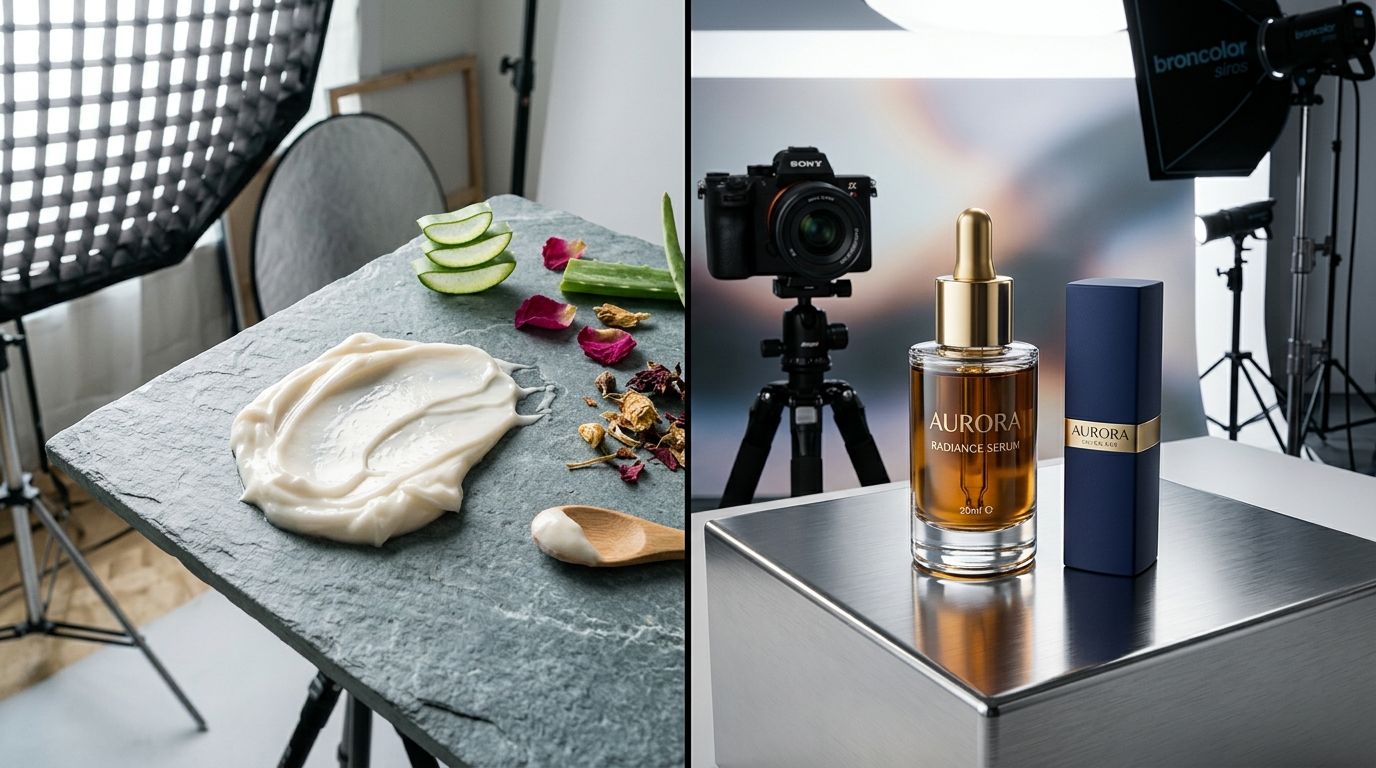
Light interacts differently with glass, plastic, and raw pigment. A professional setup manages all three simultaneously.
Fixing the Cost of Beauty Brand Photography Style
Any brand still running a full studio shoot for standard catalog images in 2026 is burning margin. The invoice is not just the photographer. It is the studio rental, the stylist's half-day, the art director's back-and-forth, and the three weeks between the brief and delivery.
Most founders cannot name the actual per-image cost of their last shoot. When they calculate it, the number is usually somewhere between $80 and $200 per finished image. That math simply does not work if you are launching new SKUs every quarter or trying to maintain a daily posting schedule on social media.
AI product photography changes that math completely. Instead of booking a three-day shoot to get lifestyle images of a new serum bottle, founders are shifting to AI generation. You upload a clear shot of your bottle, select a visual mode like Minimalist or Magazine in CherryShot AI, and generate campaign-ready photos in minutes. The per-image cost drops to under $5. The turnaround goes from weeks to an afternoon.
High-end macro shots of product texture absolutely require a skilled human photographer with a specialized macro lens. AI and standard studio setups still struggle to capture the exact, messy grain of a physical exfoliant smear. For those highly specific close-ups, you should pay the day rate.
The Anatomy of a Converting Beauty Image
Every beauty brand wants a unique visual identity, but ecommerce basics still apply. Customers need to see the front label clearly. They need to see the applicator. They need to understand the scale of the product relative to a human hand or a known object.
The brands getting the most out of their visual assets are not the ones with the biggest budgets. They are the ones testing variations quickly. When you can generate imagery for a new moisturizer in twenty minutes instead of booking another shoot day, you can test a dark moody aesthetic against a bright clinical aesthetic on your product page on the same day.
Mastering the Background
Do not let the background overwhelm the formula. A common mistake in beauty ecommerce photography is over-styling. If you put too many botanical elements, water splashes, and acrylic blocks in the frame, the customer loses the product. If you are struggling with balancing the frame, reviewing standard product lighting setups for ecommerce will ground your styling back in reality.
Keep the focus on the product finish. If the bottle is matte, use a glossy background to create contrast. If the jar is highly reflective, place it on a matte stone surface. Contrast creates visual interest.
Audit your product images for conversion performance
Review your top-performing product pages to ensure the primary image clearly communicates texture and scale. If your current images feel static or inconsistent, generate fresh lifestyle variations to see how different environments impact your click-through rates.
Try CherryShot AIFrequently Asked Questions
How do I photograph skincare products for ecommerce?
Use soft, diffused lighting to highlight packaging texture without creating harsh hotspots. Position your main light to the side or slightly behind the product to emphasize the shape of the bottle or jar. Add white bounce cards to fill in shadows on the opposite side. Backlighting is crucial for clear serums or liquids to make the formula glow for your customers.
What makes beauty product photography look professional?
Professional beauty photography demands deliberate reflection management and immaculate styling. A amateur photo often displays accidental reflections of the room or photographer in the glass. Skilled photographers use black flags to control reflections, ensuring sharp, intentional lines of light along the edges of the product. Flawless post-production to remove dust and fingerprints is a non-negotiable step for high-end results.
What surfaces work best for skincare photography?
Non-porous, slightly reflective surfaces communicate cleanliness and hydration, making them ideal for skincare. Acrylic styling blocks, tinted glass, polished stone, and seamless water surfaces represent industry standards. Matte backgrounds like textured plaster or velvet can work for specific brand identities, but they require precise, controlled lighting to avoid looking flat. Choose surfaces that provide visual contrast to your specific product finish.
What is the best lighting for cosmetic product photography?
Cosmetics require tailored lighting depending on their final finish. Matte palettes and powders look best under hard, direct light to highlight the granular texture of the pigment. Glossy lipsticks and liquid highlighters need large, soft light sources to create smooth, sweeping highlights across the packaging and the product itself. Adjust your light modifiers based on the specific material finish of your cosmetic items.
Can AI create beauty product photography?
Yes, AI product photography tools generate realistic lifestyle environments around a standard flat lay or front-facing product image. These systems understand how light interacts with glass bottles and cosmetic tubes, automatically adding accurate reflections, shadows, and complementary props. This method replaces the need for an expensive physical studio shoot, providing consistent imagery at scale for your ecommerce storefront and social media presence.
Key Takeaways
- Skincare photography must communicate moisture and viscosity through controlled lighting and backlighting.
- Cosmetics require texture shots to prove the physical payoff of the pigment inside the packaging.
- Fragrance photography is an exercise in reflection management to define the sharp edges of clear glass.
- AI tools eliminate the scheduling bottleneck for lifestyle volume and bring per-image costs under $5.
Stop paying for studio delays when your launch depends on fast visual assets. You can control the aesthetic of your beauty brand without surrendering your margin to freelance invoices. Try CherryShot AI to generate campaign-ready product photography in minutes.