Can AI Replace a Product Photographer: The Honest Answer for Ecommerce Brands in 2026
The honest answer is no. If you are asking if AI can replace a product photographer entirely, the answer is no. If you are asking if AI can replace the tedious, expensive, time-consuming catalog work that drains your marketing budget, the answer is an absolute yes. I spent eight years running ecommerce operations. I have signed invoices for thousands of dollars just to get a single lifestyle shot of a new serum bottle sitting on a bathroom counter. That specific part of the industry is over.
Definition
AI product photography is the process of using generative machine learning models to render static consumer goods within highly realistic digital environments. This technology replaces traditional studio setups by programmatically generating accurate lighting, shadows, and contextual props around a simple raw image of a product.
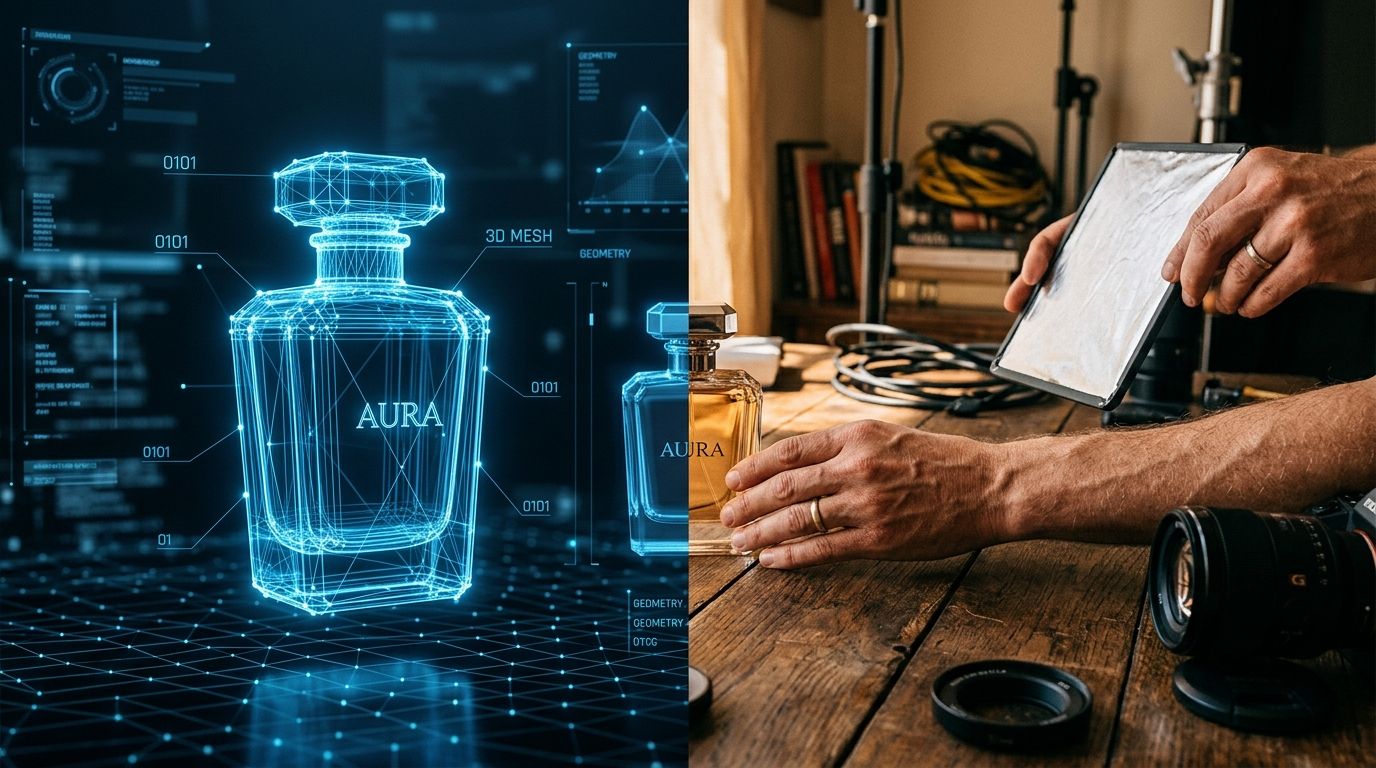
A human photographer captures raw input. AI handles the environment, lighting, and styling in minutes.
When founders ask me if they can fire their freelance photographers, they are usually asking the wrong question. You do not fire a photographer because AI is smarter. You stop booking standard studio shoots because AI is faster. You stop paying for the logistics of renting a space, sourcing marble props, and waiting three weeks for retouched files.
Right now, AI replacing product photographers is a reality for about eighty percent of standard ecommerce visual needs. The remaining twenty percent still requires a human. The brands succeeding in 2026 understand exactly where that line is drawn.
Will AI replace product photography entirely?
Let me be very clear about what happens in a typical product shoot. You book a photographer. They demand a half-day minimum rate. You hire a stylist. The stylist spends two days driving around the city buying specific dried botanicals and acrylic blocks. Shoot day arrives. The natural light in the studio is completely wrong because it is raining. You spend three hours adjusting a physical reflector to get a glare off your packaging.
A week later, you get a Dropbox folder of raw files. You select your favorites. Another week passes while the retoucher removes dust particles and fixes the color balance. You just spent three weeks and four thousand dollars to get fifteen usable photos.
That entire workflow is dead. We are seeing a massive wave of AI replacing photography studios for these exact reasons. Using tools like CherryShot AI, you take a basic photo of your product with your phone. You upload it. You select a mode like Minimalist or Loud Luxury. Two minutes later, your product is sitting on a high-end pedestal with perfect studio lighting, sharp shadows, and zero dust.
The shift from execution to direction
The debate around an AI vs human product photographer misses the point of what your brand actually needs. You do not need a photographer. You need photographs. You need compelling visual assets that make a customer click 'Add to Cart'.
When you remove the logistical nightmare of a physical shoot, your marketing team shifts from project managing a production to actually directing art. You can generate a new colorway background in twenty minutes instead of scheduling a new shoot for next month. The bottleneck moves entirely from budget to imagination.
Evaluating the product photographer vs AI 2026 landscape
If you are going to use AI effectively, you have to be brutally honest about its current limitations. Generative imagery is brilliant at static objects, perfect lighting, and environmental context. It is not magic.
| Production Element | Generative AI Software | Traditional Studio Shoot |
|---|---|---|
| Execution Speed | Minutes per generated variation | Weeks from booking to final delivery |
| Cost Structure | Predictable software subscription | Variable day rates, props, and retouching fees |
| Ideal Application | High-volume catalog and basic lifestyle | Bespoke hero campaigns and complex human models |
| Revision Process | Instant programmatic regeneration | Requires costly physical reshoots and extensive retouching |
AI still struggles with complex physical interactions. If you need a lifestyle shot of a hand physically gripping a heavily branded, curved water bottle while pouring it into a glass with perfect fluid dynamics, you need to book a human. AI has a hard time perfectly mapping text onto curved surfaces that are partially obscured by human fingers. That is a genuine trade-off you have to accept today.
(Worth noting: many top-tier commercial photographers are actually using AI themselves behind the scenes to speed up their background replacements and deliver files to clients faster.)
Where artificial intelligence dominates
Where AI wins flawlessly is volume. Think about your product detail pages. You need your product on a white background. You need it on a bathroom counter. You need it on a vanity. You need it next to some natural ingredients. Paying a human to set up those four distinct environments takes a full day. Software does it simultaneously.
Brands that launch multiple SKUs a month are the ones adopting this fastest. When you calculate the cost of AI product photography against your standard agency retainer, the math breaks. You go from paying $150 per finished image to paying roughly $5 per image. You get your assets the same afternoon you finalized the product design.
When to keep your photographer on retainer
Do not fire your lead photographer. Change their scope of work. You still need them for your massive, brand-defining hero campaigns. If you are launching a global rebrand and need highly specific, bespoke editorial concepts that require physical prototyping, put a human behind a camera.
The strategy is allocation. Knowing when AI product photography makes sense allows you to protect your creative budget. Use AI for the eighty percent of your catalog that is just standard ecommerce execution. Take the thousands of dollars you save on those mundane shoots and give it to your lead photographer to shoot one incredible, visionary campaign a year.
Stop paying creative professionals to do tedious logistical work. Stop waiting three weeks for a photo of a bottle on a rock. Let software handle the rocks. Let humans handle the vision.
Key Takeaways
- AI will not replace high-end visionary photography but will eliminate routine catalog shoots.
- The primary advantage of AI is removing the logistical delays of physical production.
- Human photographers are still required for complex physical interactions and fluid dynamics.
- Brands should use AI for volume tasks and save their budgets for human-led hero campaigns.
Frequently Asked Questions
Can AI fully replace a product photographer?
Artificial intelligence cannot completely replace a human photographer across every commercial scenario your brand might encounter. Modern software easily manages the repetitive execution of standard catalog shots, basic flat lays, and endless background variations. You must still hire experienced professionals to capture highly complex physical interactions, specific celebrity models, or intricate fluid dynamics where precise tactile art direction remains essential.
What product photography can AI do vs a human photographer?
Generative tools excel at placing static products into diverse, photorealistic environments with perfect lighting and precise shadow details. This technology handles digital flat lays, cosmetic texture smears, basic lifestyle scenes, and infinite background variations in seconds. Human photographers perform better when executing dynamic action shots, complex model interactions, and highly bespoke editorial concepts that require custom physical prototyping on set.
Is AI product photography good enough for professional ecommerce?
The output from dedicated generative photography tools is indistinguishable from traditional studio production for standard ecommerce applications. Commercial brands rely on these digital assets daily to populate Shopify storefronts, build Instagram ad creatives, and design email marketing campaigns. The final resolution, shadow accuracy, and lighting consistency meet or exceed the rigorous commercial requirements expected by modern direct-to-consumer businesses.
Should I fire my product photographer and use AI?
Brands must change how they contract creative professionals rather than eliminating those partnerships entirely. Moving your agency off retainer for basic catalog updates and seasonal colorway adjustments frees up significant marketing capital. Reallocate that saved budget to hire top-tier creative talent for massive, brand-defining hero marketing campaigns once or twice a year where human art direction dictates the aesthetic.
What percentage of product photography can AI replace?
Artificial intelligence replaces approximately seventy-five to eighty percent of the daily photographic needs for a standard direct-to-consumer brand. This dominant percentage includes secondary product angles, frequent social media lifestyle variations, and continuous seasonal background updates. The remaining twenty percent consists of major flagship hero campaigns, intricate human interaction shots, and highly conceptual art direction that demands physical studio space.
The decision to switch is no longer a risk. It is standard operating procedure. If your team is still spending weeks coordinating basic product shots, you are actively burning margin. CherryShot AI exists to fix that exact problem. Upload a reference image, choose a visual mode, and generate campaign-ready assets in minutes instead of months.
Audit your visual production pipeline
Review your upcoming content calendar to identify routine catalog shoots that drain your marketing budget. Transition those repetitive lifestyle variations to software, saving your capital for major hero campaigns.
Try CherryShot AI