Building Ecommerce Brand Visual Identity Photography
Most founders think their visual identity is their logo and their typography. They are wrong. Your visual identity is your product photography. If a customer scrolls your category page and sees three different lighting styles, your brand feels cheap. You look less like an intentional premium business and more like a dropshipper testing random inventory. Building a cohesive ecommerce brand visual identity photography system requires making specific rigid decisions about how your products exist in a physical space.
Definition
Visual identity in ecommerce is the set of consistent aesthetic rules applied to all product imagery to create a unified brand experience. It ensures that every photograph on a store, regardless of the individual product, shares identical lighting, angle, and environmental traits to build consumer trust.
Once you make those decisions, you must refuse to break them. The brands that charge a premium do not necessarily have better products. They have better discipline. They understand that a beautiful photo of a serum is useless if it looks completely unrelated to the moisturizer sitting next to it on the grid.
The four-decision framework for visual identity
A brand visual identity ecommerce strategy falls apart when founders let photographers make creative choices on set. Photographers want to make beautiful art. You need to make a repeatable system. To build a cohesive brand photography ecommerce engine, you have to lock in four specific variables.
Decision 1: The lighting system
Lighting dictates the emotional resonance of your brand faster than any other variable. Are you using a hard direct strobe that creates sharp black shadows. That communicates something edgy, modern, and high-fashion. Are you using massive diffusion panels to wrap soft light around your product. That communicates calm, wellness, and accessibility.
The mistake is mixing them. If your summer collection is shot with harsh sunlight and your winter collection is shot with soft studio banks, your store loses its identity. Every photographer has a preferred lighting style. If you do not force them into your system, they will default to theirs. This is why writing a strict photography brief for consistency is non-negotiable. You have to tell them exactly where to place the lights.
Decision 2: The background and environment
A consistent product photography brand does not invent new environments for every launch. They build a background system. Plain white seamless paper is a choice. Textured stone plinths are a choice. A specific hex code of sage green is a choice.
When you jump from a cyc wall to a marble countertop to a wooden table across different product listings, the visual noise overwhelms the buyer. If you want visual identity through product photos, pick three acceptable background textures and ban everything else.
| Feature | Standardized Approach | Inconsistent Approach |
|---|---|---|
| Lighting | Pre-set studio layout | Varies per photographer |
| Background | Defined set of textures | Random environment swaps |
| Angles | Uniform camera elevation | Mixed perspectives |
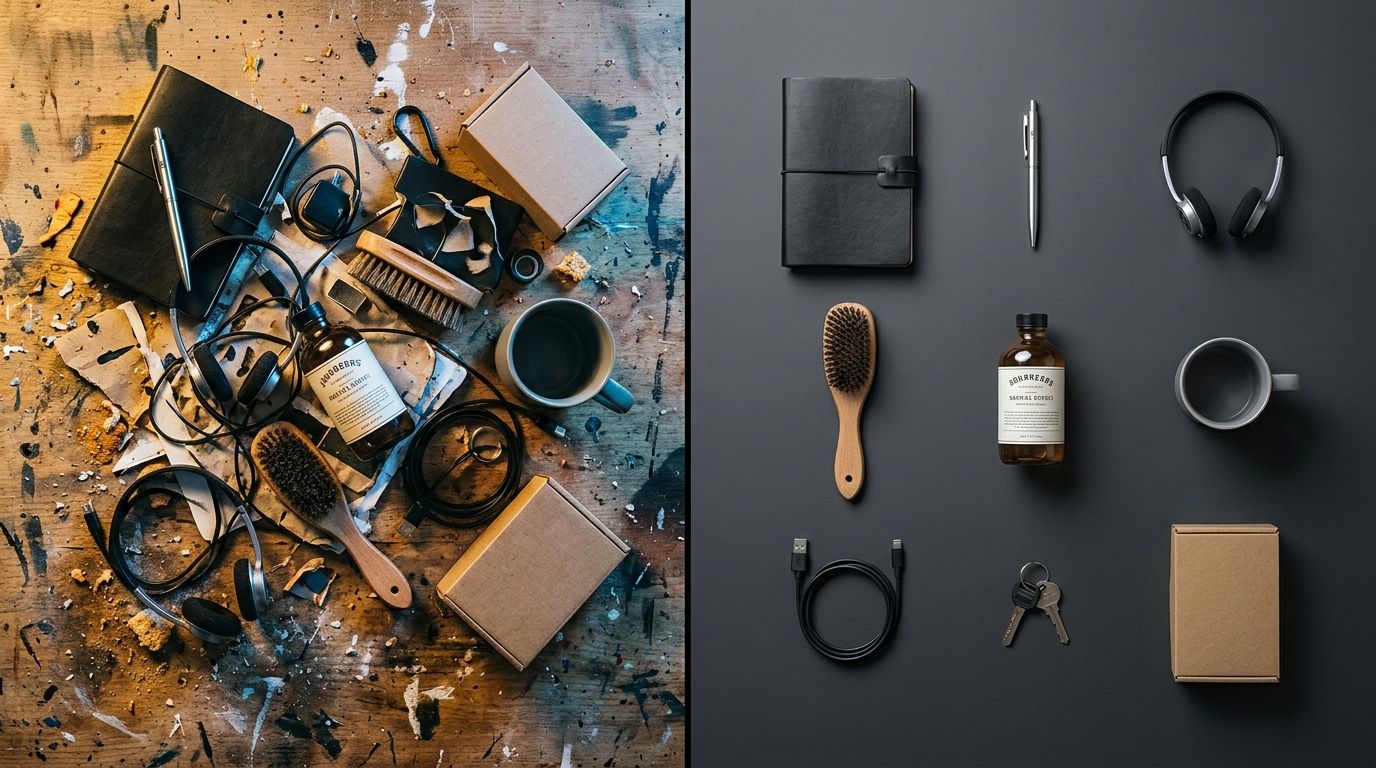
A cohesive visual grid requires absolute discipline in lighting, angle, and background choices.
Decision 3: The prop philosophy
Props are dangerous. They are the easiest way for a shoot to derail into a cluttered mess. Your ecommerce brand visual system needs a prop philosophy. If you sell skincare, do you use raw ingredients like sliced oranges and aloe leaves. Or do you use geometric acrylic blocks. Both work but they do not work together.
Determine your acceptable level of chaos. A minimalist brand might allow zero props. A Loud Luxury brand might surround a handbag with champagne flutes and crushed velvet. Define the boundaries of your universe and stay inside them.
Decision 4: The camera angle and focal length
This is the detail most founders miss. If you shoot one shampoo bottle with a 35mm lens close up, it will look slightly distorted and dynamic. If you shoot the next bottle with a 105mm lens from ten feet away, it will look flat and clinical. When those two images sit next to each other on a Shopify collection page, they look completely wrong.
You have to document the exact angle of elevation. Are we looking slightly down at the product. Are we perfectly dead on. Set a rule. Make it law.
Why visual brand standards fail at scale
Maintaining brand consistency photography is easy when you have five SKUs. It becomes a nightmare when you have fifty. The logistics of physical studio shoots naturally invite inconsistency.
First, you have the multi-photographer problem. The freelancer who shot your launch campaign in Brooklyn is booked when you need to shoot a new colorway in October. You hire someone new. They try to match the original style but their studio is different, their lights are different, and their lens is different. The result is an image that is just ten percent off. Repeat this process three times and your catalog is a mess.
Sometimes you have to break your own visual rules for a massive holiday campaign or a special collaboration. But that should be an isolated landing page experience, not something that bleeds into your permanent product grid.
Second, there is the hero versus catalog disconnect. Brands will spend ten thousand dollars getting beautiful lifestyle hero shots for their homepage. Then they run out of budget and shoot the catalog grid images with an iPhone in the warehouse. If you want to elevate brand perception, your boring catalog images need the same lighting logic as your expensive hero shots.
Solving the cohesion problem with AI
Building physical consistency at scale is painfully expensive. Paying for studio time, lighting technicians, and high-end retouchers for every minor product update destroys your margin. Every time you book a shoot, you are rolling the dice on whether the new photos will seamlessly match the old ones.
This is a hardware problem that AI has finally solved. Tools like CherryShot AI remove the physical variables from the equation. When you upload a product image and select a visual mode like Minimalist or Magazine, the AI generates the environment using fixed parameters. The virtual lighting does not drift. The virtual camera angle does not change because a tripod got bumped.
You achieve perfect photography brand guidelines without paying a human to meticulously recreate a lighting setup from six months ago. The per-image cost drops to under $5 and the turnaround happens in minutes instead of weeks.
I will admit a genuine limitation here. A human photographer is still the absolute best choice for complex multi-model lifestyle group shots where humans are interacting with the product. AI is not perfect at capturing candid human emotion on a crowded set. But for the core product imagery, the hero product shots, and the massive catalog grid, paying a physical studio just does not make financial sense anymore.
The goal is to build an ecommerce brand visual identity photography pipeline that scales with your business. You want your customers to recognize your brand from the lighting and the background alone before they even read your logo. That level of recognition requires a system that cannot be compromised by human error, shifting schedules, or studio availability.
Audit your product page images before your next campaign
Review your category grid to identify where lighting styles differ across your catalog. Use CherryShot AI to normalize these assets and create a unified visual identity for your brand.
Try CherryShot AIFrequently Asked Questions
How do I create a consistent visual identity through product photography?
Consistency relies on establishing rigid constraints across every shoot. You must lock down the lighting style, exact camera angles, and background textures used for your catalog. Applying these strict rules to every product prevents the visual drift that occurs when freelancers improvise on set. Maintaining this discipline turns a disparate collection of items into a unified brand catalog.
What photography decisions define a brand's visual identity?
Lighting quality stands as the primary factor, specifically the transition between hard and soft shadows. Focal length dictates the perspective of the product, influencing whether the viewer feels close or distant. Your selection of props and color palettes ultimately signals whether the brand identity is minimalist or luxury. These technical choices create a distinct visual language.
Can AI photography maintain brand visual identity consistency?
AI platforms allow you to select a specific visual mode for your entire product catalog. The software applies the exact same virtual environment, lighting logic, and shadow structure to every image processed. This process removes the variance that frequently happens when different human photographers manage studio equipment. Consistent output ensures your store grid looks professional and intentional.
How does cohesive photography affect brand perception?
Cohesion serves as a signal of operational competence to your potential customers. A uniform grid layout builds trust, suggesting that your internal processes are organized and reliable. Disjointed photography often makes a brand appear like a dropshipper testing random, low-quality inventory. High-value brands avoid this by ensuring every image on their site shares identical production values.
What is a background system in product photography?
A background system refers to a predefined set of surfaces and backdrops used exclusively for your brand's imagery. Instead of selecting arbitrary colors or textures for each shoot, you restrict choices to a set list like a specific concrete texture or a white sweep. This limitation forces all images into a unified visual world. Consistency here simplifies the user experience during browsing.