Product Photography Props: What to Use, What to Avoid, and the Zero-Prop AI Alternative
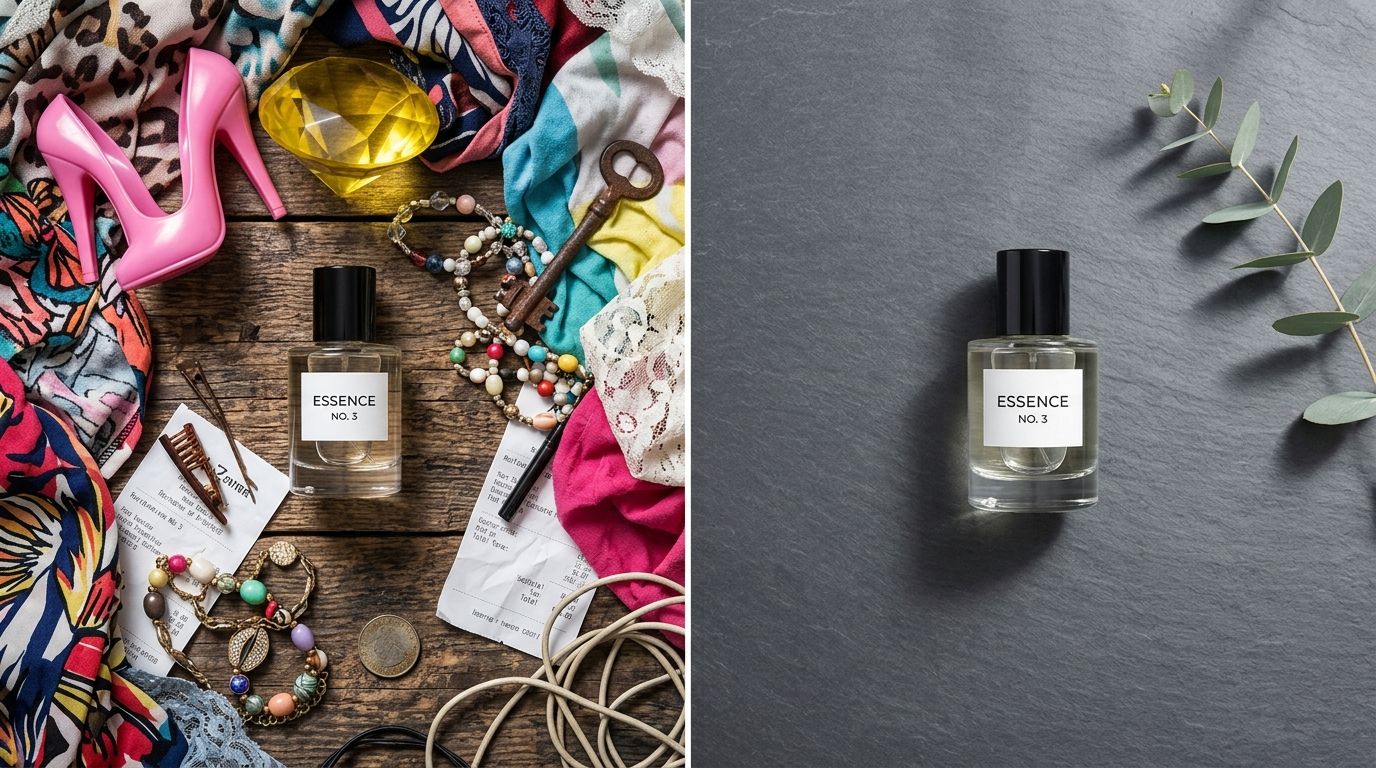
Most ecommerce founders treat product photography props like decorations. They buy acrylic blocks, dried eucalyptus, and scattered coffee beans hoping to make their catalog look expensive. The result is usually a cluttered flat lay that distracts the buyer from the actual product. Props have exactly one job in your photos. They exist to provide scale, context, or an emotional anchor that directly drives conversion.
Definition
Product photography props are physical objects placed alongside a main item to establish its size, intended use, or lifestyle environment. In modern ecommerce, these are increasingly replaced by digital assets to save on logistics and storage costs.
If a prop is not doing one of those three things, it is just visual noise. Your buyers are not paying for your styling ability. They are paying for the leather wallet or the face cream.
The reality of modern ecommerce is that physical prop sourcing is a massive budget drain. You pay for the items, the shipping, the storage, and the time it takes a stylist to arrange them with tweezers on set. Today, you do not need physical props at all. AI generation has turned styling from a logistical nightmare into a digital afterthought.
The Problem With Prop Styling Ecommerce
You sit down to plan a shoot. You know your hero item needs to stand out. The immediate instinct is to surround it with interesting things. This is exactly where prop styling ecommerce goes completely wrong. We confuse lifestyle context with an art project.
It is worth mentioning that professional prop styling is a highly specific skill. While a specialized still-life stylist can make magic happen, many generalist studio photographers will simply default to whatever they have sitting in their prop closet from last week's client.
The moment you place a complex floral arrangement next to a simple moisturizer, you force the buyer's eye to do extra work. They have to scan the image, process the flowers, and then find their way back to the jar you are actually trying to sell. Every split second of cognitive load reduces the chance they click add to cart.
Understanding the role of specific choosing product photography props requires you to think about what the buyer actually needs to know. They need to know how big the item is. They need to know how it feels. They need to know where it lives in their house. Good props answer these questions instantly. Bad props just take up space.
The Category Prop Matrix: What Actually Works
What works for a skincare brand will absolutely ruin a jewelry shot. The secret to photography props for products is staying strictly within the boundaries of your specific vertical. A prop that looks brilliant in a food shot looks absurd next to a handbag. Here is how prop selection breaks down across major ecommerce categories.
| Category | Effective Props | Avoid |
|---|---|---|
| Skincare | Water droplets, raw ingredients | Dense floral arrangements |
| Food | Consumption tools, napkins | Sterile, empty settings |
| Fashion | Scale references like phones | Cluttered non-related objects |
Beauty and Skincare
Focus entirely on ingredients and texture. If your night cream uses hyaluronic acid and rose water, the only acceptable props are water droplets, a single petal, or a smeared sample of the product itself. The goal is to communicate what is inside the bottle. Neutral texture backgrounds work exceptionally well here to let the formula shine. A clean plaster surface or a subtle ribbed fabric adds depth without screaming for attention. Avoid scattered dry goods or dense floral arrangements completely.
Food and Beverage
This is where product context photography shines. You must show the consumption moment. A bag of whole bean coffee needs a mug, a casual spill of beans, and perhaps the edge of a morning newspaper. A bottle of hot sauce needs a taco. Food flat lay props should always look like someone just paused in the middle of eating. Sterile food shots look unappetizing. Messy food shots look authentic.
Fashion and Accessories
Keep it highly organized and minimal. If you are shooting a handbag flat lay, lean heavily into knolling photography. Knolling is the process of arranging related objects in parallel or at 90-degree angles. Align the bag, a pair of sunglasses, and a phone in a rigid grid on a solid background. This technique provides instant, universal scale without adding emotional baggage. The buyer immediately knows the size of the bag because they know exactly how big an iPhone is.
Homewares
Lifestyle props are absolutely mandatory in this category. A ceramic vase shot straight-on against a white seamless paper roll is just a cylinder. Put that exact same vase on a rustic wooden table next to a half-read book and a cup of tea. Suddenly it becomes a slow weekend morning. Homewares require emotional context to justify their price points.
Where Budgets Go to Die: Prop Sourcing Photography
Sourcing physical props is a massive hidden cost in traditional studio shoots. You are paying a professional rate for someone to wander around a craft store or scour Etsy for the perfect vintage brass tray. Then you pay to ship that tray to the studio. Then you pay to store it indefinitely.
Most brands end up with a storage closet full of acrylic geometric risers, fake marble contact paper, and dried palm leaves that they use exactly once. The logistical friction of buying and storing these items simply does not make sense for modern agile brands.
Furthermore, before you even think about what goes next to your product, you must solve the surface it sits on. The background dictates the lighting, the mood, and the perceived value of the item. Evaluating the best product photo backgrounds will save you far more time than buying a box of random styling objects. A great background requires zero props to look expensive. Once the background is locked in, you will likely find you only need one supporting element instead of five.
The Zero-Prop AI Alternative
Any brand still running a full studio shoot for standard catalog images is paying for logistics instead of quality. When you calculate the actual per-image cost of a traditional shoot, factoring in the stylist's day rate and the prop budget, the number is usually somewhere between $80 and $200 per finished image.
AI product photography changes that math completely. This is exactly why the industry is moving away from physical prop sourcing. With tools like CherryShot AI, you completely bypass the craft store run. You simply upload a clean product photo taken on your phone. You select a visual mode like Lifestyle, Minimalist, Influencer, or Magazine. The AI generates the contextual background and the perfect supporting props in minutes.
Your per-image cost drops down to a few dollars. CherryShot AI pricing starts at just $10 for 50 images. The turnaround goes from three weeks of planning to a Tuesday afternoon.
There is a trade-off here. AI general image models still struggle with highly complex, physics-dependent interactions. If you need a delicate gold necklace draped perfectly over the jagged edge of a wet piece of slate, a human photographer is still your best bet. But for 90 percent of your catalog volume, standard flat lays, and lifestyle context shots, physical props are a waste of money and time.
When you look at AI vs. studio photography costs, the digital route wins aggressively for volume work. Generating imagery for a new seasonal colorway in twenty minutes instead of booking another full shoot day shifts your bottleneck from production logistics to creative ideas. You get the exact aesthetic you wanted without arguing over whether the marble slab is the right shade of white.
Scale Always Beats Decoration
If you take away one principle from this entire guide, let it be this. Never use a prop simply because a corner of the frame looks empty. Empty space allows the product to breathe. Empty space focuses the eye.
Use props to prove scale. A buyer cannot tell if a crossbody bag is ten inches wide or fourteen inches wide on a white background. Place a universally recognized object next to it. A pair of keys. A tube of lipstick. A smartphone. Instantly, the buyer understands the dimensions without having to scroll down to the specification text.
Use props to prove function. Show the knife cutting the tomato. Show the waterproof boot standing in a puddle. Show the serum dropping from the pipette.
If you follow these rules, you will stop buying useless decorations. And if you embrace digital generation, you will stop buying props altogether.
Audit your product images for unnecessary clutter
Review your current flat lays and remove props that do not provide scale or context. Use CherryShot AI to quickly place your products into clean, high-conversion scenes without the need for physical studio setup.
Try CherryShot AIFrequently Asked Questions
What props should I use for product photography?
Select props based on your specific product category to ensure relevance. Items such as water splashes or natural textures work for skincare, while consumption tools suit food photography. Sunglasses or smartphones provide necessary scale indicators for fashion accessories. Avoid including any props that fight for visual attention against the item you are trying to sell.
Where can I buy affordable photography props?
Traditional sources include local craft shops, thrift stores, and home goods retailers. Buying physical items creates long-term storage requirements and logistical overhead for your team. Many brands now prefer using AI tools to generate contextual scenes and props digitally. If you choose physical sourcing, prioritize neutral fabrics and versatile geometric shapes that complement multiple product lines.
How many props should I use in product photos?
Stick to one to three items for optimal visual balance. Using zero props makes an image feel cold, whereas exceeding three creates clutter that distracts potential buyers. Every chosen prop must serve a functional purpose, such as establishing scale, suggesting a lifestyle, or emphasizing a key ingredient in your product.
Do props help or hurt product photo conversion rates?
Props impact conversion rates based on how well they execute their purpose. Objects that successfully clarify scale or define the intended usage context help drive more sales. In contrast, complex or irrelevant styling choices cause confusion and lower conversion rates. Prioritize clear, simple compositions to ensure the buyer focuses on the actual product features.
Can AI generate different prop scenarios?
Yes, AI platforms provide the ability to place a single product image into multiple styled environments. You might switch a product from a bathroom shelf setting to a sunny vanity display by simply adjusting the visual mode. This workflow removes the burden of purchasing, shipping, and storing physical props for every individual campaign.
Key Takeaways
- Props exist strictly to provide scale, clarify context, or create an emotional anchor.
- Different categories demand different styling approaches to drive conversions.
- Physical prop sourcing is a hidden logistical cost that drains margin on traditional shoots.
- AI product photography allows brands to generate contextual props digitally in minutes.
The fastest way to improve your flat lay photography is to stop relying on random objects to make your images look expensive. Focus entirely on the product. Let digital tools handle the context. When you are ready to eliminate prop sourcing from your launch checklist completely, try uploading your next hero item into CherryShot AI to see what a zero-prop workflow actually looks like.