Hand Modeling for Product Photography: When Hands in Frame Increase Conversion
Most ecommerce founders treat hand modeling photography as an afterthought. They book a standard white background shoot and maybe grab a few lifestyle shots if there is time left on the clock. That is an expensive mistake. Putting a product in a human hand is not just an aesthetic flex. It is a direct conversion lever that anchors scale, proves usability, and gives the buyer an immediate visual reference for how the item exists in the real world.
Definition
Hand modeling in product photography refers to the inclusion of a human hand to provide physical context for a product. It serves as a visual scale reference that helps customers understand the size, texture, and ergonomics of an item better than flat imagery alone.
If you sell jewelry, skincare, or small accessories, omitting hands from your product detail pages is costing you sales.
When you rely entirely on isolated background shots, your customer has to guess what they are buying. Providing dimensions in a bulleted list does not solve this problem. People do not visualize measurements accurately. They visualize relationships. A hand model product photography shot translates numbers into reality instantly.
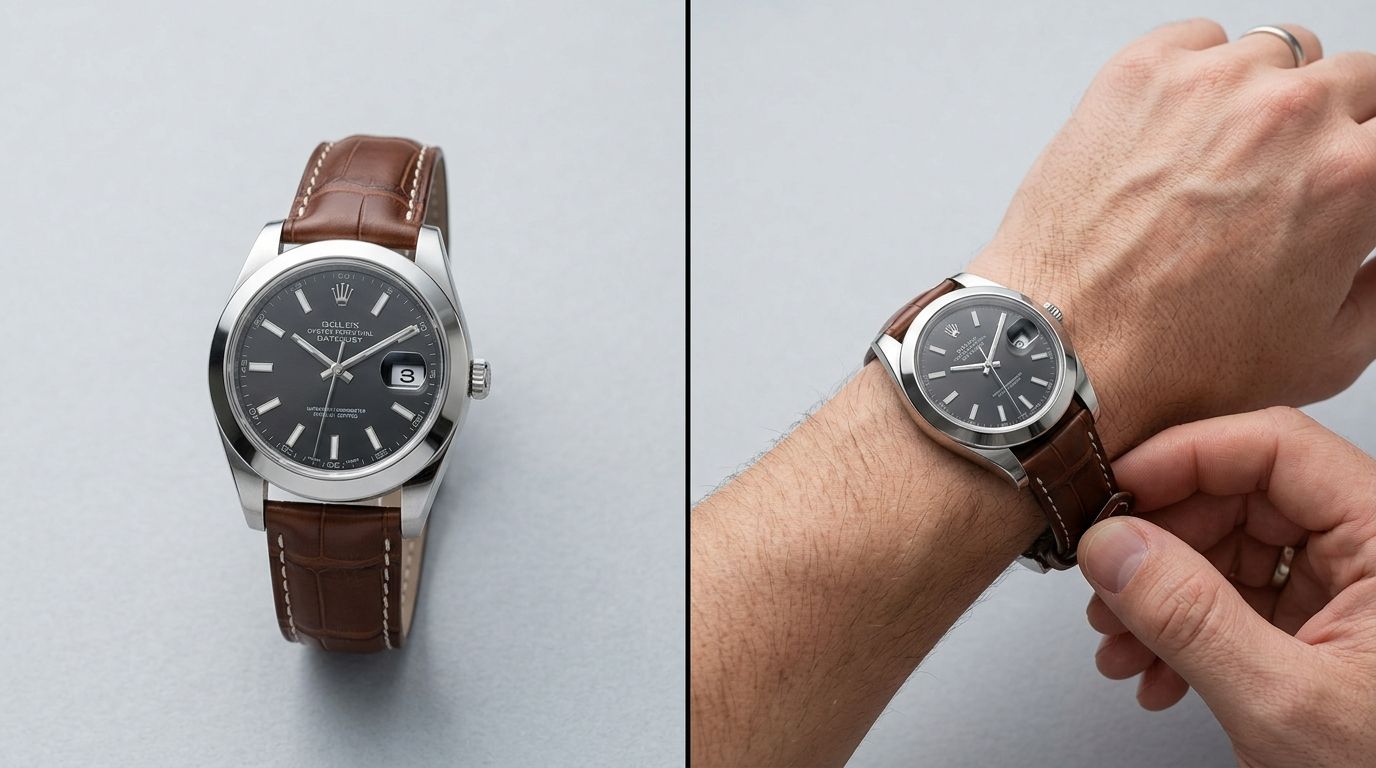
Hands in frame provide an immediate visual reference for the physical size of the product.
The Conversion Logic Behind Hands in Product Photos
Why do hands in product photos work so effectively? The human brain processes anatomical references faster than graphical overlays or text descriptions. When you look at a hand holding product photography, you instantly know how big the item is. You bypass the cognitive friction of estimating dimensions.
Solving the Scale Problem
When buyers return items for being smaller than expected, your product page failed at scale reference product photography.
Consider the last time you bought a ceramic mug or a heavy glass skincare jar online. If all you saw was the product floating in a white void, your brain had to do a lot of heavy lifting. You might check the ounce capacity in the specifications, but most casual buyers do not visualize fluid ounces with any accuracy. They visualize how an object fits in their palm. When you feature a holding product photo right in the primary image carousel, that guessing game ends immediately. The buyer sees the jar resting against a palm and understands its true volume. This hands-on product photography prevents the hesitation that leads to abandoned carts.
The Psychology of Ownership
There is also a psychological element at play called haptic imagery. When shoppers see an in-hand product photography shot, they mentally simulate the feeling of holding it themselves. This mental simulation increases feelings of psychological ownership. When someone feels like they already own an item, their willingness to pay for it increases. A sterile floating bottle does not trigger this response. A beautifully lit, relatable hand does.
Product Categories That Demand Hand Model Ecommerce Shots
Not every product requires a human element, but for certain categories, a product in use shot is absolutely mandatory for high conversion rates.
Jewelry and Fine Accessories
Detail matters in jewelry, but context matters more. Buyers need to see how thick a gold band is relative to a finger or where a pendant falls against the collarbone. Mastering the lighting for reflective surfaces can be incredibly difficult, but specific jewelry photography tips can help you balance the shine of the metal with the soft texture of human skin. A ring on a white background looks like a catalog entry. A ring on a manicured hand looks like a lifestyle upgrade.
Skincare and Beauty Textures
Serums, heavy creams, and liquid exfoliants sell based on texture. A photo of a closed bottle tells the customer nothing about how the product feels. This is exactly why skincare product photography increasingly relies on swatches and dropper shots. Consumers want to see the viscosity of the fluid resting on the back of a hand.
Food and Beverage
Food requires a tactile element to look appetizing. A hand pouring a vibrant beverage into a glass or holding a packaged snack bar implies immediate consumption. It bridges the gap between digital pixels and a physical craving.
The Logistics of Traditional Hand Modeling Photography
Here is where the reality of physical production hits hard. Booking a hand model is not as simple as pulling an employee from the marketing team who happens to have nice nails. Commercial hand models are highly trained specialists. They know how to hold an awkward object without casting harsh shadows on the label. They know exactly how to tense their fingers so the skin looks completely smooth without appearing rigid or artificial.
The Cost of Studio Reality
That expertise comes with a massive invoice. When you book a traditional hand model ecommerce shoot, you are paying agency day rates. You are paying for a professional manicurist to be on set all day. You are paying for the photographer to spend twenty minutes adjusting a wrist angle so your logo remains legible.
I have personally sat through studio shoots where half the images were unusable because the model inadvertently covered the primary label copy. We had to book a reshoot, paying everyone a second time, just to get the logo visible.
While a highly specialized professional hand model is unmatched for a global billboard campaign where every millimeter of cuticle is scrutinized at fifty feet, it is massive overkill for standard ecommerce catalog volume. You simply cannot scale that cost across fifty new SKUs every quarter.
Generating Hands in Product Photos with AI
| Feature | Traditional Studio | AI Generation |
|---|---|---|
| Cost | High (Day Rates) | Low (Per Image) |
| Speed | Days or Weeks | Minutes |
| Diversity | Requires Hiring | Instant |
| Control | Physical | Digital |
The math on human elements changed entirely when AI generation matured. Instead of running a full studio production, brands are now generating these shots dynamically.
(Anyone who tried generating hands two years ago probably remembers the terrifying six-fingered results, but modern, purpose-built models have completely solved this for commercial applications.)
Scaling Diversity and Context
With CherryShot AI, you upload a flat image of your product and select the Lifestyle or Influencer mode. Within minutes, you receive campaign-ready photos of your product being held naturally in various environments. The per-image cost drops from hundreds of dollars to just a few bucks, completely eliminating the scheduling bottleneck.
More importantly, this approach solves the diversity problem in skin tone hand photography. You want to show your product on a diverse range of skin tones so every potential customer can visualize how a gold ring or a tinted moisturizer will look against their specific complexion. Relying on physical shoots limits you to the models you cast that day. AI generation allows you to render the exact same product-in-use shot across multiple different skin tones instantly. The sheer speed of executing these visual variations is exactly why brands are rethinking the balance of AI vs real model photography for their seasonal catalogs.
Key Takeaways
- Hands in frame dramatically increase conversion by providing immediate scale reference.
- Jewelry, skincare, and food products suffer the highest return rates without contextual size cues.
- Traditional hand modeling carries massive agency fees and slows down time to market.
- AI tools like CherryShot AI can now generate photorealistic in-hand shots at scale for a fraction of the cost.
Audit your product page images before your next campaign
Review your top three selling products to see if they lack human context. Adding a single in-hand shot can often reduce return rates by helping customers better understand the scale. Use CherryShot AI to generate these variants quickly without a photoshoot.
Try CherryShot AIFrequently Asked Questions
Do product photos with hands convert better?
Product photos featuring human hands increase conversion rates by providing immediate, intuitive scale references for shoppers. Buyers avoid the mental effort of parsing dimensions in text descriptions because visual context triggers instant recognition. Seeing a familiar hand holding a product helps customers simulate the experience of owning the item themselves.
How do I style hands for product photography?
Groomed, neutral nails are mandatory to ensure the focus remains entirely on your product during the shoot. Maintain a soft, relaxed grip to avoid unnatural tension or white knuckles that distract the viewer. Use diffused, indirect lighting to soften skin texture and emphasize the high-quality finish of the item you are displaying.
What skin tone should hand models be for product photography?
Include a diverse variety of skin tones to ensure your imagery reflects the actual diversity of your customer base. Different complexions react uniquely to specific jewelry metals and makeup shades, which affects how a buyer perceives the product. Showing items against various skin tones helps more visitors visualize the product on themselves, effectively removing friction during the final purchasing decision.
Do I need to hire a hand model?
Professional agency hand models are rarely necessary for standard ecommerce catalog photography in the current market. Booking talent and studio time creates significant expenses that inflate your production costs without a guaranteed return on investment. Modern digital tools provide a direct path to generating high-fidelity lifestyle imagery without the coordination overhead of traditional physical photoshoots.
Can AI generate hand models for product photography?
AI technology now produces exceptionally realistic hand models that integrate perfectly into your product imagery. You can upload a standard flat image of your item to CherryShot AI and select lifestyle settings to generate high-resolution results in minutes. This approach provides natural, accurate scaling for your products without the time-consuming process of booking a professional studio session.
Stop losing conversions just because customers cannot figure out how big your product actually is. Adding a human element solves the scale problem instantly and permanently. If you are ready to eliminate the logistical nightmare of casting and booking talent, try generating your next batch of in-hand product photography using CherryShot AI.