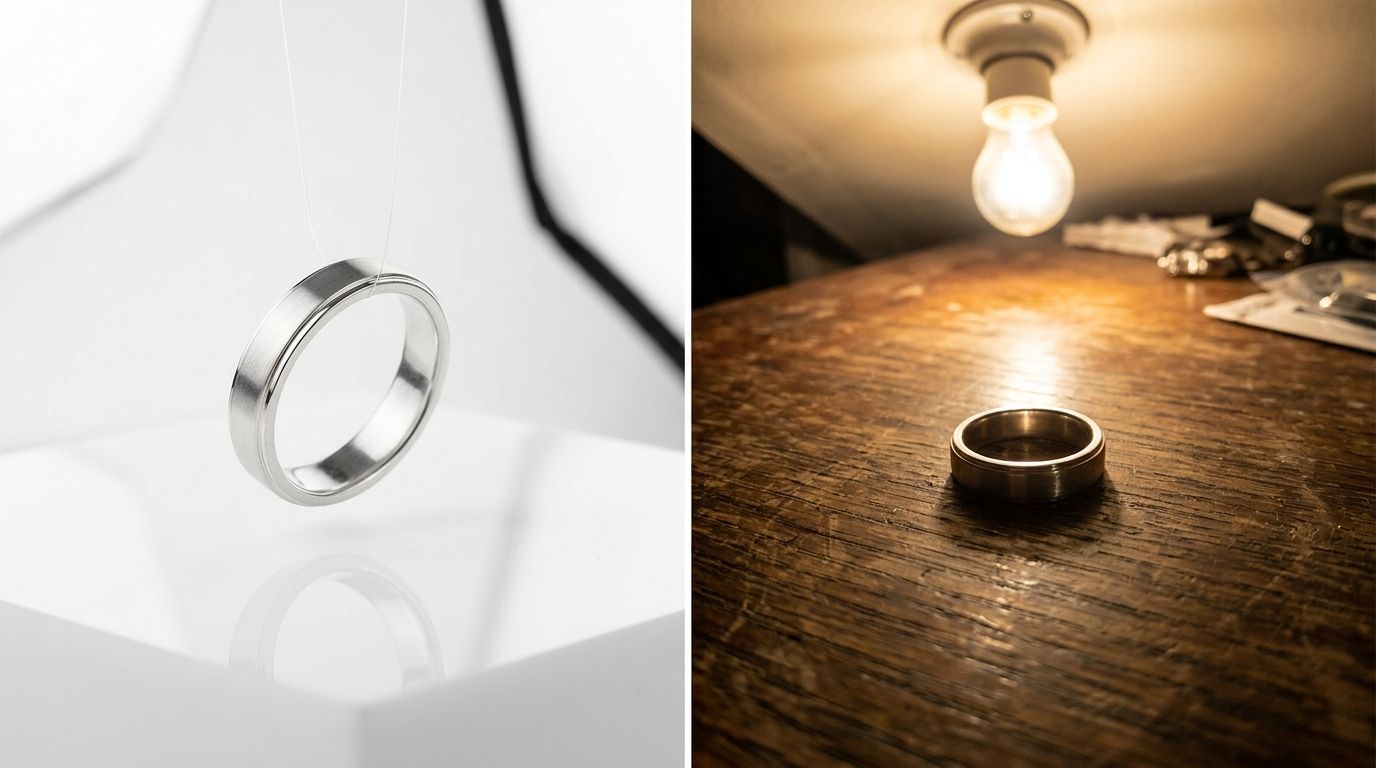
Learning how to photograph jewelry ecommerce catalogs requires mastering light diffusion and focal depth. You must position continuous LED lights behind frosted diffusers to eliminate harsh glares on gold and silver. Place the piece on an acrylic riser, lock your camera on a rigid tripod, and shoot at a high aperture to keep every gemstone crisp. Any brand still using direct flash for jewelry photography in 2024 is actively sabotaging their conversion rates.
The definitive setup for a jewelry ecommerce photography guide involves a true macro lens, a dual-light diffusion tent, and a solid tripod. This exact combination prevents dark reflections on polished metals and ensures accurate color reproduction for delicate gemstones.
Key Takeaways
- Always diffuse your lighting to prevent blown-out highlights on metallic surfaces.
- Use dental wax to hold rings upright without leaving sticky residue.
- Keep your camera aperture at f/14 or higher to capture deep focal detail.
- Replace complex on-model studio shoots with AI generation to scale your lifestyle catalog.
of consumers say that a product's image is the single most important factor when purchasing online. Salsify Consumer Research Report, 2024
Essential Equipment for Macro Photography Jewelry Ecommerce
You cannot fake your way through high-end jewelry photography with a smartphone and a desk lamp. The physical realities of shooting objects that measure less than an inch across require specialized hardware. The primary challenge is not just magnifying the object, but doing so while retaining razor-sharp edges along the facets of a diamond or the engraved text on a gold band.
Choosing the Right Macro Lens
A true macro lens is non-negotiable for professional jewelry photography tips online store execution. Standard kit lenses cannot physically focus on an object placed a few inches away from the glass. You need a dedicated lens capable of reproducing the subject at a 1:1 magnification ratio on the camera sensor. A 100mm macro lens is widely considered the industry standard. This focal length allows you to position the camera far enough away from the jewelry to avoid casting a dark shadow over the piece, while still filling the frame entirely with the product.
Shorter focal lengths force you to push the camera lens right up against the ring or necklace. This blocks your light sources and guarantees you will capture a reflection of your camera body in the polished metal. Investing in prime macro glass is the single most impactful equipment decision you will make.
Tripods and Stabilization
Macro photography magnifies everything in the frame. That includes microscopic vibrations. If your camera moves a fraction of a millimeter while the shutter is open, your jewelry will look soft and blurry.
You must mount your camera to a heavy tripod with a geared head. Geared heads allow you to make millimeter-precise adjustments to your composition without unlocking a fluid joint that might slip. Once your camera is locked in place, turn off the optical image stabilization on your lens. Leaving stabilization active while mounted on a tripod actually introduces a subtle internal vibration as the lens motor searches for movement that does not exist.
Perfecting Jewelry Product Photography Lighting
Lighting jewelry is a masterclass in controlling reflections. You are not actually lighting the object itself. You are lighting the surfaces around the object so that the metal has something clean and attractive to reflect.
Diffusing Light to Eliminate Glare
A bare continuous light bulb pointed directly at a silver ring creates a blown-out white hot spot bordered by deep shadows. The contrast is too extreme for a camera sensor to record accurately. You must soften that light by pushing it through diffusion material. Photography diffusion paper, frosted acrylic sheets, or standard nylon light tents all serve the same purpose. They scatter the directional light beam into a soft ambient glow.
Place your diffused light sources on the left and right sides of the product, angling them slightly downward. This dual-light setup provides even illumination across the primary face of the jewelry. If the top edge of a ring looks too dark, suspend a white foam board directly above the piece to bounce the side light back down onto the upper rim.
Gold and Silver Jewelry Photography Differences
Different metals demand different environmental controls. Silver acts like a perfect mirror. It will reflect the black color of your camera lens, creating an ugly dark spot right in the center of the band. To fix this, you must shoot through a hole cut into a piece of white paper. The silver will reflect the white paper instead of the dark room, resulting in a bright, clean gradient.
Gold requires careful attention to white balance. If your lights are too warm, yellow gold will photograph looking orange and unnatural. Always set your camera white balance manually using a gray card under your exact studio lights before you begin the day's shoot.
Styling and Setup Techniques for Online Stores
A typical skilled retoucher spends four to six minutes cleaning up dust and micro-scratches on a single macro ring shot. You can drastically reduce this post-production bottleneck by physically cleaning the product and styling it correctly before you press the shutter.
(Worth noting: most clients assume their gemstone colors look wrong because of the camera, but it is almost always a mixed lighting issue in the room.)
Jewelry Photography White Background Execution
Shooting on a pure white background is the global standard for ecommerce catalogs. However, placing a ring directly on a sheet of white paper rarely yields a good result. The paper texture becomes visible under macro magnification, and the shadow cast by the jewelry looks muddy.
Instead, place the jewelry on a piece of glossy white acrylic or glass. This creates a natural, elegant reflection beneath the product that anchors it in the frame. If you need a completely shadowless pure white background, place the acrylic sheet over a dedicated backlight.
Suspending Chains and Elevating Rings
Figuring out how to photograph rings and necklaces so they look three-dimensional is a common hurdle. A ring lying flat on its side rarely looks appealing. You need to stand it up. Professional prop stylists use specialized dental wax to adhere the bottom of a ring band to the shooting surface. The wax holds the heavy metal upright but cleans off easily without damaging polished finishes.
Necklaces look best when suspended naturally. Drape chains over invisible acrylic neck forms or pin them carefully to an upright foam board covered in neutral fabric. Always ensure the clasp is hidden or perfectly aligned at the top of the frame.
Generating Campaign Assets Without the Studio
While white background catalog shots are mandatory, they rarely inspire a purchase on their own. Customers want to see how the jewelry sits on a collarbone or how a ring looks on a hand. Executing an on-model lifestyle shoot for jewelry is historically the most difficult and expensive part of visual merchandising.
You must hire hand models with flawless skin, rent a larger studio space, hire a makeup artist to prep the hands or neckline, and pay a photographer to manage a complex lighting setup. The logistics alone usually limit smaller brands to shooting lifestyle images only a few times a year.
How AI Replaces Traditional Model Shoots
The smartest brands are skipping the traditional model shoot entirely. Reflective product photography tips often focus on the studio, but the easiest way to get an on-model shot today is through artificial intelligence.
Tools like CherryShot AI remove the need for models and location rentals. You can take a standard flat lay photo of your necklace or ring and upload it directly into the platform. By selecting an Influencer or Magazine visual mode, CherryShot AI maps your specific jewelry piece onto a photorealistic human model. The lighting, shadows, and physical drape of the chain are calculated instantly. You walk away with high-end campaign assets in minutes instead of waiting three weeks for a studio delivery.
Technical Execution and Camera Settings
Great lighting cannot save a photo that is fundamentally out of focus. Macro lenses have incredibly shallow depth of field. If you focus on the front prong of a diamond ring at a wide aperture, the back half of the band will blur entirely into the background.
Nailing Focal Depth in Macro Photography
To keep the entire piece of jewelry sharp, you must stop down your aperture. Set your camera to f/14 or f/16. This narrows the physical opening inside the lens and increases your depth of field. Because a narrow aperture lets in very little light, you must compensate by dropping your shutter speed dramatically. This is why a rigid tripod is an absolute necessity.
If f/16 still does not keep the entire ring in sharp focus, you will need to learn focus stacking. This involves taking multiple photos of the same ring, shifting the focus ring slightly forward for every shot. You then blend those images together in post-production software to create one flawlessly sharp final image.
Frequently Asked Questions
What is the best lighting for jewelry photography?
The most effective lighting setup for jewelry requires continuous LED lights heavily filtered through diffusion material. Bare bulbs create harsh hot spots on polished metals and wash out the natural color of delicate gemstones. By placing frosted acrylic panels or a nylon light tent between your light source and the jewelry, you scatter the light rays evenly across the surface. This creates a soft wrap-around glow that highlights the shape of the piece while preserving the exact facet details in diamonds and crystals.
How do I avoid reflections in jewelry product photos?
You eliminate reflections by controlling the environment directly surrounding the piece. Highly polished metals act like curved mirrors that reflect the camera lens, the room, and the photographer. You must block these unwanted reflections by surrounding the jewelry with white foam board or placing it inside a seamless light cone, leaving only a tiny gap for your camera lens to shoot through.
Should I photograph jewelry on a model or flat?
Ecommerce stores require both formats to maximize conversion rates. Flat lay or white background images serve as the clear catalog standard that allows customers to inspect the physical details of the design without distraction. On-model lifestyle photography provides critical context regarding scale, fit, and styling.
What camera settings work best for macro jewelry shots?
Set your camera to aperture priority mode at f/14, keep your ISO at 100 to prevent grain, and use a two-second timer to eliminate all physical tripod shake.
If you want to see what this looks like for your specific product category without renting out a studio, CherryShot AI starts at $10 for 50 images at cherryshot.ai.