Jewelry Photography for Ecommerce: How to Capture Sparkle, Detail, and Material Quality in Product Photos
The hardest thing about selling jewelry online is proving the piece is worth the price tag when the buyer cannot hold it in their hands. Bad jewelry photography for ecommerce makes a two thousand dollar engagement ring look like something pulled from a mall kiosk. Excellent photography does the opposite. If you cannot capture the exact depth of the gemstone and the polished texture of the metal, your conversion rate will suffer.
Definition
Jewelry photography is the practice of capturing high-magnification images of precious metals and gemstones while managing complex light reflections. It requires balancing soft diffusion to show metal texture with hard, direct lighting to reveal the refractive sparkle of stones.
Shooting these pieces is notoriously unforgiving. When you photograph a t-shirt, the fabric absorbs light. When you photograph a gold band, it acts as a curved mirror. It reflects the entire room back into the camera lens. You are not actually lighting the jewelry, you are lighting the environment that the jewelry reflects.
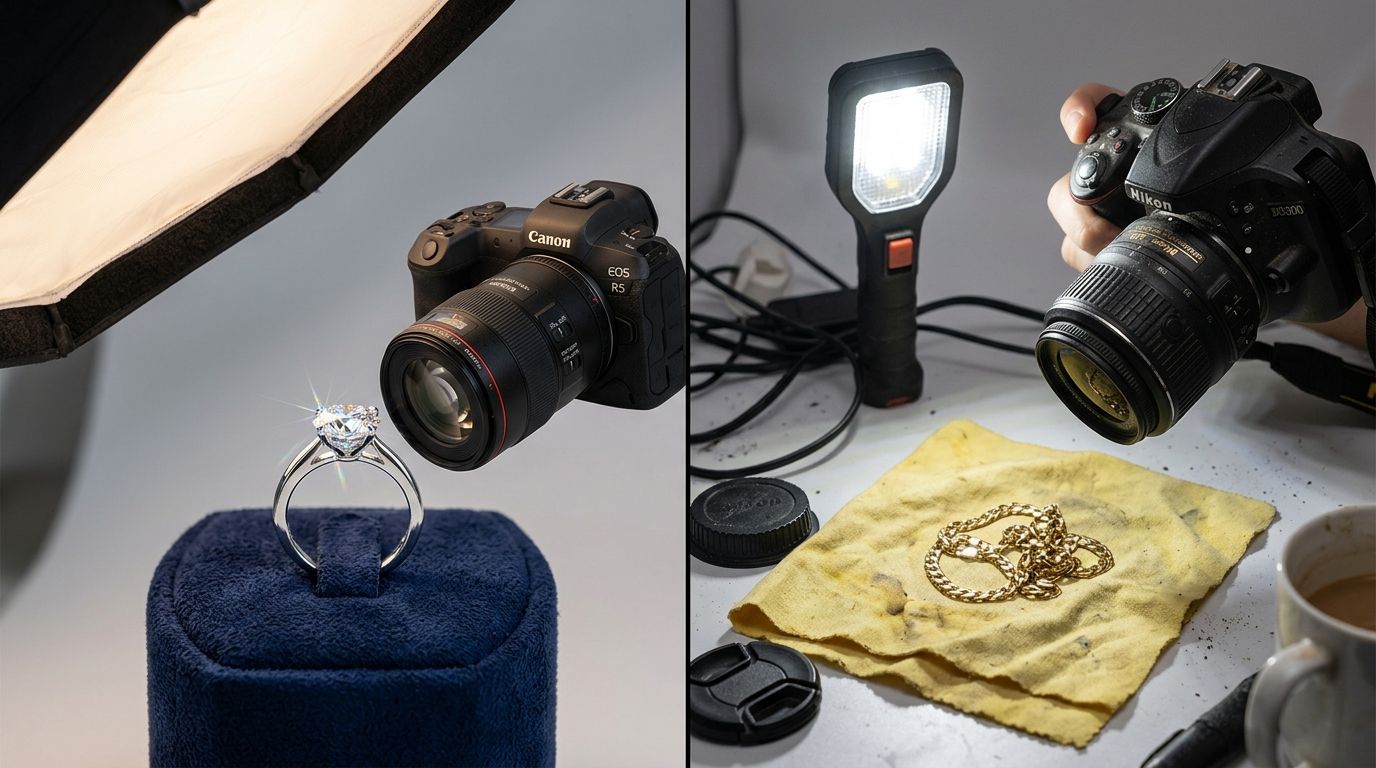
High-end jewelry photography requires precise control over both soft diffusion and hard highlights.
Worth noting, you do not need a forty thousand dollar medium format camera system to sell fine jewelry. A standard full frame camera body is completely adequate if your glass is sharp and your light is strictly controlled.
Why standard product photography fails for jewelry
Most founders assume they can hire a general product photographer to shoot their new jewelry collection. The invoice arrives, the gallery is delivered, and the gold looks dull. The silver looks like plastic. The diamonds look like flat glass. This happens because the techniques used to photograph shoes or skincare bottles actively destroy the visual appeal of precious metals.
The reflection problem
Metals have highly specular surfaces. When you place a silver dome ring on a table and point a standard strobe at it, the ring does not just get brighter. It reflects the shape of the strobe, the shape of the room, and usually the silhouette of the photographer standing behind the camera. I have literally seen the glowing green text of an emergency exit sign reflected in a polished silver pendant on a final ecommerce catalog shot.
To fix this, you have to build a controlled white environment around the piece. You bounce the light off white foam core boards or acrylic panels, and the metal reflects that clean white surface instead of the room. This is why Essential lighting for product photos matters more here than in any other category. If you master your angles, the metal will look expensive.
The macro lens depth of field trap
You need a macro lens to fill the frame with a delicate necklace or a subtle pair of stud earrings. The trade-off with macro lenses is that they have an incredibly shallow depth of field. If you focus on the front prong holding a diamond, the back edge of the ring band disappears into a blurry mess.
If you stop your lens down to f/16 to get more of the piece in focus, diffraction occurs. The light bends around the small aperture blades, and the entire image becomes soft and muddy. The only way out of this trap in a traditional studio is focus stacking. The photographer takes fifteen separate photos at different focal points and merges them manually in post-production. It takes an immense amount of time, which is why your per-image cost skyrockets.
How to capture sparkle and material quality simultaneously
The most frustrating part of jewelry product photography is the contradiction in lighting requirements. To make a silver or gold band look smooth, rich, and flawless, you need massive, ultra-soft, heavily diffused light. To make a diamond or gemstone sparkle, you need tiny, direct, hard light.
If you use only soft light, the ring looks great but the diamond looks dead. If you use only hard light, the diamond sparkles brilliantly but the metal band is covered in ugly, blown-out white hot spots and harsh black shadows.
Balancing multiple light sources
You solve this by layering your light. Start by building a soft light environment. Place large diffusers between your main lights and the jewelry. This handles the gold jewelry photography and silver jewelry photography requirements. Once the metal looks perfect, introduce a single bare bulb or undiffused LED spotlight. Aim it strictly at the gemstone. You want this hard light to hit the facets of the stone and bounce directly back into the camera lens.
When you execute this correctly, you get the rich, buttery reflection on the metal and the sharp, piercing sparkle in the stone.
Managing the post-production nightmare
Even with perfect lighting, the raw files will terrify you. A high-resolution macro sensor reveals dust particles you did not know existed. It reveals microscopic scratches in the metal from the polishing cloth. It shows every fingerprint.
This is where Professional product photo retouching drains your budget. A standard retouching house will charge extensively to manually clone out dust, smooth metal gradients, and color-correct rose gold. Rose gold is particularly notorious because digital camera sensors consistently render it either too yellow or too pink. Getting the exact copper hue right takes careful color grading.
The three paths to scaling your jewelry catalog
If you are launching multiple collections a year, the logistics of capturing these images become a severe operational bottleneck. You generally have three options for photographing jewelry for an online store.
1. The DIY macro setup
You buy a mirrorless camera, a 100mm macro lens, a light tent, and a tripod. You spend weeks learning how to focus stack and eliminate reflections. The upfront cost is a few thousand dollars. The hidden cost is your time. Every time you launch a new SKU, you lose a full working day to staging, shooting, and editing. For a founder or artisan maker, that is a day not spent designing or marketing.
2. The traditional studio retainer
You outsource the problem to a specialized product photographer. The quality is exceptional, but the logistics are painful. You have to ship valuable inventory securely. You have to wait three weeks to get on their schedule. You wait another two weeks for the retouched files to come back. The cost easily hits $100 to $150 per finished image. If you decide later that you need a lifestyle shot instead of a plain white background, you have to start the entire expensive process over again.
3. AI jewelry product photography
General-purpose AI image tools struggle heavily with jewelry. They hallucinate extra prongs, melt chain links together, and alter the shape of the gemstone. But specialized AI product photography changes the math entirely.
With CherryShot AI, you upload a basic, flat image of your jewelry piece. You select a visual mode like Minimalist or Luxury. The tool renders campaign-ready photos in minutes. The exact shape, texture, and prong count of your piece remains locked in place. The AI builds the perfect lighting environment and background around it.
Your per-image cost drops to under $5. You do not need to ship physical inventory anywhere. When you launch a new colorway or need a fresh aesthetic for an upcoming holiday campaign, you generate it on a Tuesday afternoon. The turnaround time goes from a month to twenty minutes.
| Method | Turnaround Time | Cost per SKU |
|---|---|---|
| DIY Photography | 1 to 2 days | High (Time Cost) |
| Traditional Studio | 3 to 5 weeks | $80 - $200+ |
| CherryShot AI | Under 20 minutes | Under $5 |
Focusing on material quality over staging
Shoppers buying jewelry online are deeply skeptical. They have all been burned by an Instagram ad that delivered a piece of cheap tin painted gold. Your ecommerce photos are your only defense against this skepticism. The material quality must read immediately on the screen.
If you are shooting silver jewelry, you must ensure your highlights are pure white. If your lights have a slight color cast, silver will look tarnished or gray. If you are shooting gold jewelry, you must control the warmth. Yellow gold requires absolute color accuracy to prevent it from looking like cheap brass.
Whether you learn to manipulate light yourself or you lean on an automated solution, your goal remains identical. You must present the craftsmanship honestly. If your product page photos look like generic stock images, your brand loses trust. Jewelry photography tips for fine detail will help you understand exactly which edges need to stay crisp to prove authenticity.
Streamline your jewelry catalog production
Stop relying on slow studio cycles that kill your launch timelines. Generate professional product imagery directly from your existing catalog files today.
Try CherryShot AIFrequently Asked Questions
How do I photograph jewelry for ecommerce?
Prioritize light control over camera resolution when shooting jewelry. Use a macro lens on a tripod, diffuse your primary light source heavily to eliminate harsh reflections on the metal, and introduce a small, hard light source to create sparkle in the gemstones. Keep the background clean and distraction-free. You should aim for a clear representation of the piece that avoids confusing reflections while highlighting the intricate details of the metalwork.
What lens do I need for jewelry photography?
A dedicated macro lens with a 1:1 magnification ratio is essential. Industry standards dictate using a 100mm or 105mm macro lens for the best results. This specific focal length provides enough working distance between the camera and the product to position your lighting without casting shadows over the piece. Longer focal lengths also reduce the risk of distorting the proportions of the jewelry during the capture process.
How do I capture sparkle in jewelry photos?
Sparkle requires a direct, hard light source hitting the facets of the gemstone. Use soft light to smooth out the metal band, but add a small, undiffused LED or strobe to create sharp glints. This hard light source needs to be positioned specifically to bounce off the stone and directly into the camera lens. You must balance this brightness carefully against the soft box setup to avoid blowing out the metal highlights.
What background is best for jewelry photography?
A pure white or very light gray background works best for standard ecommerce catalog pages. White backgrounds force the viewer's eye directly onto the details of the piece. You can use textured stone, acrylic blocks, or dark matte surfaces for editorial or social media shots to create visual contrast. Choose a background that complements the metal color without competing with the product for the viewer's attention during their browsing process.
Can AI photograph jewelry products?
AI product photography tools generate professional jewelry images by processing a flat or basic reference photo. These systems render the piece within professional, high-end environments to simulate studio conditions. You eliminate the need for complex lighting setups and expensive retouching while keeping accurate proportions and textures intact. This approach allows brands to produce consistent imagery for their online stores without managing the physical logistics of a traditional studio shoot or manual post-production.