Lifestyle Product Photography for Ecommerce
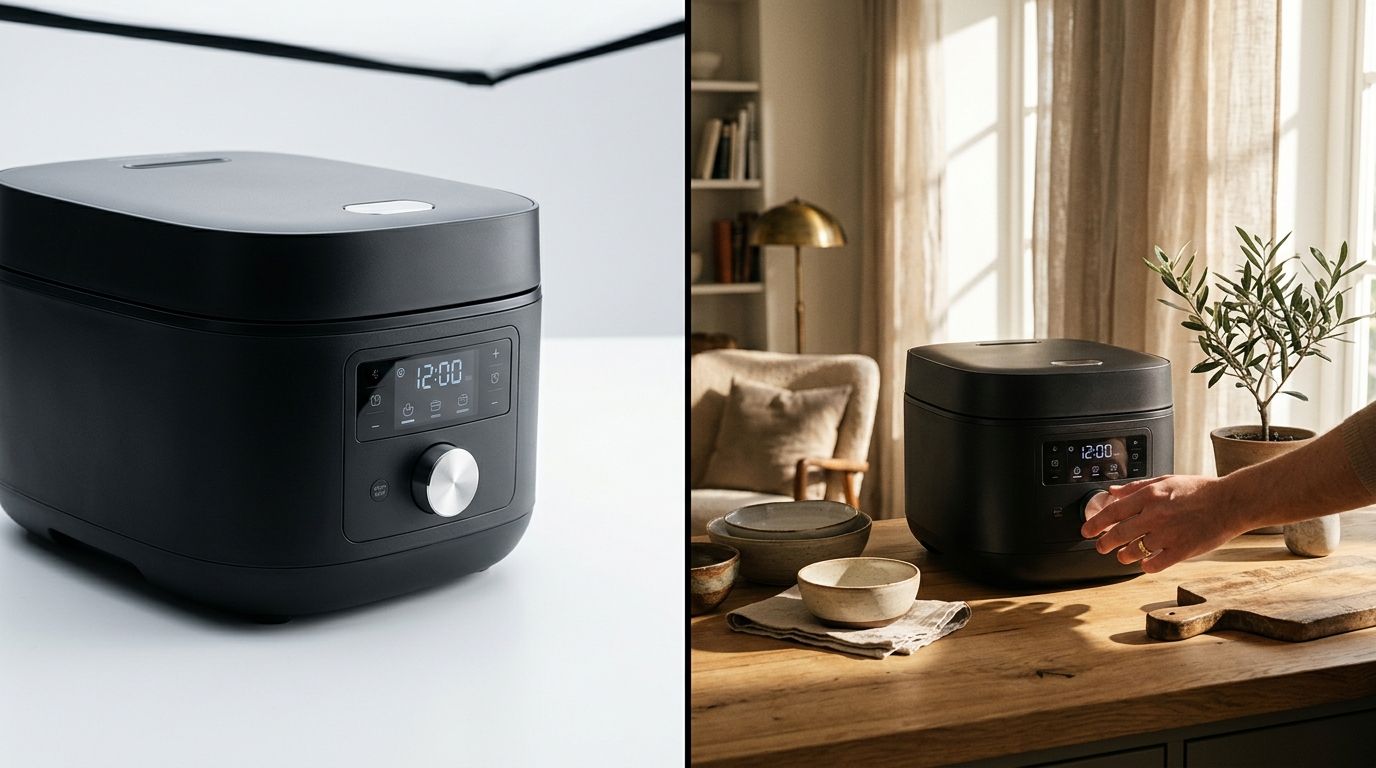
Shooting a product on a pure white background proves the item exists. Shooting that same product on a marble countertop beside a half-finished espresso proves it belongs in your customer's life. Lifestyle product photography for ecommerce is the critical bridge between a sterile, clinical catalog and a compelling brand narrative. If you want to build genuine brand aspiration and drive higher sales volumes, you have to show the product out in the wild.
Definition
Lifestyle product photography is the visual practice of displaying items within authentic, lived-in environments. This method focuses on demonstrating product utility and aesthetic value in the context of daily human activity rather than static, isolated framing.
For years, doing this at scale was nearly impossible for most independent brands. You could afford a plain studio shoot for your entire 300-item catalog. Lifestyle shots were heavily rationed and strictly reserved for homepage hero banners. Renting an architectural home, hiring a specialized prop stylist, and wrangling production schedules costs thousands of dollars a single day. The logistics killed the creative output.
AI product photography changes that entire workflow. You can now generate high-quality lifestyle product images for every SKU on your site without ever booking a location or paying a permitting fee. The bottleneck shifts from your budget to your imagination.
If your brand relies heavily on a specific human face for trust, like a famous founder actively holding the product in an instructional video, you still need a traditional photographer for those key campaigns. Generative tools are incredible for environmental context, but they are not meant to replace your actual founder's likeness just yet.
Why lifestyle product images change the conversion math
Standard product photography answers logical questions. It tells the buyer about the silhouette, the hardware, and the exact shade of blue. Lifestyle photography answers emotional questions. It tells the buyer who they become when they own the item.
Selling the environment over the item
People rarely buy isolated objects. They buy into better versions of their own daily routines. When an ecommerce brand in the home goods space displays a ceramic mug on a blank canvas, they are selling a vessel for liquid. When they display that same mug on a rustic wooden table surrounded by morning sunlight and a folded newspaper, they are selling a slow, peaceful Sunday morning.
That emotional resonance is one of the strongest product photo conversion factors you can leverage. Shoppers scroll past generic listings constantly. They stop when they see an aesthetic they want for themselves. Aspiration is a massive driver of consumer behavior in fashion, beauty, and home decor. If your visual presentation lacks that aspirational pull, you are competing purely on price.
The power of visual context
Beyond raw emotion, lifestyle context provides vital practical information that reduces return rates. Placing a handbag next to a standard tablet or a coffee cup instantly communicates the true size of the bag. A plain white background distorts scale. A customer might assume a tote bag is massive until it arrives and barely fits a laptop. Placing products in recognizable environments sets accurate expectations.
The friction of traditional lifestyle photography
If lifestyle images are so effective, why do so many brands still rely on sterile white backgrounds for 90 percent of their catalogs? The answer is pure logistics. The friction of producing lifestyle imagery the old way is crushing.
Why the invoice never matches the estimate
I have sat through enough location shoots to know that the original budget is just a suggestion. You rent a gorgeous mid-century modern home through a production booking site. You pay the day rate. Then you pay the specialized insurance. Then the photographer needs an assistant. Then it rains, and the natural window light you planned on is gone, forcing you to rent heavy continuous lighting gear at the last minute. A shoot intended to cost three thousand dollars quickly balloons to seven thousand dollars before lunch.
| Feature | Traditional Shoot | AI Generation |
|---|---|---|
| Cost | High (Variable) | Low (Flat fee) |
| Timeline | Weeks of prep | Minutes of generation |
| Logistics | Complex/Risky | Minimal |
| Consistency | Difficult to maintain | Perfect |
Prop sourcing and endless delays
Traditional lifestyle setups require physical objects to fill the frame. If you are shooting skincare, you need marble trays, specific botanicals, textured towels, and perfectly clear water glasses. Sourcing effective product photography props takes days of hunting through local boutiques. If a prop looks cheap on camera, it drags the perceived value of your product down with it. These delays add weeks to your launch schedule. By the time you get the edited photos back, the season is often halfway over.
How to create lifestyle product photos that actually convert
Throwing an item onto a random background does not automatically make it a high-converting image. The execution has to be flawless. Consumers have incredibly trained eyes in 2026. They instantly spot bad Photoshop jobs, mismatched lighting, and clashing aesthetics. If you are going to use lifestyle imagery, you have to get the details right.
Lighting coherence is non-negotiable
The single biggest mistake brands make when generating or compositing lifestyle images is ignoring light direction. If the sunlight in the background environment is hitting the floor from the left, but the highlight on your product bottle is on the right, the viewer's brain immediately rejects the image. It looks fake. High-quality lifestyle imagery demands accurate shadow casting and correct ambient light reflection.
Choosing the right aspirational setting
Your environment must match the specific price point and target demographic of the item. You do not place a twenty-dollar daily face wash on a gold-plated vanity in a luxury penthouse. It creates cognitive dissonance. You place it in a bright, clean, minimalist bathroom that feels approachable but elevated. You use your backgrounds to build visual brand identity consistently across every page. Every image should feel like it belongs to the same overarching universe.
Transitioning to AI lifestyle product photography
The math of ecommerce has shifted. High-volume brands can no longer afford to run slow, expensive studio shoots for every new drop. This is exactly where AI tools have stepped in to solve the catalog problem.
Breaking the production bottleneck
Using AI for your ecommerce lifestyle photography removes the logistics completely. You do not check the weather. You do not negotiate with a prop house. You take a clean, well-lit photo of your product in your office or warehouse. You upload that image into the software, type in the exact environment you need, and the system generates the scene.
Using CherryShot AI for catalog volume
This is precisely why we built CherryShot AI. We wanted to give founders the ability to produce campaign-ready photos in minutes instead of weeks. You can upload a simple product shot, select the Lifestyle or Luxury mode, and instantly get high-resolution images of your product sitting perfectly in an aspirational space. The AI handles the complex shadow generation, the environmental reflections, and the scale mapping automatically.
The result is a storefront that looks incredibly expensive to produce, running on a workflow that takes an afternoon. When you eliminate the massive overhead of location shooting, you free up cash flow to invest in actual customer acquisition.
Scale your lifestyle photography today
You can transform your plain product shots into aspirational assets without the traditional production headaches. Audit your current catalog to identify which SKUs lack context and use CherryShot AI to bridge that gap before your next marketing campaign launches.
Try CherryShot AIFrequently Asked Questions
What is lifestyle product photography?
Lifestyle product photography features items in curated, real-world environments instead of sterile studio backgrounds. This approach integrates products into scenes that mirror the lifestyle of your target customer base. Such imagery provides essential visual context regarding scale, typical usage, and the overall mood of the brand.
Why does lifestyle photography convert better for ecommerce?
Buyers purchase identities and emotional experiences rather than simple physical objects. High-quality lifestyle photography facilitates the imaginative process by placing products within aspirational scenarios. A cast-iron pan on a warm, rustic stove builds immediate emotional resonance that standard white backgrounds fail to provide.
How do I create lifestyle product photos for my brand?
Brands typically choose between traditional location shoots or modern AI-driven solutions. Traditional methods involve expensive prop sourcing, stylists, and full-day studio bookings. AI platforms allow you to take a single well-lit product photo and place it into infinite high-end environments in minutes. Using AI enables you to scale your entire catalog effectively without the massive overhead associated with physical production.
What makes a good lifestyle product image?
Authenticity in lighting coherence and environmental context defines a successful lifestyle image. Shadows must align perfectly with the ambient light source of the room to avoid looking artificial. Props should feel natural and curated, rather than distracting or forced. If the lighting feels disjointed or the environment appears messy, the image loses its aspirational power and fails to convince the buyer.
Can AI create lifestyle product photography?
Modern AI platforms generate photorealistic lifestyle environments around a single uploaded product shot. These tools process spatial depth, lighting, and shadow physics to ensure the product appears as if it belongs in the scene. You can select specific visual moods to match your brand identity across thousands of SKUs. The final output provides a professional, campaign-ready look without requiring complex staging or professional photography equipment.
Upgrading your catalog from plain white backgrounds to rich environmental contexts is one of the fastest ways to elevate your brand perception. Stop letting the logistics of traditional shoots hold your creative strategy hostage. Explore how CherryShot AI can transform your raw product shots into campaign-ready lifestyle imagery today.