Luxury Product Photography: How Premium Brands Use Photography to Justify Premium Prices
If your product costs three times as much as the category average, your photography has to do the heavy lifting of justifying that premium. The harsh reality of ecommerce is that nobody cares about your supply chain or your rare ingredients until the visual presentation forces them to care. High prices demand high visual codes. Premium brands do not rely on standard catalog flat lays to move expensive inventory. They engineer desire through deliberate light, aggressive shadows, and carefully controlled negative space.
Definition
Luxury product photography is a specialized visual style that emphasizes mood, texture, and product quality through advanced lighting and composition. It moves beyond simple documentation to build a premium brand identity that supports higher retail pricing.
For years, founders operating in the premium tier assumed that achieving this level of visual sophistication required massive studio budgets. I have personally sat through studio shoots that ran four hours over schedule because an art director wanted to nudge a single shadow half an inch to the left. The invoice at the end of that day was never just for the photographer. It covered the studio rental, the lighting assistant, the stylist, and the catering. We paid thousands of dollars for three usable hero images.
True luxury houses will always hire celebrity photographers for their global billboard campaigns. That level of bespoke, highly political art direction involves layers of human approval that software cannot entirely replace. I am not suggesting that an automated tool takes over a global flagship rebrand. That is a trade-off you have to accept when operating at the absolute pinnacle of fashion.
Worth noting here, the goal for most premium brands is not to replicate a Vogue cover for every single SKU, but to elevate the catalog baseline so the website feels expensive enough to support the price tag.
Today, scaling that premium visual language does not require renting a studio. By understanding the visual codes of luxury product photography, you can produce assets that communicate extreme value without the bloated production schedule.
The Psychology of Premium Pricing
Decoding the visual codes of luxury product photography
Standard product photography prioritizes clarity above all else. The objective is to blast the product with flat light so the customer can see every stitch, zipper, and label instantly. This approach works perfectly for discount retailers and basic commodities. It fails miserably for luxury goods.
A luxury brand photography style prioritizes emotion over raw utility. Premium brands use shadow deliberately to highlight texture, create depth, and establish mood. The lighting is structural rather than purely functional. When you look at an image from a top-tier fragrance house, you do not just see a glass bottle. You see the sharp specular highlight cutting across the edge of the glass. You see the deep gradient falling away into darkness. The product looks monumental.
Space is another critical visual code. Cramming a product into the frame so it fills every pixel is the visual equivalent of a discount bin. Giving a product abundant negative space is the visual equivalent of a locked glass display case in a quiet boutique. The space around the product signals confidence. It tells the customer that this item is so valuable it deserves room to breathe.
If your baseline imagery is flat, it drags down the entire perceived value of your store. Upgrading your visual baseline is the most effective way of avoiding a cheap brand look without burning cash on a massive rebrand. You do not need to change your logo or your packaging. You just need to change how the light hits your packaging.
How to Photograph Luxury Products at Volume
| Feature | Mass Market | Luxury |
|---|---|---|
| Lighting | Flat, Even | Structural, High-Contrast |
| Background | Pure White | Textured, Gradient |
| Negative Space | Minimal | Generous |
| Visual Focus | Function | Emotion |
Executing high-end photography aesthetics without the studio overhead
When founders ask me how to photograph luxury products, they usually assume the answer involves a ten thousand dollar day rate. Historically, they were right. Achieving premium photography style ecommerce visuals required a full team. You needed someone who understood lighting ratios, someone to style the props, and a retoucher to clean up the dust spots. That traditional workflow meant premium brands could only afford to shoot high-end imagery for their homepage heroes. The rest of the catalog was relegated to basic white backgrounds.
That compromise is no longer necessary. AI product photography changes the math completely. You can now execute high end product photography standards across hundreds of SKUs without waiting three weeks for retouched files.
Upload a standard flat image of a leather bag or a glass bottle, pick a visual mode, and CherryShot AI generates campaign-ready photos in minutes. By selecting the Luxury or Loud Luxury mode, the AI automatically applies the visual codes we just discussed. The texture of the leather is preserved and highlighted. The lighting feels intentional and dramatic. The final image respects the premium pricing photography rules that humans used to spend hours dialing in manually on set.
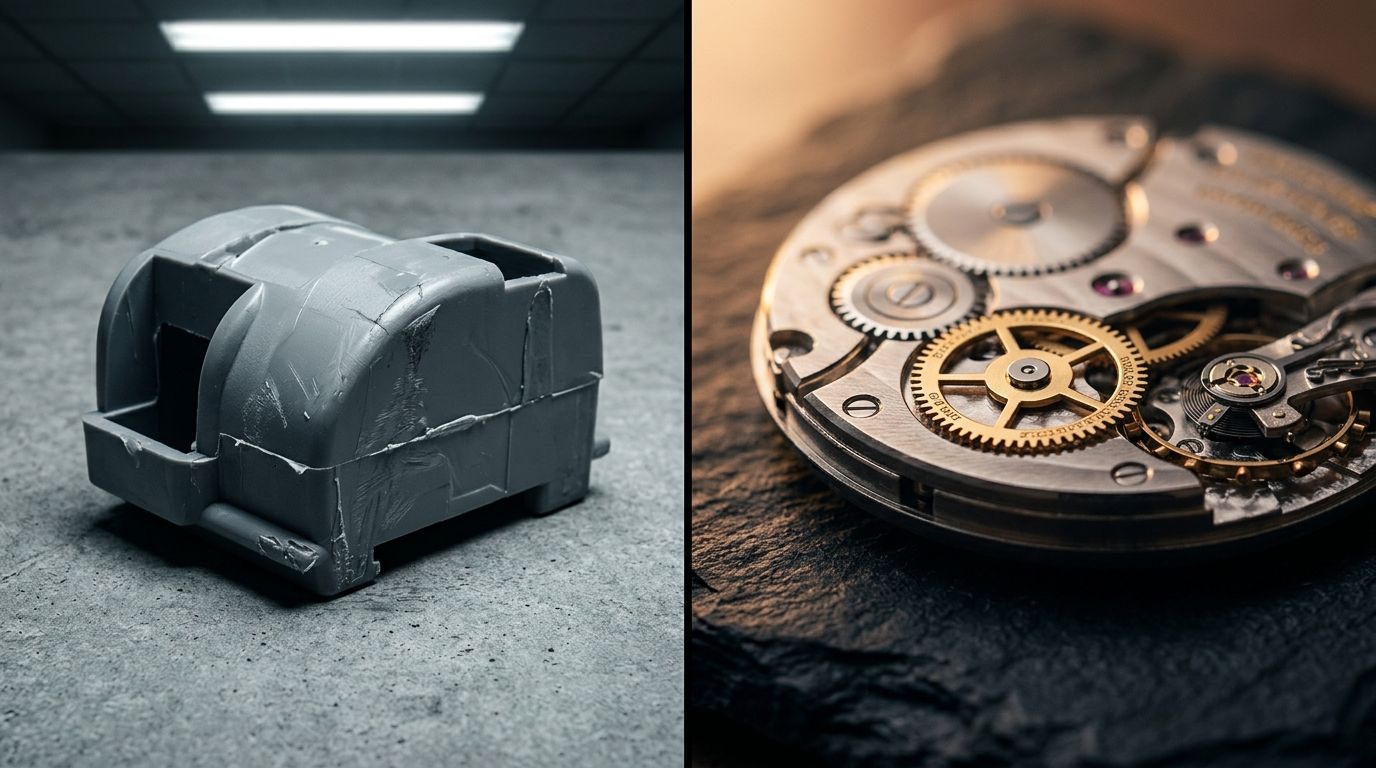
An example of premium brand photography style utilizing intentional lighting and negative space to elevate product value.
Adapting Luxury Brand Photography Techniques by Category
Nuances of premium pricing photography
Luxury is not a monolithic aesthetic. A heavy, moody shadow works brilliantly for a premium whiskey bottle or a handcrafted leather watch strap. It does not always work for a vitamin C serum. The visual codes must adapt to the category while maintaining the underlying signals of wealth and quality.
For beauty brands, the luxury codes often shift toward aggressive minimalism. Think pristine water ripples, heavy marble textures, and ultra-crisp reflections. Learning the exact nuances of premium skincare visuals means understanding how light interacts with frosted glass and high-viscosity formulas. The lighting must communicate purity and efficacy. The environment must look sterile yet expensive.
Jewelry presents an entirely different set of challenges. Customers buying a five thousand dollar ring need to see the exact cut of the stone and the polish of the metal. Capturing fine jewelry photography traditionally requires focus stacking and micro-lighting techniques to make diamonds sparkle without blowing out the highlights on the gold band. A premium brand photography style for jewelry leans heavily on dramatic contrast. Dark backgrounds are frequently used to force the viewer's eye directly onto the brilliance of the metal.
Establishing strict luxury product image standards
A single beautiful hero image loses its power if the rest of the product page looks like a cheap afterthought. Consistency across the entire customer journey is the ultimate luxury signal. You can easily spot the visual brand differentiation between a ten million dollar business and a hundred thousand dollar business just by looking at their secondary catalog images.
The big brand maintains high end product photography standards on every single hover state, variant thumbnail, and lifestyle shot. Nothing is left to chance. Every angle reinforces the price tag. By utilizing tools like CherryShot AI, smaller premium brands can finally bridge this gap. You can generate imagery for a new colorway in twenty minutes instead of booking another shoot day. When you remove the production bottleneck, you can enforce rigorous luxury standards across your entire site footprint.
Elevate your product catalog visuals
Audit your existing product pages against these luxury photography codes. If your current images fail to support your pricing, use CherryShot AI to generate premium, high-contrast assets that better represent your brand value.
Try CherryShot AIFrequently Asked Questions
What makes product photography look luxury?
Luxury product photography centers on dramatic lighting, textured shadows, and significant negative space. These elements draw the viewer's eye while signaling that the item possesses inherent value. You must avoid flat lighting setups that remove character, as these often make expensive items appear inexpensive to the target demographic.
How do luxury brands photograph their products?
Premium brands utilize complex lighting modifiers to sculpt product shape and texture. They rarely display items on plain white backgrounds, preferring textured surfaces or architectural props to ground the product. These companies enforce strict visual guidelines across every SKU to ensure the entire catalog maintains a cohesive and high-end feel.
How do I use photography to justify a premium price?
Your visual assets must mirror the status of the price tag. If an item costs more, the lighting and composition must reflect that gap in quality. Create an environment that implies value, forcing the shopper to perceive the product as high-end before they examine the specifications or ingredient lists.
What are the visual codes of luxury product photography?
Key codes include structural lighting, intentional shadows, and minimal compositions. Negative space serves as a primary marker of high-end design, signaling to the customer that the product deserves room to stand alone. This empty space creates an impression of confidence and exclusivity.
Is AI photography suitable for luxury brand products?
Yes, specialized platforms allow brands to generate professional, high-end assets that meet rigorous quality requirements. These tools apply the specific lighting and composition rules found in luxury photography, saving time while maintaining brand standards. You can produce campaign-ready imagery that matches the aesthetics of a professional studio shoot without the standard production costs.
Key Takeaways
- High prices require high visual codes like structural lighting and negative space to justify the premium.
- Standard flat catalog lighting signals utility, whereas intentional shadows signal luxury and emotion.
- Maintaining visual consistency across secondary catalog images separates top tier brands from amateurs.
- AI product photography allows brands to scale high-end aesthetics without bloated studio budgets.
You cannot convince a customer to pay a premium price if your visual presentation looks exactly like a discount competitor. Elevating your photography is not an aesthetic vanity project. It is a fundamental requirement for protecting your margins. With platforms like CherryShot AI, achieving that high-end look no longer requires weeks of planning and endless studio invoices. You can generate the exact assets you need to support your pricing strategy today.