Product Photography Consistency: How to Make Every SKU Look Like One Brand
If your collection page looks like five different brands grouped together by accident, you have a consistency problem. Product photography consistency is not about making every single image identical. It is about establishing a visual baseline so the customer focuses entirely on the product, rather than the jarring difference in lighting between two adjacent SKUs.
Definition
Product photography consistency refers to the maintenance of uniform visual standards, such as lighting intensity, camera angle, and background color, across an entire ecommerce product catalog. It acts as a set of rules that ensures every SKU appears as part of a single, cohesive brand aesthetic rather than a collection of disparate images.
A fragmented grid breaks trust instantly. Achieving true visual cohesion requires strict technical standardization or a digital system that enforces rules by default. We are going to break down exactly how to stop your catalog from looking like a garage sale.
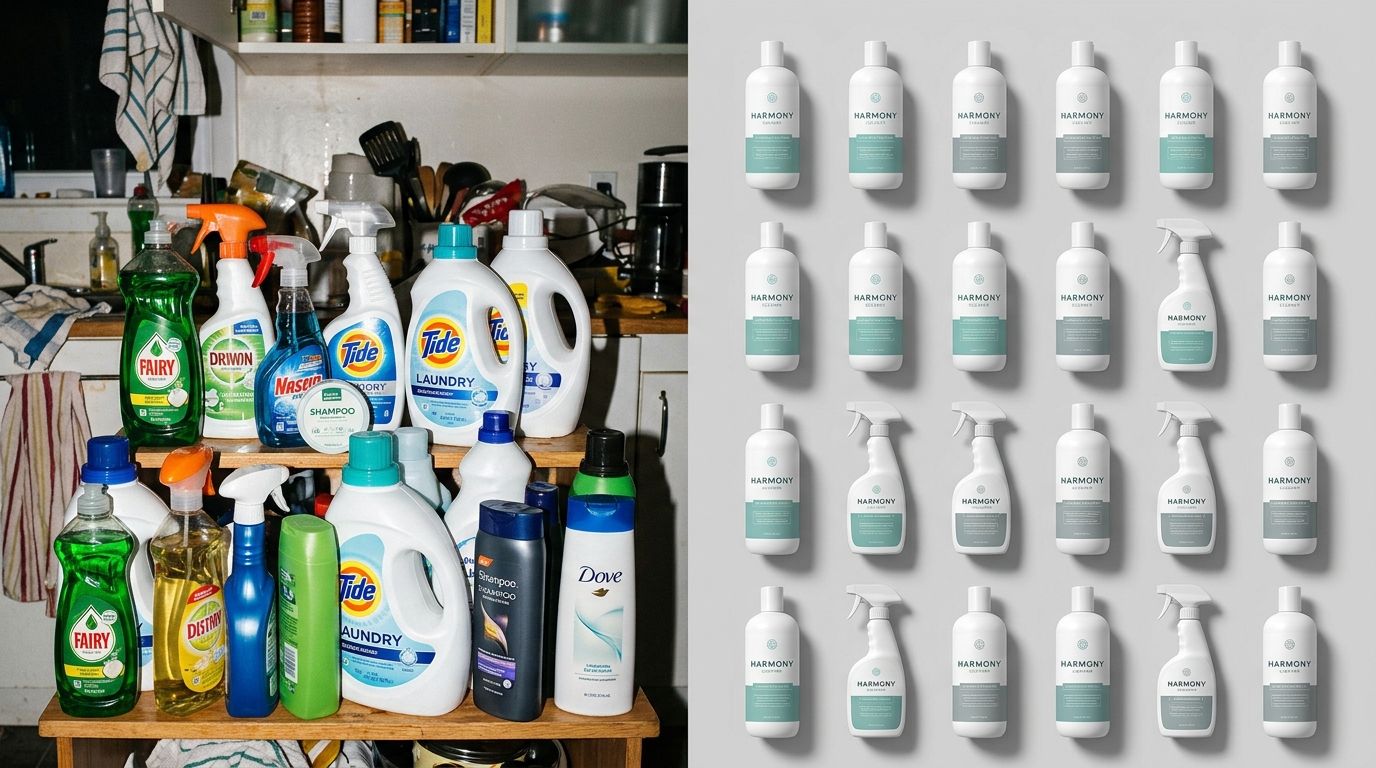
Customers do not actively notice when your catalog photography consistency is perfect. They expect it. They do notice when the background of your new hero product is a slightly warmer white than the rest of the row. That slight variation introduces friction. It signals a lack of polish.
The anatomy of an ecommerce brand photography style
Building a cohesive grid starts with documentation. You cannot tell a photographer to just make it look like the last batch. You have to hand them a blueprint. Creating a comprehensive photography brief for consistency is the only way to lock down the physical variables.
Defining your focal length and angle
Perspective shifts will ruin your grid. If one product is shot at 35mm and the next is shot at 85mm, they will look entirely different even if the lighting is identical. The wider lens introduces distortion. The longer lens compresses the product. Your style guide must mandate a specific focal length for all catalog work.
Camera height is equally critical. Shooting down at a forty-five degree angle gives a completely different context than shooting straight on. Pick an angle that serves your product category best and write it into the rulebook. Every product must occupy the exact same percentage of the frame. Margin spacing is not a suggestion.
Standardizing your light placements
Lighting is the signature of your brand. Flat lighting looks clean and clinical. Hard directional lighting creates heavy shadows and drama. Whatever you choose, you have to replicate it every single time you launch a product.
Documenting a consistent lighting setup requires a physical diagram. You need to map the distance of the key light to the product. You must record the exact power output. You have to specify the modifier type. A silver umbrella produces a drastically different shadow gradient than a double-diffused softbox. You must lock these variables down.
The logistical nightmare of SKU photography consistency
Writing a style guide is straightforward. Executing it over twelve months is a logistical nightmare. Every time you book a traditional studio shoot, you introduce physical variables back into the equation.
The reality of human error
You hire a freelancer. They read your brand guidelines. They set up the lights. They nudge the fill light three inches to the left because they think it flatters the product better. The photos come back looking fantastic in isolation. When you upload them to your site next to the previous collection, they clash entirely.
A rigid style guide guarantees a cohesive grid, but it completely limits creative experimentation during the shoot. You have to decide if you want art or if you want infrastructure.
This is the fatal flaw of relying on physical production for long-term consistency. Equipment ages. Strobe bulbs shift in color temperature over time. You might change studio spaces and suddenly deal with a lower ceiling that bounces light differently. You end up spending heavily on post-production just to color-correct the new batch to match the old batch.
How to enforce cohesive product photography without the studio
Any brand launching products continuously eventually realizes that physical shoots are the wrong tool for catalog volume. When you need consistent visuals for new SKUs, you do not need another photo shoot. You need a system that enforces your visual baseline automatically.
Moving from physical variables to digital rules
AI product photography completely bypasses the physical variables. You upload a flat product image. You select a visual mode. CherryShot AI applies the exact same lighting logic, shadow intensity, and focal depth to that new product as it did to the one you generated three months ago. The environment is structural. It cannot drift.
This structural approach is why AI works so well for ecommerce. If you choose the Minimalist mode, you know exactly how the light will hit the product. If you use the Upload Ref feature, you can mandate that every new image mimics a successful hero asset perfectly. The consistency is baked into the software.
| Photography Method | Enforcement Strategy | Drift Risk |
|---|---|---|
| Traditional Studio | Manual Style Guide | High |
| Digital Production | Structural AI Parameters | None |
By removing the physical shoot, the per-image cost drops to under $5. The turnaround time drops to an afternoon. More importantly, the visual identity of your brand remains absolutely bulletproof.
Audit your product page images before your next campaign
Compare your best-performing hero images against your newest catalog additions to identify visual drift. If your lighting or composition varies across SKUs, you are likely losing conversion opportunities. Use CherryShot AI to normalize your library by reapplying your preferred lighting and shadow settings to your entire existing inventory.
Try CherryShot AIFrequently Asked Questions
Why is product photo consistency important for ecommerce?
Consistent product photography builds consumer trust by creating a predictable visual experience across your entire catalog. Variation in lighting or angles between products creates subconscious friction that makes a brand appear disorganized or unreliable. High-quality imagery that maintains uniform technical standards forces the viewer to focus on the product features rather than technical errors. This uniformity signals professional operations and typically leads to higher conversion rates for online stores.
How do I create a product photography style guide?
Establish a master document containing your specific camera settings, lighting diagrams, and background color codes. Include reference images showing acceptable and unacceptable compositions for your brand. Detail the post-production requirements for file size, aspect ratio, and color correction to ensure every asset remains identical. Require all production team members to sign off on these technical constraints. Consistent catalogs depend on treating these guidelines as a non-negotiable contract for all future shoots.
How do I keep lighting consistent across product photos?
Use controlled artificial light rather than relying on inconsistent natural sunlight throughout the day. Document every aspect of your lighting setup, including strobe power, modifier type, and precise distance from the product to the light source. Recreate this exact geometric configuration for every single shoot to minimize variance. Digital workflows often provide superior consistency by applying identical light rendering to every product image uploaded to the system.
What settings ensure consistent product photography?
Manual camera settings provide the only path to reliable technical uniformity across a large image library. Lock your focal length between 50mm and 85mm to avoid lens distortion that changes the product shape. Set a constant aperture around f/8 to f/11 for deep depth of field and consistent sharpness. Fix your ISO at 100 to eliminate digital noise and maintain color accuracy. Consistent manual control prevents automatic camera adjustments from creating discrepancies.
How does AI ensure product photo consistency?
Artificial intelligence replaces physical production variables with rigid digital parameters applied to every asset. You select a defined visual mode that forces consistent lighting, shadow intensity, and focal depth across every product SKU. Because the software generates the environment, physical factors like bulb age or studio location become irrelevant to the final output. Every image inherits the exact same visual properties, which eliminates the possibility of human error or environmental drift.
Key Takeaways
- Inconsistent catalog imagery directly damages brand trust and increases visual friction.
- Traditional shoots require rigid style guides to lock down focal lengths, angles, and lighting outputs.
- Physical setups are incredibly vulnerable to human error and environmental drift over months of production.
- AI tools provide a structural solution that enforces your visual baseline automatically across unlimited SKUs.
Visual consistency is the foundation of a premium ecommerce experience. Stop paying for endless rounds of post-production just to make a new product match your existing catalog. Build a workflow that enforces your brand style by default. Explore CherryShot AI to see how structural image generation keeps your grid flawless.