Ring Light vs Softbox for Product Photography: Which Lighting Wins?
The debate between a ring light and a softbox usually ends the second you try to shoot a glossy product. A softbox wins for almost all commercial catalog work. It provides the wide, smooth illumination required to make apparel look premium and electronics look expensive. A ring light is a specialized tool built to flatter human faces. If you try to use a ring light for product photography, you will spend your entire afternoon trying to edit out the glaring white circles reflecting off your packaging.
Definition
Product photography lighting modifiers are tools used to change the quality, direction, and shape of light before it hits a subject. Softboxes diffuse light to create soft gradients, while ring lights concentrate light into a circular pattern often used for portraits.
Choosing the right modifier dictates the entire quality of your catalog. Every product interaction with light is different. A matte cardboard box absorbs light smoothly. A glass perfume bottle acts like a mirror that shows the customer exactly what is happening behind the camera.
Worth noting, ring lights do have one specific use case in macro beauty shots where the circular reflection is an intentional creative choice. For standard catalog volume, they are a massive liability.
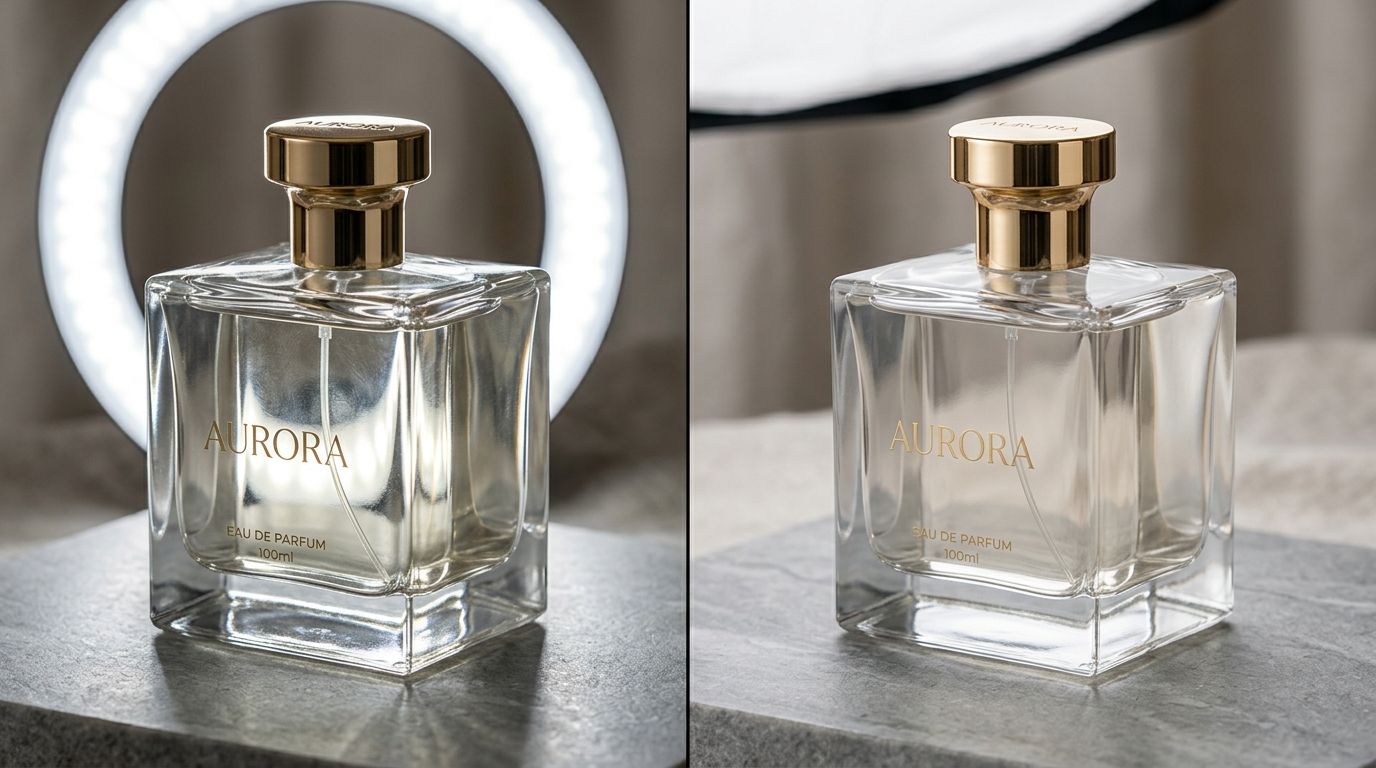
A standard softbox provides the smooth gradient highlights required for premium ecommerce photography.
Understanding the product photography lighting comparison
To understand why one modifier beats the other, you have to understand how light travels. A bare lightbulb shoots harsh, direct rays. This creates dark shadows and tiny, blindingly bright spots on your product.
To fix this, photographers place materials in front of the bulb to scatter the rays. The size and shape of that material determine the quality of the light hitting your SKU. This is the foundation of any reliable essential lighting setups used by top ecommerce brands.
The mechanics of a ring light
A ring light is exactly what it sounds like. It is a circular band of small LED bulbs. Its primary purpose in the photography industry is vlogging and portraiture. When placed directly in front of a person, it illuminates the face evenly from all sides and creates a distinct white circle in the subject's eyes.
This is called catchlight photography. In human eyes, it looks lively and modern. On a shiny plastic shampoo bottle, it looks like a cheap manufacturing defect. Because the light source is a literal ring, any reflective object will mirror that exact shape back into the camera lens.
The mechanics of a softbox
A softbox is a rectangular, octagonal, or square enclosure that surrounds a lightbulb. The inside is lined with reflective silver material to push all the light forward. The front is covered by one or two layers of translucent white fabric.
When the light pushes through that fabric, it scatards evenly. This creates perfect diffuse light product photography. Instead of a harsh circle, you get a broad, gentle wash of light. When this light reflects off a cylindrical product, it creates smooth specular highlights. A specular highlight is the bright gradient line running down the side of a wine bottle or a lipstick tube. That smooth gradient is the universal visual cue for premium quality.
Softbox vs ring light product photography: By category
| Product Category | Ring Light Performance | Softbox Performance |
|---|---|---|
| Cosmetics & Skincare | Creates harsh, distracting circles | Produces premium gradient lines |
| Apparel (Flat Lay) | Generally acceptable results | Superior texture enhancement |
| Jewelry & Watches | Poor, unappealing reflections | Excellent control and contrast |
| Electronics | Reflects off screens poorly | Provides broad, even coverage |
When to use a ring light ecommerce photos
There are very few scenarios where a ring light is the best tool in the room. If you are shooting top-down flat lays of completely matte objects like paper greeting cards or canvas tote bags, a ring light positioned directly over the camera lens provides an incredibly fast, shadow-free exposure.
It is also highly portable. If your brand relies on behind-the-scenes social media content shot on a smartphone, a ring light is easy to move around the warehouse. But for the main website catalog, it falls drastically short.
When a softbox product photography setup is mandatory
A softbox is the undisputed workhorse of commercial studios. If you want your products to look like they belong in a high-end department store, you need softboxes.
They give you absolute control. You can move a softbox to the side to emphasize the rugged texture of a leather boot. You can place it directly overhead to illuminate the interior of a luxury handbag. If you are building a complete product photography setup, a pair of large rectangular softboxes is the very first purchase you should make.
The reality of managing a fill light setup
Owning the best lighting for product photography does not automatically yield perfect photos. Lighting is a game of physics and patience.
When you place a softbox to the left of your product, the right side falls into deep shadow. You then have to build a fill light setup. This usually involves placing a white foam board on the right side to bounce light back into the shadows. You spend ten minutes angling the board perfectly. Then you realize the background is too gray, so you add a third continuous light product photography fixture just to illuminate the seamless paper.
You finally get the lighting perfect for a wide bottle of lotion. The next SKU on your shot list is a tall, thin tube of lip gloss. The dimensions are completely different. Your perfect lighting setup is suddenly casting a terrible shadow. You have to start the entire adjustment process over.
This is the hidden cost of DIY studio work. Every minute you spend nudging a softbox two inches to the left is a minute your new product line is sitting in the warehouse instead of generating revenue on your website.
The smarter alternative to the lighting debate
The choice between a softbox and a ring light is ultimately a choice about how you want to spend your time. Managing physical lights requires studio space, expensive modifiers, and hours of tedious adjustments.
If you are running a brand that launches dozens of SKUs per quarter, arguing over modifier shapes is a massive bottleneck. The modern approach bypasses the studio entirely.
Audit your product page images before your next campaign
If your current product photos feature inconsistent lighting or harsh circular reflections, they are likely hurting your conversion rate. You can upload your raw images to CherryShot AI to generate perfectly lit, high-converting product shots in minutes, completely bypassing manual studio setups.
Try CherryShot AIFrequently Asked Questions
Is a ring light good for product photography?
Ring lights perform poorly for product photography because they produce artificial, circular reflections on shiny surfaces. Most commercial items feature glass, plastic, or metal that act as mirrors, exposing the light source shape clearly. You should choose a diffused light source instead to ensure professional results. Use ring lights only for flat, matte objects like paper goods or fabric if you absolutely must maintain a minimal, low-cost lighting setup.
What size softbox do I need for product photography?
Select a softbox that measures at least the dimensions of your product, though twice the size is preferable. Small jewelry items usually require a 24-inch modifier, while larger apparel on mannequins needs a 48-inch softbox to wrap light effectively. Properly sizing your modifier ensures the light source wraps around the curves of your product. Always measure your largest items before purchasing equipment to guarantee sufficient coverage for all your current inventory.
Can I use a ring light for ecommerce product photos?
Ring lights are unsuitable for most ecommerce catalogs because they generate distracting, unnatural reflections on reflective packaging. These artifacts are difficult to remove in post-production and signal low-quality images to your potential customers. Stick to this tool only for matte, flat-lay photography where surface reflections are non-existent. Professional stores require soft, broad light sources to create the high-end look expected by online shoppers during the final purchase decision process.
How many lights do I need for product photography?
Professional results usually demand two to three light sources to properly define product shapes. A primary key light handles the main exposure, while a secondary fill light prevents harsh shadows on the opposite side. Include a third background light if you need to isolate your product against a pure white surface. Beginners might start with one large, diffused light plus a bounce card, but multi-light setups provide more consistent, predictable output.
What is the best affordable lighting for product photography?
The most effective budget lighting consists of a standard continuous LED bulb housed inside a large, rectangular softbox. Pair this with inexpensive foam core boards to serve as reflectors for filling in dark shadow areas. This combination mimics the light quality of expensive strobe systems without the high price tag. Maintain consistency by keeping these light and reflector positions fixed once you find an arrangement that creates clean, soft gradients on your products.
Stop fighting with light stands and shadow adjustments just to get a catalog shot live. When you realize when DIY photography works and when it creates a massive operational delay, the decision becomes simple. Go to CherryShot AI, upload your product, and generate your entire catalog in the time it takes your competitors to set up their tripods.