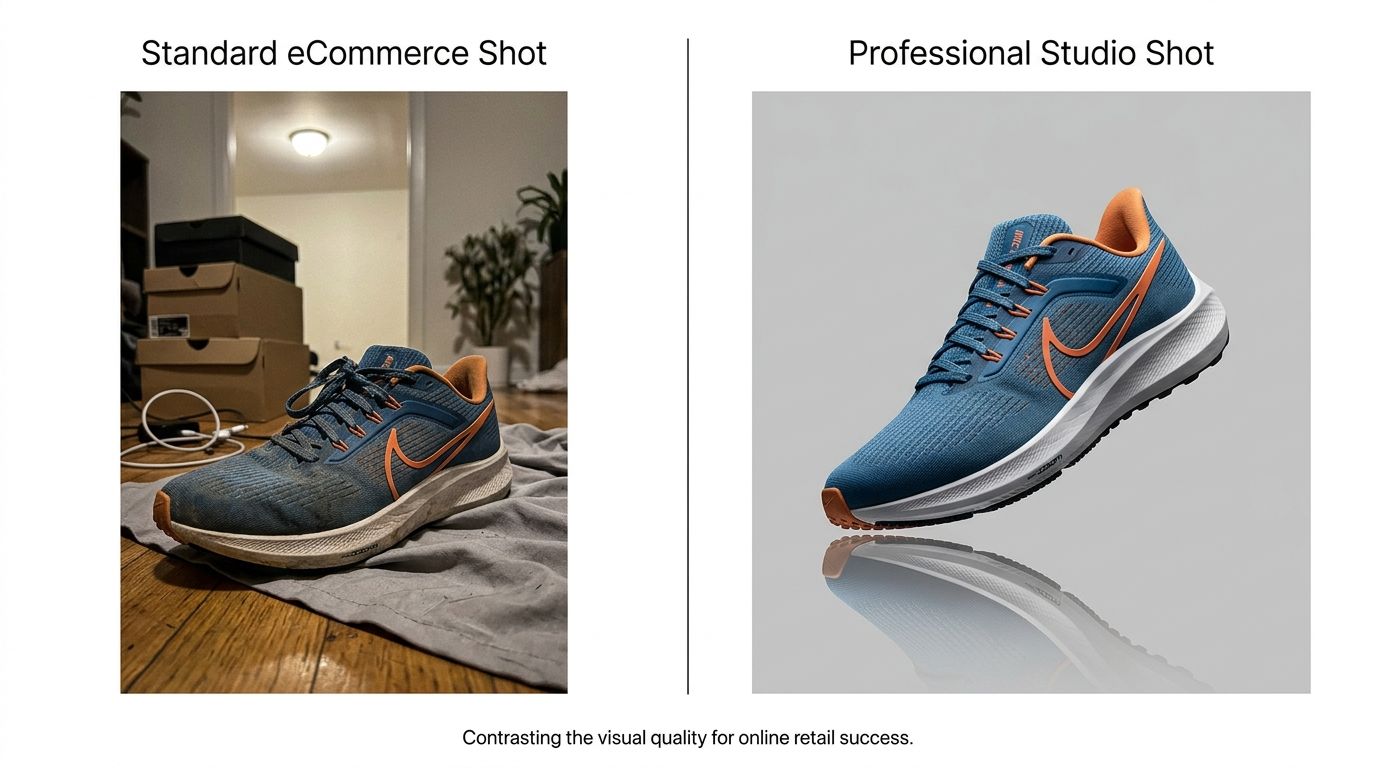
Successful shoe photography ecommerce listings do not leave the buyer guessing about fit, texture, or arch support. Top footwear brands standardize their visual approach by capturing specific angles, controlling lighting to highlight material depth, and mixing pure white backgrounds with lifestyle context. Any brand relying on just a top-down and a single side profile is throwing away conversions.
Effective shoe photography for ecommerce requires at least six specific angles to drive purchases. These essential shots include a direct side profile, a three-quarter angled front view, a top-down perspective, a back heel shot, a sole detail, and a macro texture photograph. Providing this comprehensive visual data bridges the gap between digital browsing and physical retail.
Key Takeaways
- Shoppers require six standardized angles to understand a footwear silhouette completely.
- Proper internal stuffing prevents sagging and makes the product look structured and premium.
- Focal lengths between 50mm and 85mm prevent the toe box distortion common in smartphone photography.
- AI generation replaces expensive location shoots for rendering contextual lifestyle backgrounds.
of ecommerce product returns happen because the item looks different in person than it did in the online photos. Invesp, 2024
The Essential Footwear Product Photography Guide
Building a high-converting product page starts with establishing visual consistency across your entire catalog. When a customer clicks from a running sneaker to a leather boot, the presentation style must remain identical. This consistency builds trust. It signals that the brand operates at a professional level and pays attention to the small details. Achieving this level of uniformity requires a strict set of operating procedures for every shoot.
Shoe Photography Angles Ecommerce Buyers Demand
Your hero image must do the heavy lifting. The undisputed champion of footwear hero images is the three-quarter front angle. This specific positioning turns the shoe slightly toward the camera, revealing the shape of the toe box, the curve of the instep, and the branding on the side panel all in one frame. It is the most informative single angle you can capture.
Once the hero image draws the customer in, the supporting gallery must answer their practical questions. The direct side profile proves the heel drop and ankle height. The top-down view shows the width of the shoe, which is a critical buying factor for a massive segment of the population. The back heel shot demonstrates the Achilles support structure. Finally, a clear, well-lit shot of the sole proves the traction pattern and durability. Skipping the sole shot is a common mistake that leaves outdoor and athletic buyers completely in the dark.
How to Photograph Shoes for Online Store Consistency
An empty shoe looks terrible on camera. Gravity causes canvas to collapse, leather to crease, and soft materials to sag lifelessly. Before a shoe ever gets near a camera lens, it must be meticulously stuffed and styled. Professional studios use a combination of wooden shoe trees, crumpled tissue paper, and transparent acrylic forms to push out the toe box and stand the tongue upright.
Lace styling requires just as much attention. Sloppy, uneven laces instantly cheapen the perceived value of the product. The laces should be tied tightly enough to hold the structure of the shoe together, with the excess neatly tucked inside the cavity of the shoe. If the design features a prominent bow, the loops must be perfectly symmetrical.
Advanced Sneaker Photography Ecommerce Tips
Once the physical product is prepared, the technical execution dictates the final quality. Smartphone cameras have improved dramatically over the last five years, but they still struggle with the specific geometric and lighting demands of footwear. Getting the shape and texture right requires a fundamental understanding of optics and illumination.
Lens Selection and Distortion Management
Focal length completely changes the apparent shape of a shoe. Most smartphones use a wide-angle lens by default. When you place a wide-angle lens close to a shoe, perspective distortion takes over.
A wide-angle lens will distort the toe box and make the heel look unnaturally narrow.
To capture an honest representation of the footwear silhouette, you need a focal length between 50mm and 85mm. This compresses the background slightly and renders the proportions of the shoe exactly as the human eye sees them. The shoe looks grounded, proportional, and accurate. If you are shooting with a smartphone, you must switch to the telephoto lens setting and physically step back from the product.
Controlling Lighting for Canvas and Suede
Lighting strategy changes entirely depending on the material of the shoe. Flat, even lighting works well for a smooth patent leather dress shoe, but that same lighting setup will make a textured suede sneaker look flat and inexpensive.
Proper lighting reveals the quality of your materials.
For highly textured materials like suede, heavy canvas, or intricate knit meshes, you need directional light. Placing a strong light source at a sharp angle to the fabric casts micro-shadows across the texture. This highlights the nap of the suede and the weave of the knit.
(Worth noting: shooting pure white leather against a pure white backdrop requires underexposing the shoe by at least one full stop to prevent the laces and stitching from blooming into pure digital white.)
Scaling Backgrounds Without a Studio
The average DTC footwear brand updates its core catalog imagery four times a year. Doing this entirely with physical shoots creates a massive logistical burden. You have to book studio time, coordinate shipping for physical samples, and hope the weather holds up if you need natural lighting. Modern ecommerce teams bypass this bottleneck entirely by rethinking how they handle their background imagery.
Elevating Shoe Flat Lay Photography
Flat lays serve a distinct purpose in your marketing funnel. They are highly effective for social media campaigns, email newsletters, and unpacking sequences. They allow you to show the shoes alongside related accessories like socks, laces, or cleaning kits. However, a flat lay should never be your primary product image. It inherently flattens the 3D volume of the shoe, making it harder for the buyer to visualize the fit.
When executing flat lays, shadow management is critical. The shoes must look like they belong in the scene, not like they are floating in space. Creating soft, realistic drop shadows under the footwear gives the image gravity and professionalism.
Using AI for Contextual Environments
The standard white background is non-negotiable for clean product grids, but secondary images require context. A hiking boot needs to be seen on rocks. A minimalist white sneaker benefits from a clean architectural background. A luxury heel looks best on marble or velvet.
Instead of renting multiple locations to get these distinct aesthetics, forward-thinking brands use AI workflows. You can take a basic, well-lit studio shot, upload it to CherryShot AI, and select a visual mode like Minimalist or Lifestyle. The platform analyzes the lighting and perspective of the original photo and places the shoe into a photorealistic, campaign-ready environment. This workflow generates dozens of high-quality variations in minutes. It completely removes the need to hire location scouts or transport inventory across the city.
This approach also allows for rapid seasonal updates. When winter arrives, you can process your existing boot photography through a different visual mode to instantly generate cold-weather context imagery without touching a physical camera.
Frequently Asked Questions
What are the most important angles for shoe product photography?
The essential angles include a three-quarter front view, a direct side profile, a top-down shot, a back heel view, and a clear shot of the sole. The three-quarter view serves as the best hero image because it shows the toe box shape and side profile simultaneously. Adding a macro shot of the material texture helps reduce return rates by setting accurate expectations. A complete set of these six angles gives buyers the confidence of holding the shoe in their physical hands.
How do I photograph white shoes without overexposure?
You must separate the lighting on your background from the lighting hitting the shoe itself. Keep your main light slightly feathered away from the footwear and use negative fill cards to add subtle gray shadows along the outer edges.
Should I photograph shoes on a model or flat?
You should shoot the primary catalog images flat or on clear acrylic stands and reserve on-model photography for secondary gallery images.
What is the best background for shoe photography?
A pure white or light gray background remains the industry standard for main product pages because it removes distractions and keeps the focus strictly on the footwear silhouette. For promotional materials and social channels, textured surfaces like concrete or minimalist studio sets provide necessary brand context. Many modern brands now generate these contextual backgrounds from a single white-background source image.
If you want to quickly turn a basic product photo into a premium contextual lifestyle shot without booking a studio, CherryShot AI starts at $10 for 50 images at cherryshot.ai.