Shoes Photoshoot: 7-Shot Formula That Drives Footwear Sales in 2026
You are losing sales right now because a customer cannot tell how thick the padding is around the ankle collar of your best-selling sneaker. They want to buy it. They have the item in their cart. But they have been burned by stiff heel counters before, and your single profile shot does not give them the confidence to click checkout.
Definition
A footwear photoshoot is the process of capturing specific angles of a shoe to verify its construction, fit, and material quality for online shoppers. The goal is to replicate the experience of inspecting a product in a physical store using only high-resolution imagery.
A high-converting shoes photoshoot is not an exercise in creative expression. It is an exercise in answering objections. Footwear is notoriously difficult to sell online because fit and feel are deeply personal, and a flat image cannot easily communicate arch support or toe box width.
You beat footwear return rates through aggressive visual clarity. This means delivering exactly seven specific angles on every single SKU you sell.
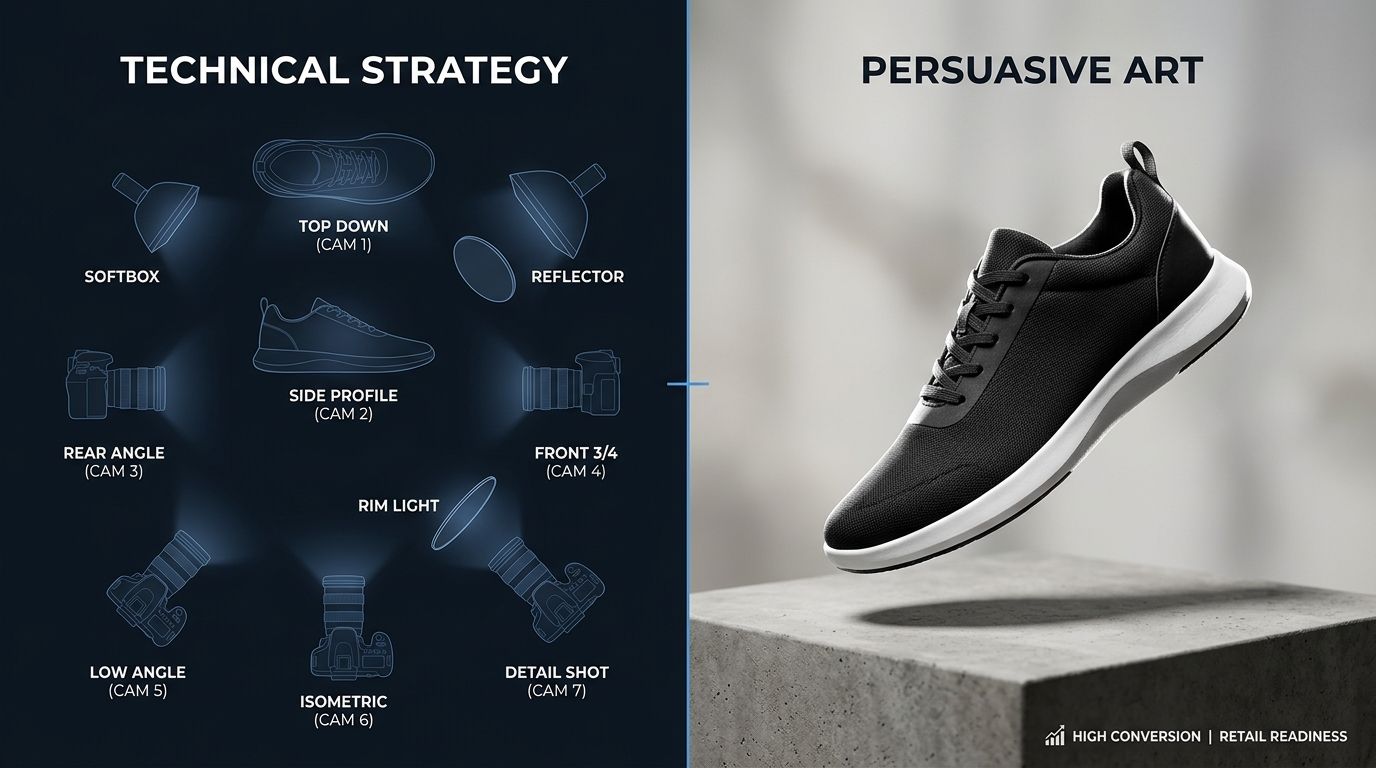
Why footwear product photography breaks studio budgets
Before we break down the specific angles, we need to acknowledge why shoes are uniquely frustrating to shoot. Apparel can be steamed and draped. Cosmetics sit perfectly still in nice packaging. Shoes are chaotic combinations of mixed materials that all interact with light differently.
You might have a single sneaker featuring brushed suede panels, a patent leather swoosh, a matte rubber midsole, and reflective nylon mesh. When you blast that shoe with a standard strobe light, the patent leather blows out into a white glare while the suede turns into a muddy, textureless shadow. A photographer has to build complex flags and bounces just to expose all four materials correctly in a single frame.
When you multiply that lighting setup time across an entire seasonal catalog, the logistics collapse. This is why mastering your ecommerce lighting setup is the hardest part of managing physical shoe production. It takes hours.
The physical structure of a shoe also causes massive headaches. An unlaced sneaker looks sloppy on a white backdrop, but a tightly laced empty sneaker looks suspiciously flat. Studios spend an absurd amount of money paying stylists to stuff tissue paper into toe boxes just to recreate the volume of a human foot.
The 7-shot formula for footwear ecommerce photography
Stop guessing what angles your customers need to see. If you are struggling with determining your optimal image count, six to eight is the industry standard for footwear. Every successful shoe listing on the market today follows this exact sequence.
| Shot Angle | Purpose | Key Visual Check |
|---|---|---|
| Profile | Hero view | Level with midsole |
| Three-Quarter | Toe box volume | 45-degree angle |
| Heel Counter | Ankle support | Symmetry |
| Top-Down | Lacing view | Vertical alignment |
| Sole | Traction | Tread pattern |
1. The pure profile shot
This is your hero image. It is the immediate silhouette read. The camera must be positioned completely parallel to the shoe, sitting roughly at the midpoint of the midsole. Do not shoot down at an angle. Do not shoot up. You want a perfectly flat architectural elevation.
Customers use this shot to instantly judge the heel drop, the arch profile, and the general chunkiness of the sole. If you angle the camera even slightly upward, you distort the proportions and make the shoe look clunky.
2. The three-quarter toe-forward angle
This is the angle a customer sees when they look down at their own feet while wearing the shoe. Position the shoe at a 45-degree angle facing the camera, slightly offset. This is historically the most clicked image after the hero shot.
This angle communicates the volume of the toe box. Customers with wide feet are scanning this specific photo to see if their pinky toe is going to be crushed against the lateral edge. Ensure the lacing is perfectly symmetrical for this shot.
3. The direct heel counter
Turn the shoe exactly 180 degrees from the camera. You are photographing the back of the heel straight on. This is where most brands hide their core branding elements, like embroidered logos or custom pull tabs.
More importantly, this shot proves the structural integrity of the ankle collar. Shoppers want to see if the heel is rigid or collapsible. They are looking for the thickness of the internal padding to judge blister risk. Keep your depth of field deep enough so the internal lining stays sharp.
4. The direct top-down view
Suspend the camera directly above the shoe. This angle is brutal because it exposes any asymmetry in your manufacturing, but buyers demand it. It provides the absolute clearest view of the lacing system, the tongue thickness, and the internal insole graphics.
For slip-on shoes or loafers, this shot is critical for showing the exact shape of the foot opening. A narrow opening signals a difficult entry, which a buyer needs to prepare for.
5. The explicit sole shot
If you skip the sole shot, you are asking for returns. Lay the shoe on its side or tilt it back so the bottom tread faces the lens squarely. Footwear buyers are incredibly particular about traction.
Someone buying a trail runner needs to see the exact depth of the rubber lugs. Someone buying a dress shoe needs to know if the sole is pure leather, which slips on carpet, or if it features rubber grip inserts. Never make the customer guess what is touching the ground.
6. The macro material detail
Move the camera in uncomfortably close. You want to fill the entire frame with a three-inch section of the upper material. If it is full-grain leather, the customer needs to see the pores. If it is knit mesh, they need to see the weave pattern and breathability holes.
This shot single-handedly justifies your price point. Cheap synthetic leather looks flat up close. Premium materials have character. Highlight your stitching density and glue lines. Clean construction in a macro shot builds massive brand trust.
7. The contextual lifestyle shot
White background shoe photos isolate the product, but lifestyle images give it scale and context. A chunky dad shoe looks completely different floating in a void than it does paired with wide-leg denim. You must provide at least one image showing the shoe on a human foot in a realistic setting.
When you are approaching lifestyle product photography, remember that you are selling the aesthetic outcome. A running shoe should be shot on pavement or a track. A luxury loafer belongs on a polished stone floor or a textured rug.
Escaping the traditional studio bottleneck
Delivering seven unique angles across a catalog of forty SKUs means producing 280 flawless images. If you are shooting physical samples in a traditional studio, you are looking at thousands of dollars in day rates and weeks of post-production retouching to clean up dust and scuffs.
This is where general-purpose image tools fail, but specialized AI product photography thrives. AI tools excel at taking a single baseline image of a shoe and regenerating it across dozens of environments without requiring a physical set.
You can upload a basic smartphone photo of your new sneaker on a desk. By selecting the Minimalist mode in CherryShot AI, you instantly receive a perfectly lit studio catalog shot with pure white backgrounds and correct drop shadows. Switch to the Influencer mode, and that exact same sneaker is suddenly being worn on the streets of New York, styled perfectly with modern denim.
The math is impossible to ignore. A studio shoot runs anywhere from $80 to $200 per finished image. CherryShot AI pricing starts at $10 for 50 images. You can generate the entire 7-shot sequence for a new colorway in under five minutes.
There is one genuine limitation to acknowledge here. AI can occasionally struggle with hyper-complex, untied laces floating in mid-air. For the absolute best results, upload your reference photos with the laces tied neatly. The AI will preserve the exact geometry of the shoe body, the branding, and the textures flawlessly.
Key Takeaways
- Shoppers require at least six explicit angles to trust a footwear listing enough to purchase.
- The pure profile shot must be entirely flat and level to avoid distorting the shoe proportions.
- Every listing must include a direct sole shot to prove traction and a macro detail shot to prove material quality.
- AI generation drops the per-image cost of a full 7-shot sequence from hundreds of dollars to pennies while eliminating studio scheduling bottlenecks.
Audit your product page images before your next campaign
Review your top three sellers against the seven-shot criteria defined above. If you are missing a sole shot or a clear macro detail, you can upload your existing hero images to CherryShot AI to quickly generate the missing angles in a matching style.
Try CherryShot AIFrequently Asked Questions
What are the best angles to photograph shoes?
The absolute required angles for a complete footwear listing are the straight profile, the three-quarter toe-forward angle, the direct heel back, the top-down toe shot, and a clear shot of the sole. You must also include at least one macro detail shot showing the primary material and one lifestyle image establishing scale and wearing context. These seven shots collectively answer the most common technical questions shoppers ask during the research phase of their purchase.
How do I photograph shoes without a model?
You can photograph shoes effectively without a model by using clear acrylic stands to hold the shoe upright or by stuffing the toe box with tissue paper so the upper maintains its structured shape. Once you capture these standalone product photos on a flat surface, you can run them through an AI tool using a Lifestyle or Influencer mode to generate realistic wearing contexts without ever booking a talent agency or a professional photographer.
What background is best for shoe product photos?
A pure white or very light gray background remains the standard for primary hero images on ecommerce listings because it removes all visual distractions from the shoe silhouette. For secondary catalog images, minimal architectural surfaces like concrete, pale wood, or matte stone provide texture that elevates the perceived value of the footwear without overwhelming the product details. Consistency across these backgrounds ensures that your brand catalog feels professional and organized to returning site visitors.
How do I photograph sneakers for resale?
Sneaker resale requires hyper-specific proof of authenticity and condition. You must document the sizing tag inside the tongue, the original box label, the precise tread condition on the outsole, and any factory flaws. Buyers in the resale market are inspecting images for verification just as much as they are looking at the aesthetic appeal. Clear, sharp documentation of these specific wear points prevents disputes and increases buyer confidence in high-ticket transactions.
Can AI generate footwear product photography?
Yes. You can upload a standard flat photo of a shoe and AI tools will map the exact geometry of the footwear to place it in high-end studio or lifestyle settings. The system preserves the exact branding, material textures, and silhouette of your original upload while building completely new contextual lighting and background environments around the product. This approach maintains high visual quality while drastically reducing the time required to populate a new seasonal inventory.
Your customers cannot try on your shoes through a screen, which means your photos carry the entire burden of proving value and fit. When you are ready to produce high-end footwear listings in minutes without waiting on physical studios, try CherryShot AI to scale your next campaign.