Candle Product Photography: The Complete Lighting and Styling Guide
Selling a candle online means selling a scent the customer cannot smell. Your photography has to do all the heavy lifting. Mastering candle photography requires balancing two conflicting light sources. You need intense studio lighting to render the label and the glass vessel clearly. You also need dim ambient lighting to capture the soft glow of a lit wick without blowing out the exposure. Most home fragrance brands fail here. They end up publishing photos with harsh reflections blocking the label or dark images where the wax looks like muddy plastic. You fix this by treating the glass and the flame as two distinct lighting problems.
Definition
Candle photography is the practice of capturing the aesthetic and functional details of wax-based products for ecommerce use. It focuses on rendering the clarity of glass vessels, the texture of the wax, and the atmospheric glow of a flame while maintaining accurate branding information on the label.
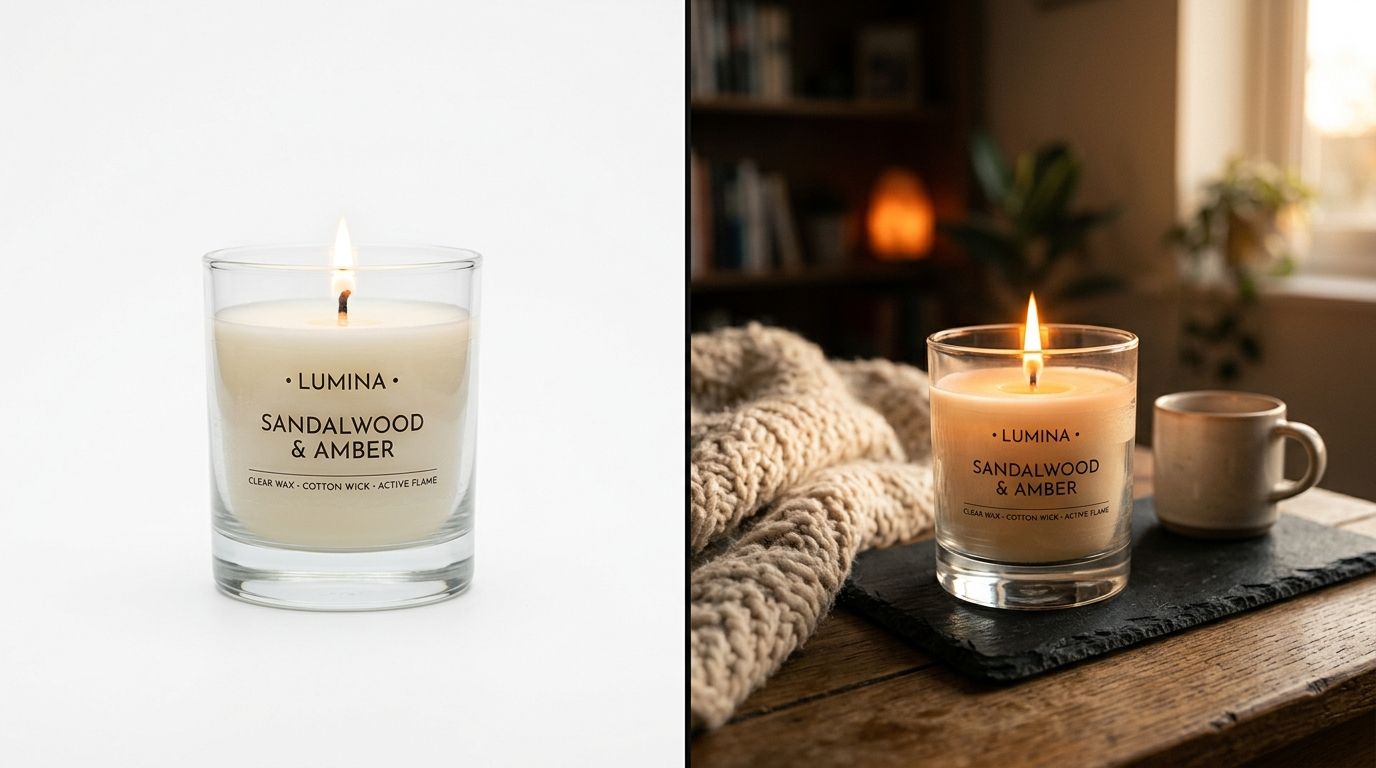
A successful candle photograph requires precise control over both the ambient room light and the directed studio strobes.
How to master candle product photography for ecommerce
Catalog images live or die by their clarity. When a shopper clicks on a white-background listing on your site, they need to read the scent notes on the label instantly. The wax color must be accurate. The glass must look premium, not cheap. Achieving this requires strict control over your environment.
Lighting the glass vessel clearly
Glass is practically a curved mirror. Whatever is in the room will reflect on the surface of your candle jar. If you set up a bare flash in front of the product, you will get a bright, ugly white rectangle stamped directly over your carefully designed label.
The solution is diffusion and angles. Place two large strip boxes on the left and right sides of the candle, angled slightly behind the product pointing forward. This creates an appealing gradient of light along the edges of the jar while leaving the center label clear of direct reflections. Getting this angle correct is the absolute foundation of photographing glass products successfully.
Next, you need negative fill. Position two tall pieces of black foam core board just outside the camera frame on either side of the candle. The black boards block the glass from reflecting the white walls of your studio. This creates sharp, defined dark edges along the contour of the jar. Without negative fill, clear glass visually bleeds into a white background and looks undefined.
Capturing the wax texture and wick
Flat lighting kills texture. If your light source is directly beside the camera lens, the surface of the candle wax will look completely flat. Customers want to see the smooth, creamy texture of soy wax or the intricate placement of a wooden wick.
To reveal texture, you need raking light. Position a smaller light source above and slightly behind the candle, pointing down at the wax surface. This shallow angle casts tiny shadows across the natural imperfections of the wax, giving it dimension. A simple piece of white cardstock placed just below the camera lens can bounce a tiny bit of light back up to fill in shadows that get too heavy.
How do you photograph a candle flame perfectly?
Combining a bright studio flash with a live fire is a logistical nightmare. Strobes fire at a fraction of a second with immense power. A candle flame is a weak, continuous light source. If you expose your camera for the strobe to capture the label perfectly, the flame vanishes entirely into a tiny white speck. If you expose for the flame, your strobes will blow out the label until it is unreadable.
There is no camera setting that solves this perfectly in a single click. Combining two exposures in post-production adds time to your workflow, but it is the only way to get a perfectly crisp label and a warm, glowing flame in the same shot.
Balancing ambient flame exposure with studio light
Lock your camera on a heavy tripod. You are about to take two photos that must align perfectly pixel by pixel.
Even pressing the shutter button with your finger can introduce microscopic camera shake. Use a remote trigger or a two-second timer to ensure the camera remains absolutely motionless.
First, turn on your studio strobes. Expose entirely for the glass jar and the label. The candle can be unlit for this shot. Take the photo.
Second, turn off the strobes entirely. Light the candle. Lower your shutter speed dramatically. You might need a shutter speed of 1/15th of a second or slower to capture the warm, ambient glow of the fire hitting the inside of the glass. Take the photo. Finally, layer the two images in Photoshop and mask in the perfect flame over the perfectly lit vessel.
Lifestyle candle photography for social media
White background shots convert on product pages. Lifestyle shots convert on Instagram, Pinterest, and ad creatives. A lifestyle image sells the mood that the scent promises. If you are selling a cedar and smoke candle, you need a dark, moody environment. If you are selling a linen and citrus scent, you need bright morning sunlight and sheer curtains.
Setting the atmosphere and utilizing props
The biggest mistake brands make with lifestyle shoots is clutter. They surround the candle with pinecones, cinnamon sticks, loose matches, and a book. The product gets lost. Sourcing effective photography props means finding items that hint at the scent notes without overwhelming the frame.
Place the candle in the foreground. Use a wide aperture like f/2.8 or f/4 to blur the background into a soft bokeh. This keeps the viewer's eye anchored entirely on your label while the background props provide context and atmosphere.
| Production Method | Typical Time | Asset Volume |
|---|---|---|
| Traditional Studio | 3-5 Hours/Scene | Low |
| AI Photography | 5 Minutes/Scene | High |
Traditional studio shoots vs. AI candle photography
Shooting twenty new SKUs across four different seasonal environments takes days. You have to source props, rent studio space, build the sets, light the sets, and manage the composite editing process for every single flame. The per-image cost climbs rapidly.
This is why high-volume brands are moving lifestyle production entirely to software. With CherryShot AI, you upload one perfectly lit white-background photo of your unlit candle. You select a visual mode like Luxury or Lifestyle. The AI understands the dimensions of the vessel and generates campaign-ready lifestyle environments around it in minutes.
The lighting matches. The shadows behave realistically against the surface below the candle. The background blur naturally isolates the product. You skip the prop sourcing and the set building entirely.
If you are still mapping out ecommerce lighting setups for fifty different lifestyle scenes a year, you are wasting margin. A good photographer still makes sense for your primary brand identity shots. For the sheer volume of assets required to run modern social media campaigns, the traditional studio math simply breaks.
Audit your product page images before your next campaign
Review your current catalog to ensure every vessel is clearly defined and free of harsh reflections. If your lifestyle assets are lacking, upload your existing product shots to see how a consistent environment can improve your click-through rates.
Try CherryShot AIFrequently Asked Questions
How do I photograph a candle with the flame lit?
Capture a lit candle by combining two separate exposures into one final image. First, shoot the candle with studio lighting to ensure the label and glass vessel appear sharp. Turn off the studio lights and adjust the shutter speed to capture the ambient glow of the flame without overexposing the scene. Use image editing software to layer these two exposures together for a perfectly lit product.
What background works best for candle photography?
Pure white backgrounds are mandatory for ecommerce product pages and standardized catalogs. Lifestyle imagery performs better with textured surfaces such as marble, slate, or natural wood grains to provide contrast. Choose a background that complements the vessel material while keeping the focus on the product branding. These textures add depth to the frame without distracting from the candle's specific design or the light emitted by the burning wick.
How do I show the glass vessel clearly in candle photos?
Position two strip boxes on either side of the candle to create clean highlights along the glass edges. Place black foam core boards just outside the camera frame to act as negative fill. This technique eliminates unwanted room reflections and creates high-contrast, defined edges. Properly managing these reflections ensures the glass looks premium and avoids the common issue of the product appearing flat or muddy in the final image.
What lighting creates atmospheric candle photography?
Atmospheric candle photos require a low-key lighting setup to emphasize the glow of the flame. Position a single, heavily diffused continuous light source at a forty-five-degree angle to cast soft, natural-looking shadows. Keep the surrounding room dark to allow the flame to act as the primary light source for the props. This method creates a moody environment that effectively highlights the candle as the centerpiece of the scene.
Can AI generate candle lifestyle photography?
Yes, you can generate lifestyle photography by uploading a clean studio photo of an unlit candle to an AI platform. The software analyzes the vessel dimensions and lighting to place the product into realistic, high-quality environments. This process removes the need for physical set building and complex prop styling for every new scent launch. Designers can now produce consistent brand imagery across entire product lines in just a few minutes.