Ecommerce A/B Testing for Product Pages: Why You Should Test Images Before Anything Else
Every ecommerce growth manager eventually hits the exact same wall. You launch a split test on your add-to-cart button. You wait three weeks for the data to mature. You get a 0.2 percent lift. You declare victory in Slack, but you know the needle barely moved. If you are running an ecommerce A/B testing product page strategy and ignoring your visual assets, you are fighting over pennies while leaving dollars on the table.
Definition
Ecommerce A/B testing is the practice of splitting live site traffic evenly between two distinct versions of a webpage to measure which generates more sales. On product pages, this typically involves isolating a specific variable, such as the hero image or gallery layout, to accurately track its impact on purchase behavior. Teams use this methodology to make strict data-backed design decisions rather than relying on subjective internal opinions.
Testing button colors is a waste of traffic if your hero image does not immediately answer why a customer should care. Shoppers do not read your carefully crafted bullet points until they are already sold on the visual presentation. When you want to see actual, undeniable changes in your conversion rate, you have to test the element that commands the most attention.
(To be clear, layout testing matters when your base conversion rate is already elite. For the other 99 percent of brands, you need tests that swing the conversion rate by a full percentage point, not a fraction of one.)
Why traditional product page split testing fails
The standard playbook for conversion rate ab testing ecommerce sites is broken. Marketers are trained to test the elements that are easiest to change rather than the elements that drive user behavior. Swapping a hex code in CSS takes three minutes. Sourcing a new hero image takes days or weeks. Consequently, teams test typography, button placement, and headline copy endlessly.
The micro-optimization trap
When you run a product page variant test focusing purely on layout, you are running a micro-optimization. You are assuming the customer fundamentally wants the product but is somehow getting confused by the placement of your checkout button. This is rarely true. Usually, the customer is bouncing because the perceived value of the product does not match the price tag. Visuals dictate perceived value entirely.
Traffic volume realities
The genuine limitation of visual testing is that it requires a baseline of traffic to reach statistical significance, meaning smaller stores might wait weeks for a clear result on any split test. However, statistical significance is a function of both traffic volume and the magnitude of the change. A tiny change to a button color requires enormous traffic to prove it worked. A massive change to your hero asset causes a wider split in user behavior, allowing you to reach significance with much less traffic.
Visual A/B test ecommerce frameworks
Once you commit to visual testing, you need a structured approach. Throwing random photos onto a page is not an experiment. You need isolated variables to understand why a specific image changed the conversion rate. If you want to know exactly how to A/B test product photos , you must start with a distinct hypothesis about what your customer needs to see.
The lifestyle vs white background test
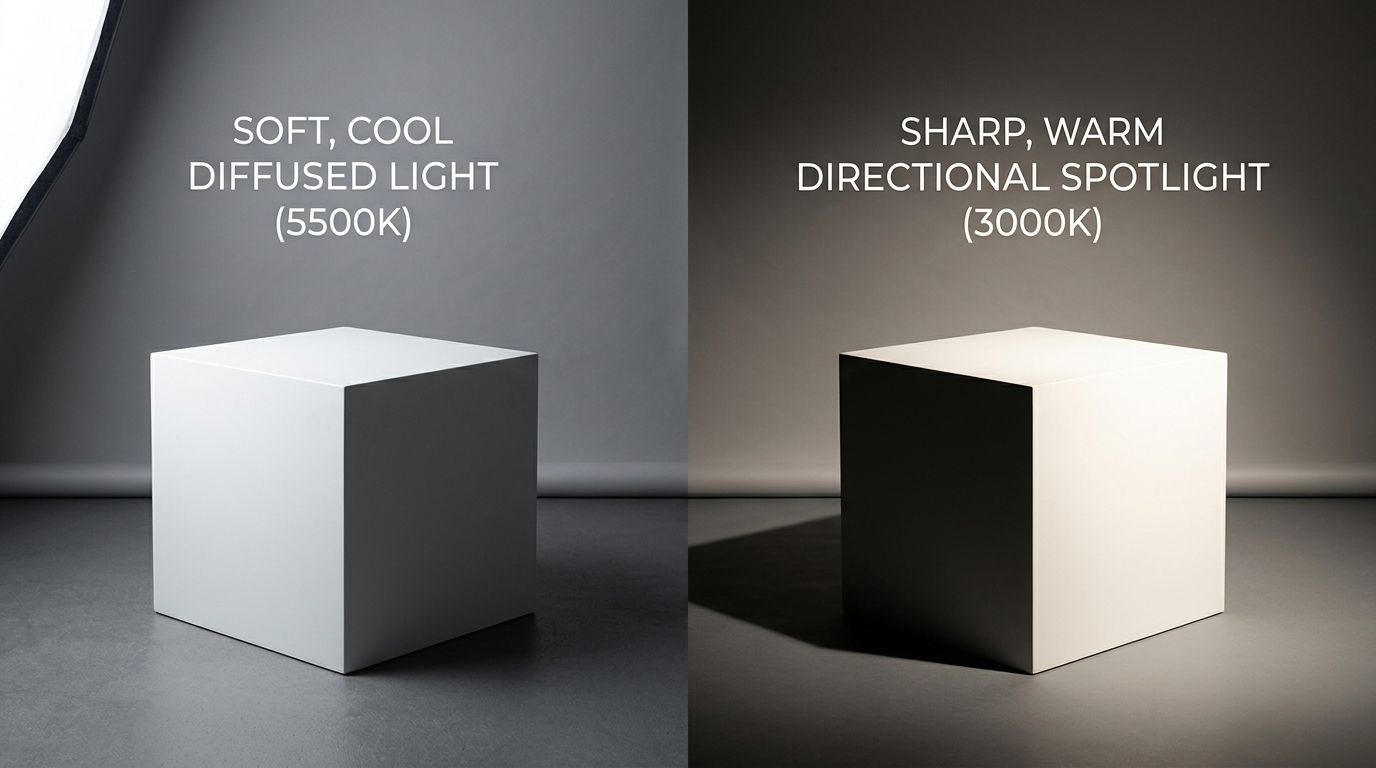
This is the most critical split test product images can undergo. Pure white backgrounds are the default standard. They are clean, they remove distractions, and they are required for Google Shopping feeds. But they are completely sterile. They offer zero emotional resonance and zero context regarding scale.
A lifestyle image places the product in a real environment. It tells the customer how the item fits into their daily routine. Testing a clinical studio shot against a contextual lifestyle shot is the fastest way to learn what drives your specific audience. Some technical buyers want the clinical shot to inspect details. Lifestyle buyers want the mood. You only find out by testing.
| Visual Attribute | Pure White Background | Contextual Lifestyle |
|---|---|---|
| Primary Function | Highlights specific technical details without distraction | Demonstrates physical scale and real-world usage |
| Emotional Impact | Clinical and strictly informational | Aspirational and highly mood-driven |
| Ideal Placement | Google Shopping feeds and specification galleries | Landing page hero images and social advertisements |
The hero image ab test
The hero image is the first image in your product carousel. It is the thumbnail on the collection page. It is the most viewed asset your brand owns. Many brands suffer from broken continuity. Their ad creative is vibrant and engaging, but the landing page hero image is flat and boring.
If your marketing metrics look great but your revenue does not follow, your product images are losing the conversion. An effective hero image ab test involves keeping the exact same product but changing the angle, lighting, or background strictly on that first slot in the gallery. You measure the impact on bounce rate first, then add-to-cart rate second.
Information density testing
Sometimes the issue is not the primary photo, but the supporting cast. Testing gallery depth is highly illuminating. You might assume more photos are always better. Often, a massive gallery overwhelms the mobile shopper, causing fatigue before they reach the description. Figuring out exactly how many product images convert best for your specific SKU category is a test worth running across your entire catalog.
Executing the ecommerce product page ab test
Knowing what to test is only half the battle. The mechanics of running the test properly separate the professionals from the amateurs. A poorly configured shopify ab testing setup will give you corrupted data, leading you to make terrible inventory or marketing decisions.
Shopify ab testing configuration
To run a clean test on Shopify, you need a dedicated application. VWO, Optimizely, or lighter apps like Dexter split your traffic evenly at the server level. You create two distinct URLs or dynamic page states. State A holds your current gallery. State B holds the new visual assets.
You must run the test for at least two full business cycles, typically fourteen days, to account for weekend buying patterns. Never stop a test early just because it looks like one variant is winning on day three. The data must stabilize.
Fixing the production bottleneck
The main reason teams avoid testing product images is the logistics pipeline. You cannot test a Lifestyle mode against a Classic studio shot if you do not own both assets. Booking a freelance photographer to shoot variant images purely for an experiment destroys your testing budget. Waiting three weeks for those variants kills your velocity.
This is exactly where CherryShot AI enters the testing workflow. Instead of coordinating a studio shoot, you upload your existing product image to the platform. You select a visual mode like Minimalist, Loud Luxury, or Influencer. CherryShot AI generates campaign-ready variant photos in minutes. The per-image cost drops to under five dollars.
When you remove the production delay, visual testing becomes as fast as changing a headline. You can launch a hero image test on Monday morning with brand new assets, monitor the data all week, and deploy the winner by Friday afternoon. The bottleneck completely shifts from asset production to idea generation.
Key Takeaways
- Testing minor layout changes yields negligible results compared to testing major visual assets.
- Hero images dictate perceived product value and heavily influence immediate bounce rates.
- A clean split test requires at least two full weeks of traffic to account for weekend buying habits.
- AI generation tools eliminate the logistical delay of sourcing variant images for active tests.
Frequently Asked Questions
How do I A/B test my ecommerce product page?
Identify the specific page element with the highest documented impact on user behavior to begin your experiment. Split testing software handles the technical routing, allocating incoming traffic exactly evenly between your existing control page and the new variant. Monitor the dashboard until the data reaches statistical significance, ensuring the observed difference in conversion rate actually stems from your visual changes rather than random daily traffic fluctuations.
Should I test product images in A/B tests?
Product images drive the absolute highest variance in online purchase behavior compared to any other standard page element. Customers instinctively process visual information to quickly assess item quality, physical scale, and environmental context long before reading written text descriptions. Launching experiments that replace flat studio photography with contextual lifestyle assets consistently generates significantly higher conversion rate lifts than adjusting minor typography details or overall layout structures.
What gets the highest conversion lift from A/B testing?
Major adjustments to the primary visual hierarchy consistently generate the highest overall conversion rate improvements across all product categories. Shoppers heavily weigh the main hero asset when deciding whether an item actually justifies its currently listed price tag. Completely swapping the initial carousel thumbnail or testing an entirely new primary product angle swings final purchase rates by several full percentage points instead of minor fractions.
How do I set up an A/B test for product images on Shopify?
Install a dedicated split testing application directly from the Shopify App Store to handle server-level traffic routing. The software allows you to quickly duplicate your chosen product page and swap the primary image on the new variant without altering your live theme code. Set the audience allocation rules to an exact even split while aggressively tracking add-to-cart clicks as the primary success metric for the entire experiment.
What is the best A/B testing tool for ecommerce product pages?
The ideal testing software selection relies entirely on your monthly site traffic volume and internal engineering resources. Enterprise brands frequently choose sophisticated platforms like Optimizely or VWO to gain granular control over complex audience segmentation logic. Smaller operators running simple image variant tests achieve highly accurate results using lightweight native Shopify applications like Dexter or Convert without needing to write any custom tracking code.
Stop wasting your high-intent traffic on tests that do not move the needle. Your customers want visual proof of value before they hand over their credit cards. If you want to start running high-impact visual tests today without waiting for a studio, explore the visual modes at CherryShot AI and generate your first variant in minutes.
Prepare variant images for your next product page test
Stop delaying your visual testing roadmap because you lack alternative assets. Upload your existing standard product shots to create multiple contextual environments for your upcoming split tests. Produce the required creative variations in minutes rather than waiting on a traditional studio schedule.
Try CherryShot AI