Ecommerce Conversion Rate Optimization in 2026: Fix the Product Page Before You Touch Checkout
Every week I talk to store owners who are spending thousands of dollars on Meta ads but panicking because their sales are flat. Their first instinct is always to audit the checkout flow. They obsess over changing button colors, adjusting shipping thresholds, or adding trust badges below the credit card fields. That is the wrong place to look. If your traffic is not adding items to the cart in the first place, your checkout process is completely irrelevant. True ecommerce conversion rate optimization starts entirely on the product page.
Definition
Ecommerce conversion rate optimization is the systematic process of improving your online store to increase the percentage of visitors who make a purchase. It involves diagnosing drop-offs in user flow and adjusting page elements to remove purchase hesitation. The core goal is extracting more revenue from your existing traffic rather than simply buying more ads.
The product page is the only place the customer decides if they trust you enough to pull out their wallet. If the page feels cheap or confusing, they bounce. No amount of optimized checkout routing can save a sale that never started.
The trap of the checkout audit
When mid-market brands get frustrated with flat conversion rates, they often hire agencies to run a full ecommerce CRO checklist. These agencies usually return a presentation deck full of micro-adjustments targeted at the bottom of the funnel. They tell you to remove the navigation bar on the payment screen. They tell you to offer guest checkout. These are valid best practices, but they are optimization tactics for a healthy funnel. They will not fix a broken one.
If you are seeing lots of traffic but nobody is clicking buy, investigating your low add-to-cart rates is the first necessary step. A customer abandoning a cart because shipping is too expensive is a logistical problem. A customer leaving the product page after three seconds is a trust problem. The vast majority of online stores suffer from the latter.
| Optimization Focus | Primary Goal | Traffic Symptom |
|---|---|---|
| Product Page Fixes | Building visual trust and answering objections | High pageviews, low add-to-cart rate |
| Checkout Flow Tweaks | Removing payment friction and logistics anxiety | High add-to-cart rate, low purchase rate |
Why founders focus on the wrong metrics
We focus on checkout because it feels controllable. It is easy to toggle a setting in Shopify to enable Apple Pay. It is much harder to look critically at your own product page and admit that your presentation is lacking. But the hard truth is that modern shoppers are completely ruthless. They have been trained by massive retailers to expect a certain level of polish. If your product page does not meet that baseline visual standard, they will assume your product quality is equally poor.
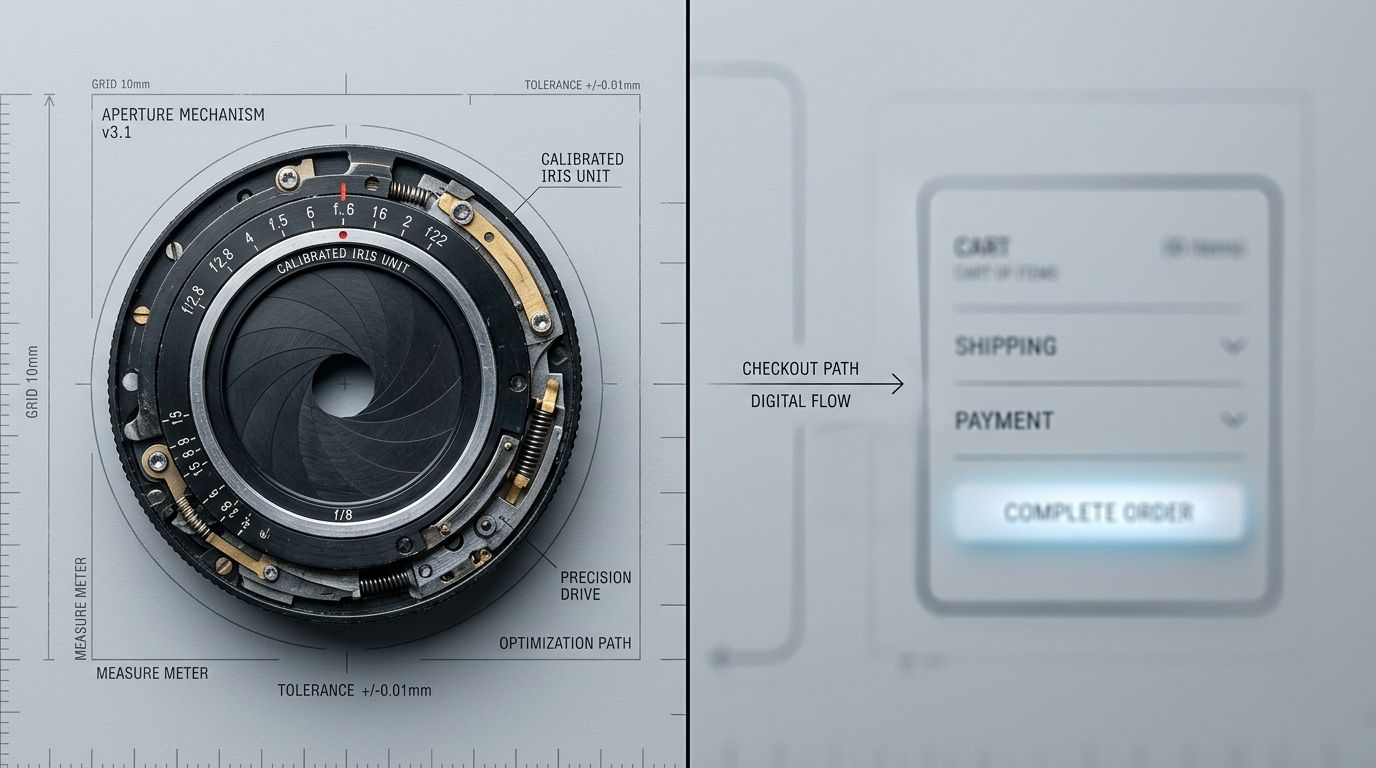
High-quality imagery anchors the visual hierarchy of an optimized product page.
Visual trust is your biggest lever
The single most impactful element of ecommerce product page optimization is the photography. Images are the digital proxy for the physical product. They answer unspoken questions about texture, scale, and build quality. When you optimize product page images, you directly address the anxiety your customer feels about buying something they cannot touch.
I spent years running ecommerce brands before joining CherryShot AI. I know exactly how painful it is to get those images using traditional methods. I have personally sat through studio shoots that ran four hours over schedule just to get a decent lighting angle on a summer apparel line. I have paid invoices that arrived two weeks after the campaign was supposed to launch. I have argued with freelance photographers about whether a shadow was distracting. We routinely paid over $150 per finished image. When you are launching fifty new SKUs a quarter, that math simply does not work.
This production bottleneck is why so many brands settle for mediocre white-background catalog shots. They know the images hurt conversion, but they cannot afford the time or money to shoot anything better.
How AI changes the production math
AI product photography changes this dynamic completely. You no longer have to choose between your profit margins and your conversion rate. With a tool like CherryShot AI, you upload a basic reference photo of your product, select a visual mode like Lifestyle, Minimalist, or Loud Luxury, and generate campaign-ready photos in minutes. Pricing starts at $10 for 50 images. The per-image cost drops to pennies, and the turnaround time goes from three weeks to an afternoon.
(Worth noting: AI photography will not save a fundamentally bad product. If your sizing chart is inaccurate or your shipping takes four weeks, pretty pictures will only delay the inevitable wave of angry customer service emails. But if your product is solid, poor imagery is the single biggest artificial cap on your growth.)
The elements of an optimized product page
Once you solve the visual trust bottleneck, you can focus on the structural elements of the page. There are dozens of small layout tweaks you can make to increase product page conversion once your photography is handled.
Mastering the mobile layout
Over seventy percent of your traffic is browsing on a phone. If your product page requires users to scroll past three paragraphs of text to find the add-to-cart button, you are losing sales. The visual hierarchy must be ruthless. The hero image sits at the top. The price and product title sit directly underneath. The primary value proposition follows immediately, and the buy button must be visible within the first thumb-scroll.
Removing variant friction
If you sell a product in multiple colors or sizes, the selection process must be foolproof. Dropdown menus often cause friction on mobile devices. Use clear visual swatches for colors and prominent buttons for sizes. If a user clicks a red swatch, the main product image must instantly change to show the red variant. Broken variant linking is a massive conversion killer.
Answering objections in the copy
Most product descriptions are boring lists of specifications provided by the manufacturer. Good product copy actually sells the item. It anticipates the reasons a customer might hesitate and addresses them directly. If you sell a heavy winter coat, do not just list the fabric weight. Tell the customer it will keep them warm in sub-zero temperatures. Keep paragraphs short. Use bullet points for easy scanning.
Measuring the fix
Do not measure the success of your product page changes by looking at your overall store conversion rate right away. Overall conversion rate is a blended metric that includes returning customers, email marketing traffic, and wholesale orders. It is too noisy.
Instead, look specifically at your add-to-cart rate for the pages you optimized. If you upgrade your imagery and clean up your mobile layout, the percentage of visitors clicking the buy button should measurably increase. Once that metric stabilizes at a higher level, then you have earned the right to audit your checkout flow.
Key Takeaways
- Checkout optimization cannot save a store that fails to convince visitors to add items to their cart.
- Visual trust is the foundation of product page conversion, and premium imagery is the fastest way to build it.
- AI photography tools eliminate the time and cost bottlenecks of traditional studio shoots.
- Always measure product page success by tracking your add-to-cart rate before looking at overall revenue.
Frequently Asked Questions
What is conversion rate optimization in ecommerce?
Conversion rate optimization in ecommerce is the practice of increasing the percentage of website visitors who complete a purchase. Online merchants achieve this by identifying friction points in the buying process and systematically adjusting page elements to eliminate hesitation. You can improve this metric by analyzing user heatmaps, clarifying your shipping policies, and upgrading your product photography to build immediate visual trust.
What is the average ecommerce conversion rate in 2026?
The global average ecommerce conversion rate hovers between two and three percent across most major retail categories. This broad metric fluctuates significantly based on your specific industry, product price point, and primary traffic sources. Instead of chasing an arbitrary benchmark, merchants should establish an internal baseline and run isolated tests on page layouts to measure incremental improvements against their own historical performance data.
How do product images affect conversion rate?
Product images serve as the digital proxy for physical items by providing essential visual proof of quality. Shoppers rely entirely on these photographs to judge the texture, scale, and build materials of your merchandise before buying. Supplying multiple high-resolution angles alongside realistic lifestyle contexts directly reduces purchase anxiety and increases the probability of a visitor adding the item to their cart.
Should I optimize my product page or checkout first?
Online merchants must prioritize optimizing the product page before adjusting the checkout flow. Tweaking payment screen layouts only matters if visitors actually initiate the buying process by adding merchandise to their cart. Fixing visual drop-offs and clarifying product descriptions at the top of your funnel guarantees that a much higher volume of qualified shoppers eventually reaches your final checkout sequence.
What are the most impactful ecommerce CRO tactics?
The highest impact optimization tactics focus entirely on reducing transaction uncertainty for the potential buyer. Store owners accomplish this by clarifying shipping policies near the buy button and improving mobile page load speeds to prevent early bounces. Upgrading your static catalog photos to show multiple viewing angles and realistic lifestyle contexts provides the strongest immediate boost to your add-to-cart conversion metrics.
Fixing your product page is the most profitable work you can do for your store this quarter. Stop guessing what your customers want and start giving them the visual proof they need to trust your brand. If you are ready to upgrade your product photography without the logistics of a studio shoot, try CherryShot AI and get your campaign ready today.
Audit your product page metrics before your next campaign
Check your analytics right now to find your true add-to-cart rate. If traffic is high but carts are empty, your visuals are likely the culprit. Replace those uninspired catalog shots with high-converting lifestyle images in minutes.
Try CherryShot AI