Etsy Product Photography Visual Standards
An image that crushes it on Amazon will often tank on Etsy. Etsy buyers do not want sterile perfection. They are looking for context, scale, and a visual guarantee that a real human made this item. If your Etsy product photography relies entirely on pure white backgrounds, you are signaling mass production to an audience actively trying to avoid it. The specific visual standard Etsy requires is warmth mixed with absolute clarity.
Definition
Etsy product photography visual standards refer to the specific aesthetic expectations and technical guidelines governing images on the handmade marketplace. These standards prioritize contextual, warm, and authentic lifestyle staging over the clinical white backgrounds typical of traditional e-commerce catalogs. Meeting these requirements signals independent craftsmanship while providing buyers with clear evidence of physical scale, material texture, and overall quality.
The problem most sellers face is not knowing how to use a camera. The problem is treating an Etsy listing like a standard catalog entry. When you understand the unique psychology of the handmade marketplace, your approach to visual merchandising has to shift. You are no longer just documenting the physical dimensions of a product. You are selling the aesthetic lifestyle attached to it.
The Etsy Buyer Psychology
When someone searches for a ceramic mug on a general retail site, they are solving a functional problem. They want to know the volume, the material, and if it is microwave safe. When someone searches for a ceramic mug on Etsy, they are solving an emotional problem. They want a morning ritual. Your photos have to bridge that gap immediately.
Context over sterility
This is the fundamental difference between generic e-commerce imagery and successful etsy shop photography. Buyers need to see the item living in the real world. A leather wallet isolated on a perfectly white background looks like it was dropshipped from an overseas factory. That same wallet sitting on a raw oak desk next to a cup of black coffee suddenly has a narrative. It feels crafted. It feels intentional.
Understanding what makes product photos convert on this specific platform requires leaning into texture and shadow. Natural shadows prove the item physically exists in a real space. Flat, shadowless lighting removes depth and makes your handmade items look like digital renders.
| Visual Element | Traditional E-commerce | Etsy Marketplace |
|---|---|---|
| Primary Background | Pure white (RGB 255) isolation | Styled lifestyle or textured surface |
| Lighting Style | Flat, shadowless, and clinical | Natural, directional with visible depth |
| Buyer Motivation | Functional product verification | Emotional connection and aesthetic fit |
| Prop Usage | Strictly prohibited by guidelines | Actively encouraged for scale and context |
The trust gap in handmade goods
Etsy buyers know they are taking a slight risk. They are buying from an independent creator, not a massive corporation with a no-questions-asked return policy. Your photography is the only tool you have to close that trust gap. If your photos are blurry, poorly lit, or carelessly cropped, the buyer subconsciously assumes your craftsmanship is equally careless.
Crisp, high-resolution imagery signals professionalism. It tells the buyer that you take your business seriously, which implies you will take their order seriously.
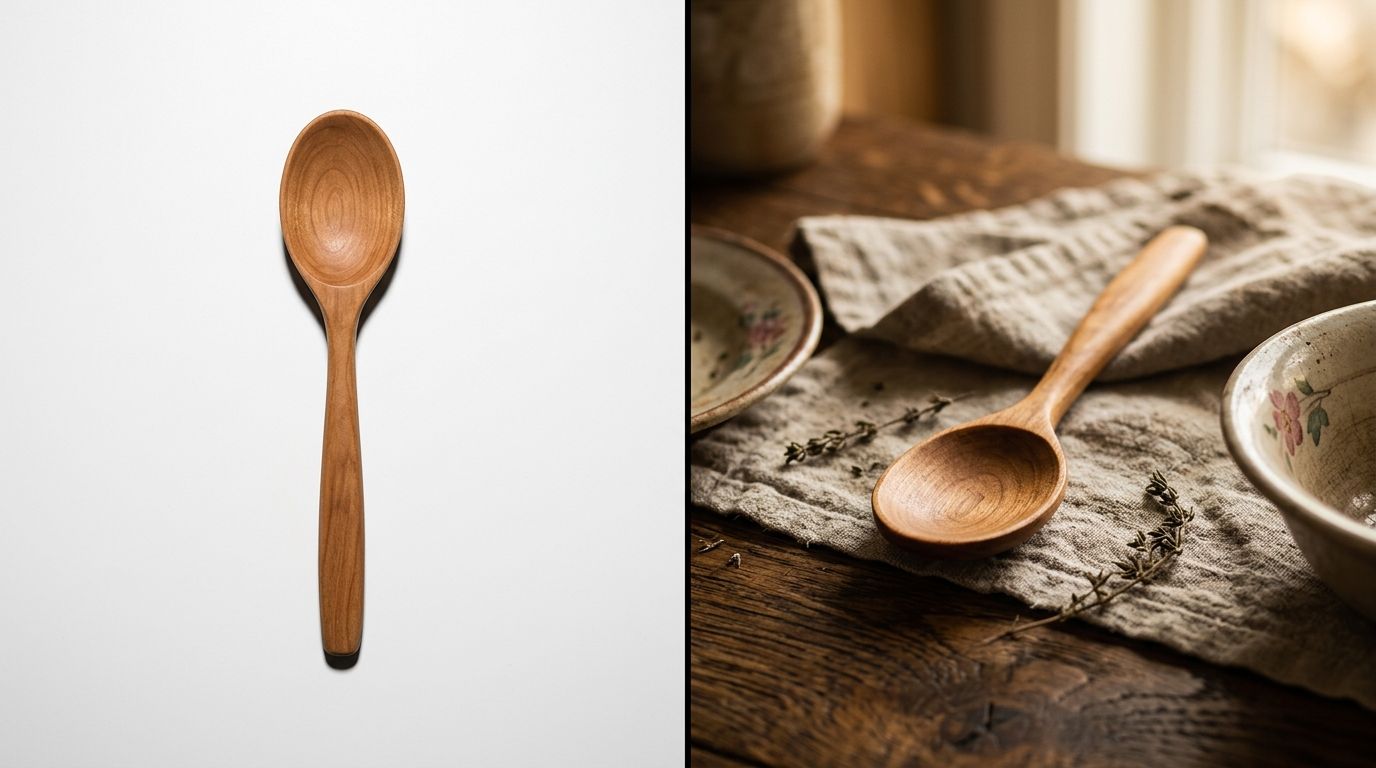
Contextual lifestyle styling performs significantly better on Etsy than sterile white backgrounds.
Mapping Your Ten Listing Photos
Etsy gives you ten image slots. Using only three is leaving money on the table. Every empty slot is a missed opportunity to answer a buyer's unasked question. Treat these ten slots as a sequential sales pitch.
The hero shot (Slot 1)
Your first image has one job. It must stop the scroll in a crowded search feed. This is where your strongest lifestyle image belongs. The product should fill about seventy percent of the frame, leaving just enough negative space to establish the environment. Do not clutter this shot with heavy props that distract from the item you are actually selling.
(Worth noting: while aesthetic backgrounds win the click, you still need at least one high-contrast, distraction-free photo in your carousel so the buyer can clearly see the physical borders of the item before they pay.)
Scale and detail shots (Slots 2 through 5)
Once you earn the click, the buyer starts looking for flaws. This is where you show the tight stitching on a bag, the hallmark on a silver ring, or the grain of the wood. Get extremely close.
You also need to demonstrate scale. Listing the dimensions in your description is not enough because people do not read. Show the item being held by a human hand or placed next to an instantly recognizable object like a smartphone or a standard coffee cup.
The lifestyle context (Slots 6 through 8)
Show the product in use. If you sell wall art, show it hung above a modern sofa. If you sell apparel, show it worn by a model in natural light. Executing effective lifestyle product photography gives the buyer permission to imagine the item in their own daily routine.
Packaging and variations (Slots 9 and 10)
A huge percentage of Etsy purchases are gifts. Show what the unboxing experience looks like. A beautiful photo of your branded packaging, complete with tissue paper and a thank you card, is a massive conversion driver. Use your final slots to display every available colorway or material variation so the buyer never has to guess what the "Slate Gray" option actually looks like.
Technical Etsy Image Requirements
You can style a perfect scene, but if you upload it incorrectly, Etsy's compression algorithms will ruin it. You need to understand the platform's specific technical constraints.
Nailing the aspect ratio and thumbnail crop
Etsy crops your primary image differently depending on where the buyer is looking. In search results, it might display horizontally. In a shop feed, it might display as a square. Always shoot your hero image a little wider than you need. Keep your product dead center and leave a buffer of empty space around the edges. This ensures the vital parts of your product are never chopped off in a search thumbnail.
Resolution limits
Etsy requires a minimum width of 2000 pixels on the shortest side. Do not upload raw 40-megapixel files from a DSLR. Massive files will slow down page load times, particularly for mobile shoppers. Compress your JPEGs to stay under one megabyte while maintaining sharpness.
Solving the Photography Bottleneck for Etsy Shops
The advice to build a beautiful lifestyle set for every product is great in theory. In practice, it is a logistical nightmare for a seller launching a dozen new items a week. Most independent sellers simply do not have the time, space, or budget to run constant photo shoots.
The limits of natural light at home
You probably started by shooting near a large window. This works brilliantly on a clear Tuesday morning. It fails completely when you finish a custom order at midnight on a rainy Thursday and need to ship it the next morning. Relying entirely on daylight limits how fast you can list new inventory.
Learning a few basic iPhone product photography tips helps, but eventually, you hit a wall where styling physical props takes longer than actually making the product.
Scaling variations with CherryShot AI
This is where modern workflows diverge from traditional setups. Instead of building physical sets for every single listing, smart sellers are capturing one perfectly lit, plain background shot of their item and using AI to handle the environmental styling.
Using AI to generate your lifestyle backgrounds saves weeks of production time, but you still need to capture a sharp, honest source image of the physical item. If the source lighting is terrible, the generated scene will not save it.
With tools like CherryShot AI, you can upload your base photo, select a mode like "Minimalist" or "Lifestyle", and generate campaign-ready scenes in minutes. You get the warmth and context that Etsy buyers demand without the four-hour prop-styling ordeal. At $10 for 50 images, the cost per listing drops to pennies. When you can generate imagery for a new colorway in twenty minutes instead of booking another shoot day, your listing velocity skyrockets.
Key Takeaways
- Etsy buyers prioritize lifestyle context and visual warmth over sterile catalog perfection.
- Use all ten listing photo slots to intentionally answer buyer questions about scale, texture, and packaging.
- Shoot your hero images with breathing room around the edges to survive Etsy's automatic thumbnail cropping.
- AI generation allows you to scale lifestyle imagery across your entire catalog without building physical sets.
Frequently Asked Questions
How should product photos look on Etsy?
Etsy product photos must appear warm, authentic, and professionally lit to signal genuine independent craftsmanship. Shoppers browse this particular marketplace actively seeking a highly curated lifestyle aesthetic rather than the sterile catalog perfection required by other major retail sites. Photograph your physical items in carefully styled, natural environments that clearly emphasize unique textures, accurate scale, and specific handmade details to build immediate trust and drive higher conversion rates.
Does Etsy require a white background?
Etsy does not enforce a mandatory white background policy for your primary listing image. Relying entirely on pure white backgrounds often damages conversion rates because it makes handmade goods look like mass-produced inventory from overseas factories. Use an engaging, context-rich lifestyle background for your main search thumbnail, then place one clean, distraction-free catalog shot later in the image carousel to prove exact product dimensions.
How many photos does Etsy allow per listing?
Etsy permits sellers to upload a maximum of ten photos for every individual product listing. Treating each available image slot as a sequential sales pitch forces you to answer unasked buyer questions before they abandon the page. Fill the complete carousel by combining one primary lifestyle hero shot, clear macro details of your materials, real-world scale comparisons, branded packaging examples, and all available physical color variations.
What size should Etsy photos be?
Etsy mandates that product images measure at least 2000 pixels wide on the shortest side to maintain crisp visual fidelity. Compressing your final image files below one megabyte prevents agonizingly slow page load times for the massive volume of mobile shoppers browsing the app. Frame your core product directly in the center of a horizontal composition with plenty of negative space to survive automatic, aggressive thumbnail cropping across different marketplace search feeds.
Should I use lifestyle or white background photos on Etsy?
You must combine an engaging lifestyle photo for your primary thumbnail with at least one clean background image in the secondary carousel slots. The styled environmental shot captures immediate attention in a crowded search feed by helping the target buyer visualize the item existing inside their own home. An isolated white background shot acts as a factual anchor deeper in the listing, proving exactly what physical components arrive inside the shipping box.
Your photography sets the ceiling for your shop's growth. You can craft the highest quality items in your niche, but if the initial visual hook fails to capture the unique handmade aesthetic buyers expect, they will click right past you. Stop trying to mimic the big box retailers. Lean into the context, embrace the lifestyle elements, and if styling physical scenes is slowing you down, let CherryShot AI handle the heavy lifting.
Upgrade your Etsy lifestyle backgrounds without physical props
Review your current shop inventory and identify listings relying entirely on sterile white backgrounds. You can instantly place your physical items into warm, contextual environments that match your buyer's aesthetic preferences.
Try CherryShot AI