Hire Product Photographer: The Complete Process From Brief to Delivery
Hiring a product photographer is a logistics exercise disguised as a creative process. To do it right, you need a rigid brief, a clear contract, and a strict deliverables list before you ever look at a portfolio. Start by defining your exact shot count, required visual style, and non-negotiable usage rights. Only then should you begin reviewing portfolios for lighting consistency and reaching out to candidates to secure test shoots.
Definition
A product photography brief is a formal technical document that dictates exact shot counts, required camera angles, and strict visual benchmarks. It serves as the single source of truth for a studio shoot, ensuring creatives deliver precise commercial assets rather than subjective artistic experiments.
Most ecommerce brands fail at hiring photographers because they expect the photographer to double as a brand strategist. You do not hire a photographer to figure out your brand identity. You hire them to execute a vision you have already documented. When you leave the creative direction open to interpretation, you end up paying for hours of studio time while someone experiments on your dime.
The brands that get the highest return on their visual assets treat product photography like a manufacturing pipeline. They know exactly what angles they need before the first camera battery is charged. Traditional studio shoots offer unparalleled control over complex custom lighting and practical effects, but that control costs you three weeks of waiting for assets to clear the editing desk. Understanding how to manage that timeline is the difference between launching a product on schedule and missing a seasonal window entirely.
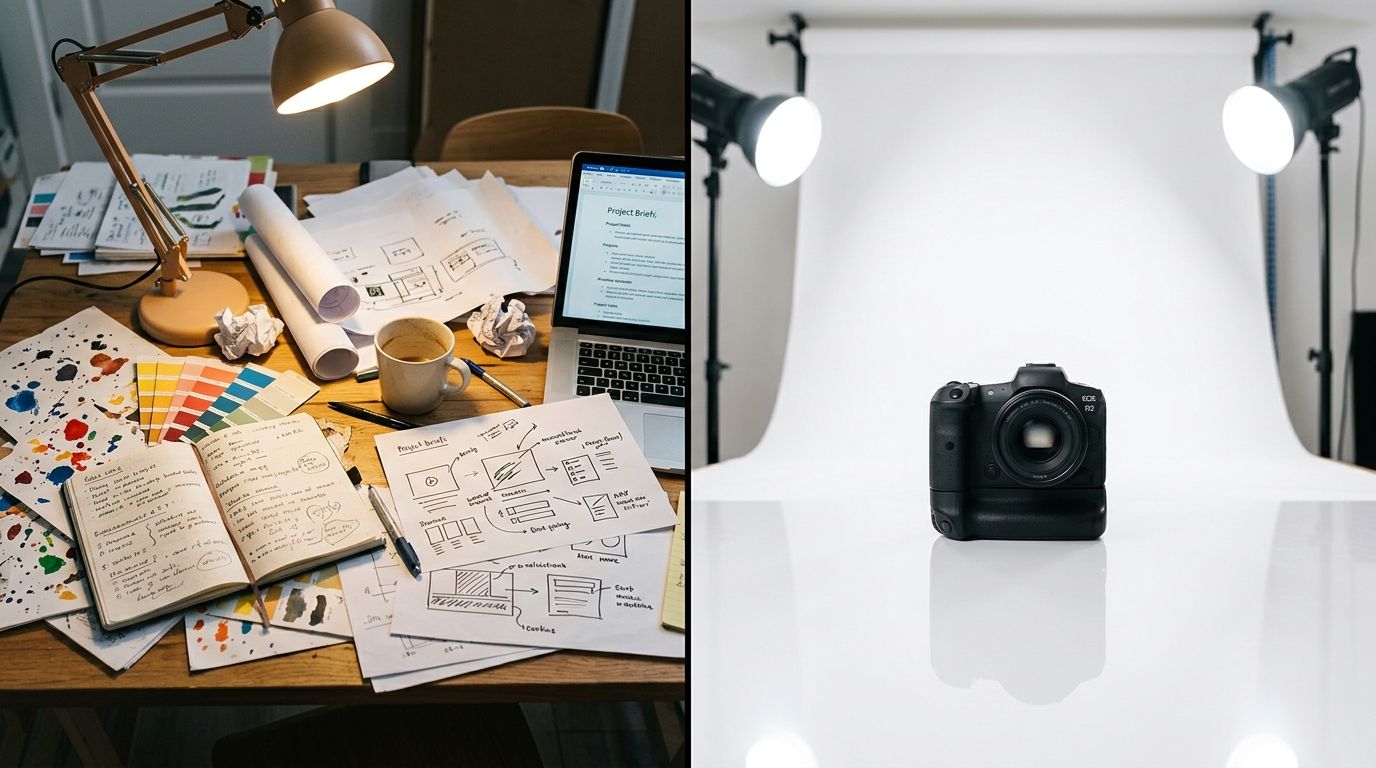
A clear brief and defined deliverable list separate successful product shoots from expensive mistakes.
The Preparation Phase
Before you send a single email to a prospective photographer, you have to get your own house in order. The worst way to start the hiring process is by sending a link to your website and asking for a quote. You will either get ignored by top-tier talent or taken advantage of by amateurs who quote a flat fee without understanding the scope.
Building the creative foundation
A professional photographer quotes based on time, complexity, and risk. To give you an accurate number, they need to see exactly what you expect. You accomplish this by creating a detailed brief that removes all guesswork from the equation. Your brief should read like an instruction manual.
Start with the technical requirements. List every single SKU that needs to be photographed. Next to each SKU, write down the specific angles required. A standard ecommerce breakdown usually includes a straight-on front shot, a 45-degree angle, a detail shot showing texture, and an environment shot showing scale. Multiply your SKUs by your angles, and you have your total deliverable count. This number dictates everything that follows.
Next, gather visual references. Do not use adjectives like moody or clean. Words mean different things to different creatives. Pull three reference images for lighting, three for styling, and three for crop framing. Put them in a document and state clearly that this is the exact benchmark for quality you expect.
Sourcing and Evaluating Portfolios
Finding a photographer is easy. Finding the right product photographer for your specific category is incredibly difficult. A phenomenal portrait photographer will often struggle to light a highly reflective glass bottle. An architectural photographer might lack the macro lenses required to shoot fine jewelry.
Looking past the hero shots
When you start clicking through websites, ignore the homepage. Every photographer puts their single best image from their most expensive shoot on the landing page. You need to look at their catalog work. Dig into the middle of their portfolio to see what to look for when hiring a true professional. Check the pure white background shots. Are the shadows muddy? Are the highlights blown out? Is the color of the product accurate across different angles?
You also need to verify their experience with your specific material type. If you sell apparel, look for their fabric texture rendering. If you sell cosmetics, evaluate how they manage reflections on glossy plastic tubes. Ask them directly to send you a full gallery from a single client rather than a curated highlight reel. Seeing a complete project reveals their ability to maintain consistency across forty different items.
Negotiating Contracts and Usage Rights
Creative contracts are filled with hidden traps for first-time founders. The biggest mistake you can make is assuming that because you paid for the photo shoot, you own the photos. In photography, copyright remains with the creator unless explicitly transferred in writing. You are paying for a license to use the images.
Structuring the payment
You will generally encounter two pricing structures. The first is a day rate. The second is a per-image rate. Understanding which one applies to your project requires understanding pricing models thoroughly.
(Worth noting: you should never pay a day rate unless you are shooting complex lifestyle scenes with models. For white background or styled catalog work, always demand a per-image rate to protect your budget.)
When a photographer quotes a day rate, they are renting you their time. If they only manage to shoot ten products that day because the lighting was tricky, you still owe the full day rate. When you negotiate a per-image rate, the financial risk of a slow workflow shifts to the photographer. They are incentivized to work efficiently, and you know exactly what your final invoice will be before the shoot begins.
Beyond the rate, scrutinize the usage license. Many commercial photographers limit usage to one year or restrict the images to digital use only. If you print a catalog next year, they will send you another invoice for a print license. Always negotiate for full, unrestricted commercial usage in perpetuity across all media. It might cost slightly more upfront, but it prevents extortion later.
The Alternatives: When Traditional Studios Stop Making Sense
For a massive rebrand or a flagship product launch, coordinating a studio shoot is justified. You need that bespoke human touch to establish the visual language of the campaign. However, applying that same cumbersome process to routine catalog updates is financially irresponsible.
Escaping the logistics trap
Any brand still running a full studio shoot for standard catalog images in 2026 is paying for logistics, not quality. The invoice is not just the photographer. It is the studio rental, the stylist's half-day minimum, the assistant fees, and the catered lunch. More importantly, it is the three weeks of waiting. The time delay between shipping the physical products and receiving the retouched files creates a massive bottleneck for your marketing team.
When you start looking at AI vs. studio shoot costs, the math changes completely. With an AI product photography platform like CherryShot AI, you remove the physical dependencies. You upload a basic product image, select a visual mode like Minimalist or Loud Luxury, and generate campaign-ready photos in minutes. The per-image cost drops from $80 down to a few dollars. The turnaround time drops from three weeks to ten minutes.
| Production Method | Average Turnaround Time | Primary Best Use |
|---|---|---|
| Traditional Studio Shoot | 2 to 4 weeks | Complex lifestyle campaigns with human models |
| Freelance Photographer | 1 to 2 weeks | Custom styled hero shots and small batches |
| AI Photography Generation | 10 to 15 minutes | High-volume catalog and seasonal updates |
The brands scaling the fastest right now treat traditional photographers as specialists reserved for hero imagery. For everything else, they use AI to generate volume. When you can render a new colorway in a lifestyle setting instantly instead of booking another shoot day, you can launch products the moment they arrive in the warehouse.
Frequently Asked Questions
How do I hire a product photographer?
Write a comprehensive brief outlining your exact shot count, required visual style, and non-negotiable usage rights before contacting any candidates. Sourcing professionals requires evaluating their middle-portfolio catalog work to verify lighting consistency across multiple items, rather than judging them solely on their curated hero shots. Secure a contract that clearly defines deliverables, commercial usage terms, and final turnaround times to protect your budget and timeline.
What should I include in a product photography brief?
Document the exact total SKU count, required camera angles per item, strict file format specifications, and clear visual reference images for your lighting expectations. Communicating these technical requirements upfront prevents expensive studio reshoots and guarantees the final files match your specific ecommerce platform architecture. Include concrete details regarding delivery deadlines, preferred crop ratios, and whether the assets require transparent backgrounds or practical styling props.
How much should I pay a product photographer?
Standard catalog work typically ranges from $30 to $100 per image, while custom styled hero shots command $150 to $500 per image. Negotiating a per-image rate protects your budget by shifting the financial risk of a slow workflow directly to the creator. Freelancers charging day rates between $800 and $2,500 rarely include studio rentals, specialized equipment, or practical prop expenses in their initial quotes.
What deliverables should I get from a product photographer?
Request both high-resolution files formatted for print campaigns and web-optimized assets sized specifically for your ecommerce platform architecture. Securing these distinct formats prevents you from having to resize massive images manually or suffering quality loss during website uploads. Demand layered TIFF or PSD files when paying for complex retouching, alongside a contract granting full commercial usage rights in perpetuity across all media channels.
Is hiring a photographer or using AI better for ecommerce?
Hiring a traditional photographer remains necessary for complex brand campaigns featuring human models or highly elaborate practical sets. Transitioning to an artificial intelligence tool provides a massive advantage for rendering routine catalog volume and quickly processing minor seasonal colorway updates. Generating your visual assets programmatically eliminates expensive physical studio rentals and allows your marketing team to launch new products weeks faster than a standard timeline.
Key Takeaways
- Write a rigid creative brief detailing shot counts and reference styles before contacting candidates.
- Evaluate middle-portfolio catalog work to judge true lighting consistency over curated hero shots.
- Always negotiate per-image rates for catalog work to shift financial risk away from your budget.
- Use AI platforms for rapid catalog volume and reserve traditional photographers for complex hero campaigns.
Stop paying a premium for the administrative friction of organizing a photoshoot. Take control of your visual assets by defining exactly what you need upfront, demanding strict usage rights, and ruthlessly cutting the logistical bloat. If you are tired of waiting three weeks for catalog shots that should take three minutes, it is time to try CherryShot AI and get your products online faster.
Generate your routine catalog updates instantly
Review your upcoming product shot list and isolate the standard white-background angles that do not strictly require a physical studio. Process those high-volume images programmatically to bypass photographer day rates and eliminate the three-week retouching bottleneck.
Try CherryShot AI