Jewelry Light Box Guide 2026: When It Works and When AI Beats It
Shooting jewelry is notoriously difficult because you are not actually photographing the product. You are photographing the reflection of the room surrounding the product. Point a macro lens at a polished silver band, and you will see your camera, your hands, and the window behind you perfectly mirrored in the metal. The traditional jewelry light box became the default piece of equipment for thousands of brands specifically to solve this frustrating physics problem.
Definition
A jewelry light box is an enclosed, translucent photographic tent used to diffuse light. It serves to eliminate harsh reflections on metallic surfaces while creating a clean, high-key background for ecommerce product listings.
By placing a piece of jewelry inside a seamless white tent, you give the metal nothing to reflect except pure light. The result is the smooth, glowing gradient that defines traditional catalog imagery. But catalog imagery on a clinical white background is no longer enough to scale a modern brand. Consumers scroll past floating rings. They want context, environment, and lifestyle styling that tells a story.
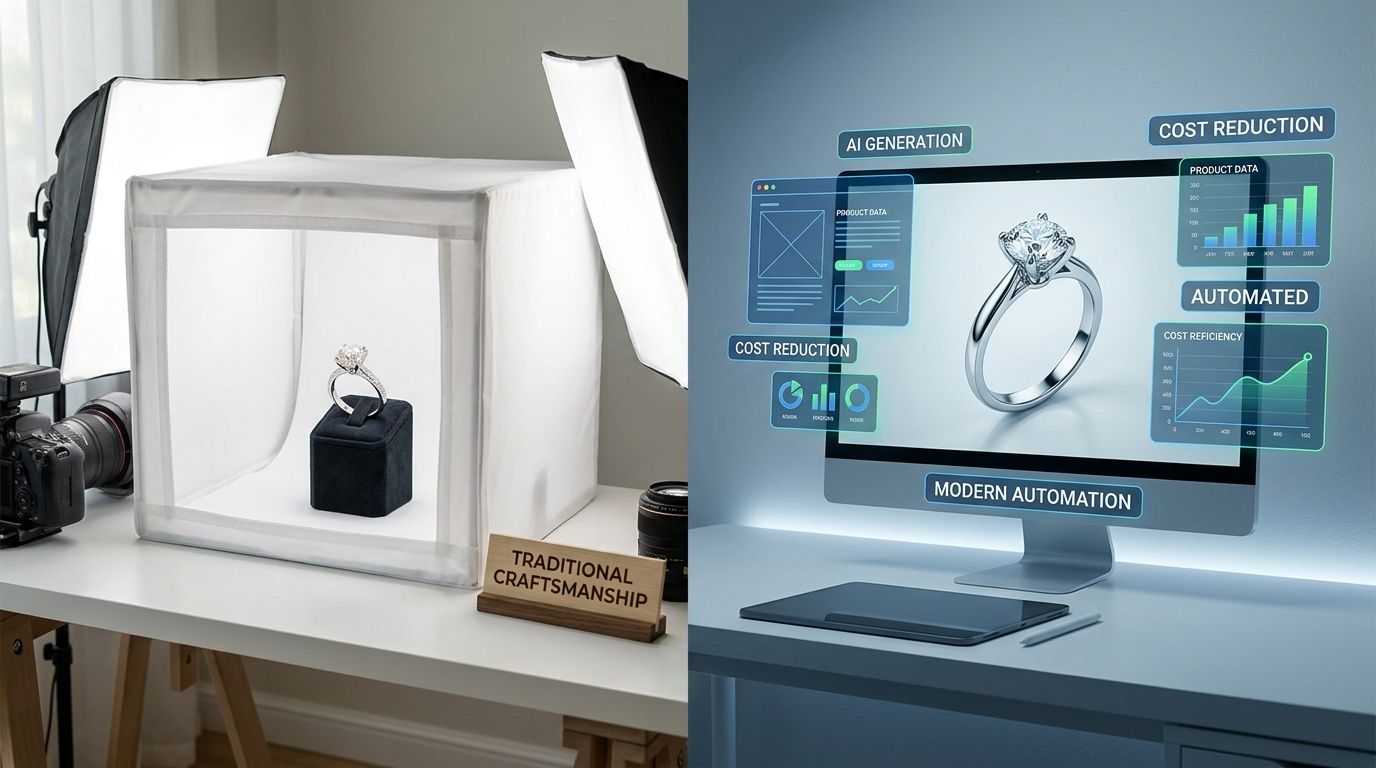
This is where the production math breaks down for modern sellers. If you rely entirely on a physical lightbox to shoot your inventory, you are trapped in a sterile visual aesthetic. Today, the smartest brands are combining these tools. They use a simple light box to capture one perfectly lit base photo, and then they feed that image into CherryShot AI to generate complete, campaign-ready environments in minutes.
Note: this shift to artificial intelligence does not completely eliminate the need for good camera hygiene. AI can place your necklace on a stunning marble pedestal in perfect sunlight, but it cannot invent the intricate facet structure of a diamond if your original photo is a blurry mess. You still have to nail the initial focus and basic lighting.
The physics of lightbox product photography
I have personally sat on the floor of a studio for hours trying to block a tiny black reflection from ruining a shot of a gold watch. When you deal with curved, highly polished surfaces, every object in the room becomes a potential ruinous reflection.
A portable light studio works by enveloping the subject in diffusion material. The bright LED lights sit outside the box, shining through translucent fabric or frosted plastic. This scatters the light waves, softening them before they hit the jewelry. Instead of a harsh, bright pinpoint of light that creates aggressive shadows, the item is bathed in a continuous wrap of illumination.
| Method | Best Use Case | Output Quality |
|---|---|---|
| Physical Lightbox | High-gloss metal and clear gems | Flat, isolated white background |
| AI Generation | Lifestyle and brand context | Immersive, high-end environment |
Why highly reflective metals demand a diffuse lighting box
Metals like platinum, polished silver, and high-karat gold act exactly like funhouse mirrors. If you light them with a bare bulb or a standard desktop lamp, you get high-contrast hot spots. A hot spot is a small area of pure blown-out white surrounded by dark, muddy metal. It makes expensive jewelry look cheap and plastic.
When you place that same piece inside a light box for jewellery, the metal reflects the illuminated white walls of the tent. This creates a soft gradient across the curvature of a ring or the links of a chain. Mastering this basic concept is the foundation of all ecommerce product lighting setups. You are shaping the reflection, not illuminating the object.
When photographic light boxes are the right tool
Despite the rapid advancement of AI, keeping a simple light tent in your office still has tremendous value. There are specific technical requirements in macro photography where a controlled physical environment is unbeatable.
Capturing transparent gemstones and facet clarity
Diamonds, sapphires, and emeralds rely on light passing through them to demonstrate their value. A high-quality lightbox provides the intense, wraparound light necessary to illuminate the interior of a gem. You can position small pieces of white bounce card inside the box to push light directly into the table of a diamond, making the facets pop.
We have to acknowledge a strict limitation here. While a diffuse box is great for smooth metal and clear gems, it is actually a terrible choice for pearls, opals, or heavily textured vintage pieces. Flat, even lighting destroys depth. It makes pearls look like flat white discs and hides the dimensional carving of vintage rings. For those items, you need a single directional light source to create defining shadows.
The portable light studio advantage for quick macro shots
If you run an Etsy shop or launch a massive volume of one-off vintage pieces, speed is your primary metric. Setting up umbrellas, adjusting light stands, and tweaking softboxes takes time. A portable light box folds out in seconds, plugs into a USB port, and gives you a consistent baseline environment.
This consistency is vital when capturing your base images. If you are learning how to take white background product photos at home, the lightbox eliminates the variables of changing daylight or mixed room lighting. You get a clean, sharp, isolated image of your product that is perfectly primed for post-production.
Where jewelry lightbox photography fails your brand
The problem with traditional tent photography is that it creates an isolated, floating object. It strips away all context. When a customer is browsing an online catalog, they need visual cues to understand scale, vibe, and application.
The infinite white background trap
White backgrounds do not sell lifestyle. They do not trigger the emotional response that drives a luxury purchase. If a customer is looking at a $400 pendant, they want to see it resting on dark slate, draped over silk, or bathed in warm golden hour sunlight. They want the aesthetic to match the price tag.
Trying to create these contextual scenes inside a small box is impossible. You cannot fit props, textures, and dynamic background lighting into a 14-inch cube. The moment you try to style a scene inside a lightbox, you block the LED panels and ruin the diffuse lighting that made the box useful in the first place.
Scaling issues and set design fatigue
Building physical sets for your jewelry is expensive and slow. Sourcing marble slabs, finding the right velvet displays, and manipulating external lights to cast dramatic shadows takes hours. If you launch a new collection of twenty pieces, shooting styled environmental images for every single SKU will consume your entire week. Most founders eventually give up and just post the plain white box photos, sacrificing their brand aesthetic for the sake of getting the listing live.
AI product photography vs traditional setups
This bottleneck is exactly why the industry is abandoning complex physical set design. The current best practice treats the physical shoot merely as a data capture exercise. You put the ring in the lightbox, snap a crisp photo on your phone, and the physical work is done.
Shifting from physical sets to visual modes
Once you have that clean reference photo, CherryShot AI handles the heavy lifting. You upload the image, select a visual mode like Luxury or Magazine, and the AI generates stunning, photorealistic environments around your jewelry. The software understands how to render accurate drop shadows, complex reflections on marble, and realistic depth of field.
You get the crisp, perfect lighting of a lightbox on the product itself, combined with the expensive, aspirational styling of a high-end studio set. You can instantly switch a silver bracelet from resting on a minimalist concrete block to sitting beside a pool of water in a Loud Luxury setting.
When you review an AI photography cost comparison, the financial case becomes impossible to ignore. A freelance photographer charges thousands of dollars and takes two weeks to deliver a stylized jewelry campaign. AI generates those same campaign-ready images in minutes at a fraction of a dollar per photo. The lightbox gets you the clear base image. The AI builds the brand.
Audit your product page images before your next campaign
Collect your base photos from your lightbox and run them through CherryShot AI to see how they look in high-end lifestyle settings. This simple test confirms if your lighting setup provides the clean data our models need for your brand imagery.
Try CherryShot AIFrequently Asked Questions
What size light box do I need for jewelry?
A 12-inch to 16-inch box is the ideal size for most jewelry pieces. This dimension provides enough room to position your camera and adjust small props without pushing the light source too far away. You should select a unit based on the largest item you plan to photograph regularly.
Does a lightbox work for all jewelry types?
No. A lightbox works exceptionally well for high-gloss metals and transparent gemstones like diamonds or sapphires. It fails when photographing opals, pearls, or textured matte metals. These specific materials require directional lighting to show depth and iridescence, which the flat, even lighting of a diffuse box completely eliminates.
How do I avoid shadows in a lightbox?
You eliminate shadows by balancing your light sources. Most modern photographic light boxes use built-in LED strips. If yours relies on external lamps, position two identical lights on opposite sides of the box at equal distances. Placing the jewelry on a piece of elevated acrylic or glass helps to separate the item from the floor of the box.
Is a DIY lightbox as good as a purchased one?
A DIY diffuse lighting box made from cardboard and tissue paper can produce acceptable results for a beginner. However, you will struggle with color temperature consistency. Purchased portable light studios use balanced LEDs that guarantee a pure white background without the yellow or blue color casts often found in makeshift setups.
What is a good alternative to a lightbox for jewelry?
AI product photography has become the primary softbox alternative for ecommerce brands. Instead of buying physical equipment to shoot contextual or lifestyle images, sellers capture a simple, clear base photo and use AI tools to generate campaign-ready backgrounds, realistic shadows, and varied environments in minutes. This approach provides a massive upgrade in visual quality compared to a standard white background.
There is no reason to abandon your light tent, but there is every reason to stop relying on it as your final output. Use your physical equipment to solve the physics problem of metallic reflections. Capture a clean, sharp, brilliantly lit image of your product. Then, let CherryShot AI take over the set design. You will launch faster, spend less on props, and give your customers the rich visual context they need to confidently add to cart.