Natural Light Product Photography: When It Works, When It Fails, and How to Replicate It with AI
Natural light product photography is beautiful, entirely free, and completely unscalable. Relying on the sun is a fantastic way to shoot your first five products. It is also the fastest way to miss a launch deadline when a week of rain rolls in. You cannot build a predictable ecommerce content calendar around unpredictable weather.
Definition
Natural light product photography is the practice of illuminating ecommerce merchandise using only daylight, typically through a window or outdoors. This method relies entirely on available weather conditions and physical modifiers like bounce cards rather than powered artificial studio strobes.
I have personally sat on the floor of a warehouse, taping parchment paper over a window because the midday sun was casting a harsh glare on a glass bottle. We got the shot, but it took three hours of waiting for the clouds to shift. Every brand eventually hits a breaking point where the organic look of sunlight is no longer worth the logistical nightmare of capturing it. The shift toward AI product photography means you can now get that exact same window-lit look without checking the forecast.
There is a massive difference between knowing how to capture natural light for product photos and actually doing it at a volume that supports a growing store. Understanding how to manage these light sources, and knowing exactly when to replace them with technology, changes how fast you can move inventory.
Why natural light product photography appeals to brands
Humans are naturally wired to respond to daylight. Artificial strobes and softboxes create perfect, clinical environments. That is great for technical catalog shots on pure white backgrounds. But when you want a customer to imagine a product sitting on their own kitchen counter or bathroom vanity, clinical lighting breaks the illusion.
Product photography with natural light feels familiar. It creates soft, wrapping shadows that suggest a real space. When you browse a lifestyle brand's Instagram feed and see a ceramic mug bathed in warm morning light, you are not just looking at a vessel for coffee. You are looking at an aspirational morning routine. That emotional connection drives sales.
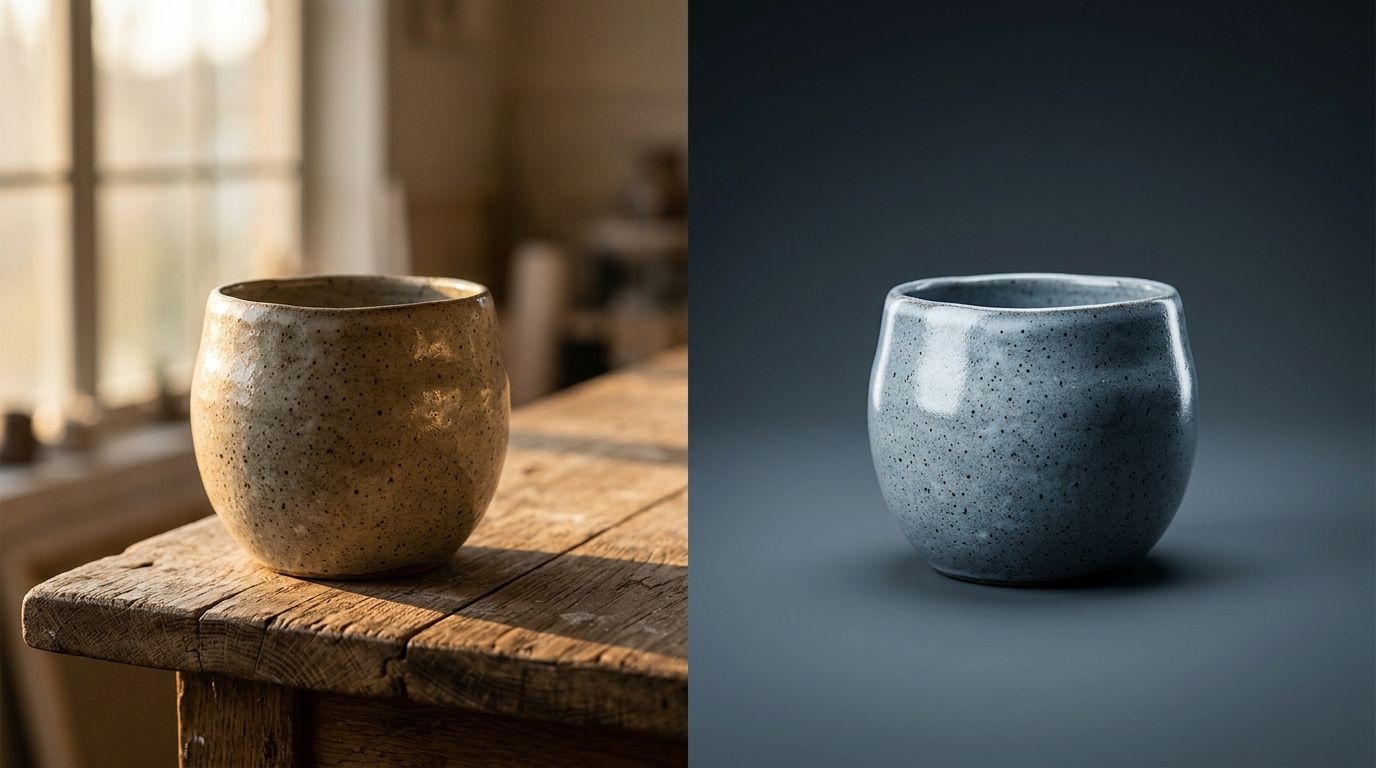
Soft window light creates organic, familiar shadows that artificial studio strobes often struggle to replicate.
The magic of overcast light photography
Most amateur photographers think they need bright, sunny days to shoot. Professional product photographers know that direct sunlight is usually the enemy. Direct sun creates hard, black shadows and blown-out highlights that destroy the texture of your product.
The actual secret to stunning outdoor product photography light is cloud cover. Overcast light photography is highly prized because the entire sky acts as a massive, free diffuser. The clouds scatter the sun's rays, wrapping your product in even, soft illumination. This diffused natural light eliminates the stark contrast between highlights and shadows, allowing the camera to capture every detail of the product's label and material.
Chasing golden hour product photography
If you sell skincare, jewelry, or food, you have likely tried to capture the golden hour. This happens shortly after sunrise and just before sunset. The sun is low on the horizon, traveling through more of the Earth's atmosphere. The result is a highly directional, incredibly warm light that casts long, dramatic shadows.
Golden hour product photography creates high-end editorial looks without expensive gear. It communicates luxury and warmth. But it also lasts for exactly forty-five minutes. If you have ten products to shoot in different angles, you are racing the clock. By the time you get to the seventh product, the light has changed completely, and your images will no longer match.
The fatal flaw of relying on the sun
The aesthetic benefits of natural light are obvious. The operational drawbacks are brutal. If you run an ecommerce business, your catalog demands consistency. A customer browsing a collection page expects to see a unified grid of products. If the lighting jumps from cool morning light to warm afternoon light, your brand looks amateurish.
Color temperature is the biggest enemy of a window light setup product photography workflow. Sunlight changes its color temperature by the minute. If you shoot a moisturizer at 10:00 AM, the light will likely have a cool, slightly blue tint. If you shoot the matching serum at 3:00 PM, the light might be warm and yellow. When you place those two photos side by side on your website, the backgrounds will not match. The product colors will not match.
You then have to spend hours in Lightroom adjusting white balance, painting over shadows, and trying to force two fundamentally different light sources to look identical. A window setup costs absolutely nothing to build, but you will pay dearly for it in post-production hours.
(Worth noting: if you are an artist making a handful of unique ceramic pieces a month, stick to the window. When your volume is low and every item is unique, weather delays will not wreck your margin or your website consistency.)
Eventually, every brand realizes that taking one beautiful photo is easy. Taking fifty beautiful, matching photos is where the process breaks down. Understanding exactly when DIY product photography stops working is a critical milestone for any founder trying to scale their visual output.
How to build a reliable window light setup
If you are in the phase of business where natural light still makes sense, you need to control the environment as much as possible. You cannot just put a product on a table and hope for the best. You need a dedicated window light product photography setup that minimizes the sun's unpredictability.
Turn off all indoor lights
This is the most common mistake beginners make. Overhead office lights and household lamps have a completely different color temperature than daylight. If you leave them on while shooting near a window, you will create cross-lighting. Your product will have blue light hitting one side and yellow light hitting the other. The camera cannot fix this, and editing it out is incredibly difficult. Always shoot with indoor lights completely off.
Use diffusion on direct sunlight
If you are forced to shoot on a bright, sunny day, you must filter the light. Tape sheer white curtains, tracing paper, or a professional diffusion panel directly to the window glass. This mimics overcast light photography conditions indoors. It scatters the hard rays into a soft, even glow that is far more flattering for reflective products like glass or glossy plastic.
Master the bounce card
A window only lights one side of your product. The opposite side will fall into deep shadow. To fix this, you need a bounce board. A simple piece of white foam core from a craft store works perfectly. Stand it up vertically on the shadow side of the product, just outside the camera frame. The sunlight will hit the white board and bounce back into the product's shadows, lifting them and showing the hidden details. Moving the board closer to the product makes the shadows brighter.
The shift to AI natural light effects
No matter how well you manage your bounce cards and diffusion paper, you are still at the mercy of the weather app. This is why thousands of ecommerce brands are abandoning DIY setups entirely. You can skip the studio and still figure out how to take good product photos without a professional photographer by utilizing specialized AI tools.
| Production Method | Lighting Consistency | Scalability for Ecommerce |
|---|---|---|
| Window Light | Changes constantly based on weather | Low (best for single hero shots) |
| Golden Hour | Shifts rapidly, lasts under an hour | Very low (requires rushing) |
| AI Generation | Identical match across all images | High (operates on demand) |
CherryShot AI replaces the entire physical logistics chain of a natural light shoot. You upload a basic, evenly lit photo of your product. You do not need to worry about shadows or golden hour timing. You then select a visual mode like Lifestyle or Magazine. The AI generates campaign-ready photos in minutes. It places your product in a realistic environment, casting perfect, directional window light across the scene.
Absolute consistency at scale
The true value of an AI natural light effect is not just that it looks real. It is that it looks real consistently. If you need to generate images for a new flavor of energy drink six months after the initial launch, you do not need to pray for the same weather conditions. You upload the new SKU to CherryShot AI, use the same prompt or visual mode, and the output perfectly matches the original catalog. The shadows fall at the exact same angle. The color temperature is identical.
With pricing starting at $10 for 50 images, the financial argument for spending three days managing a window shoot evaporates. Instead of fighting the sun, you can focus on generating enough visual assets to test different marketing angles. General-purpose AI image tools often struggle to maintain the product's exact details, but a dedicated tool like CherryShot AI preserves your branding perfectly while transforming the environment.
If you want to understand the exact mechanics behind this transition, looking closely at how AI product photography works reveals exactly why shadows, reflections, and ambient light now map correctly to complex object shapes.
Frequently Asked Questions
Is natural light good for product photography?
Natural light excels at creating an organic, authentic lifestyle aesthetic for product photos. Sunlight casts a familiar warmth and soft shadow falloff that artificial studio strobes require extensive modifiers to duplicate. Restrict these unpredictable outdoor lighting setups to small batches or standalone hero images where matching color temperatures across a massive inventory catalog is not your primary goal.
When is natural light best for product photography?
Natural light works best for lifestyle imagery requiring a soft, approachable aesthetic. Food, skincare, and apparel brands benefit from outdoor sunlight to convey specific aspirational settings like a morning routine or backyard environment. Early-stage brands can position products next to a large window with a simple white bounce card to capture high-quality content without investing heavily in expensive lighting equipment.
How do I use window light for product photography?
Position your product on a flat table immediately adjacent to a large window while keeping all overhead indoor lights turned off. Mixing warm artificial room lamps with cool natural daylight causes severe color balancing problems that ruin the final image. Place a white foam bounce card opposite the window to reflect illumination back onto the dark side of the product, and tape diffusion paper over the glass if the sun casts hard shadows.
What is the best weather for natural light product photography?
Bright, entirely overcast weather creates the optimal conditions for natural light product photography. Heavy cloud cover acts as a massive natural softbox, filtering out the harsh rays of direct sun and blanketing your merchandise in even, diffused illumination. Schedule your outdoor shoots during these cloudy days to eliminate dark, distracting shadows and secure a highly consistent color temperature for several hours of continuous production.
Can AI replicate natural light in product photos?
Modern AI generators accurately replicate natural sunlight and window lighting setups. Processing a standard product image through an artificial intelligence platform applies precise directional shadows and the soft falloff characteristics of genuine daylight. Select a specific environmental mode inside the software to instantly generate the exact aesthetic of an outdoor morning shoot without checking weather forecasts or managing physical diffusers.
Key Takeaways
- Natural light provides an unmatched organic aesthetic but severely limits production speed.
- Overcast days offer the best diffused lighting by acting as a giant natural softbox.
- Indoor overhead lights must be turned off to prevent mixed color temperatures.
- AI tools now replicate perfect natural lighting and golden hour shadows instantly on demand.
There is a romantic idea in ecommerce that the best photos come from a founder standing by a window at dawn with a camera. That might be true for day one. By day one hundred, that process is actively costing you money. Moving your workflow to a platform like CherryShot AI lets you keep the aesthetic of natural light while entirely removing the friction of capturing it. The light is always perfect, the weather never matters, and your products launch on time.
Generate perfect window light on demand
Stop adjusting bounce cards and waiting for the clouds to shift. Upload your standard product images to CherryShot AI to map consistent, realistic daylight shadows across your entire inventory in minutes.
Try CherryShot AI