Volume Discount Photography for Ecommerce: How to Visually Show Value
Selling three units of a product requires a completely different visual approach than selling one. If your volume discount photography ecommerce strategy is just slapping a red text overlay reading "3-Pack" onto a single product image, you are leaving conversion on the table. Customers need to see the abundance. To visually show value when selling in multiples, you must show the actual physical quantity. Doing so triggers the psychological weight of the deal and makes the savings tangible.
Definition
Volume discount photography is the practice of photographing multiple units of a product together to visually communicate a bulk purchase offer. It relies on physical staging, accurate spatial relationships, and lighting to show the actual quantity a customer receives, replacing simple text overlays with tangible visual weight.
I spent three hours on a Tuesday back in 2019 watching a photographer try to arrange four bottles of moisturizer so they looked like a deliberate set. Every time he moved one bottle, the shadow cast over the label of the bottle behind it. We nudged them left. We nudged them right. We added a bounce board to soften the reflections. We billed the client for half a day of studio time just to get one usable shot of a simple multi-pack.
That is the reality of traditional buy more save more photography. You assume shooting three items is the exact same process as shooting one. It is absolutely not. You are managing multiple reflections. You are fighting overlapping shadows. You are trying to create depth without obscuring the core product details. But getting it right is the single fastest way to pull your average cart value out of the gutter.
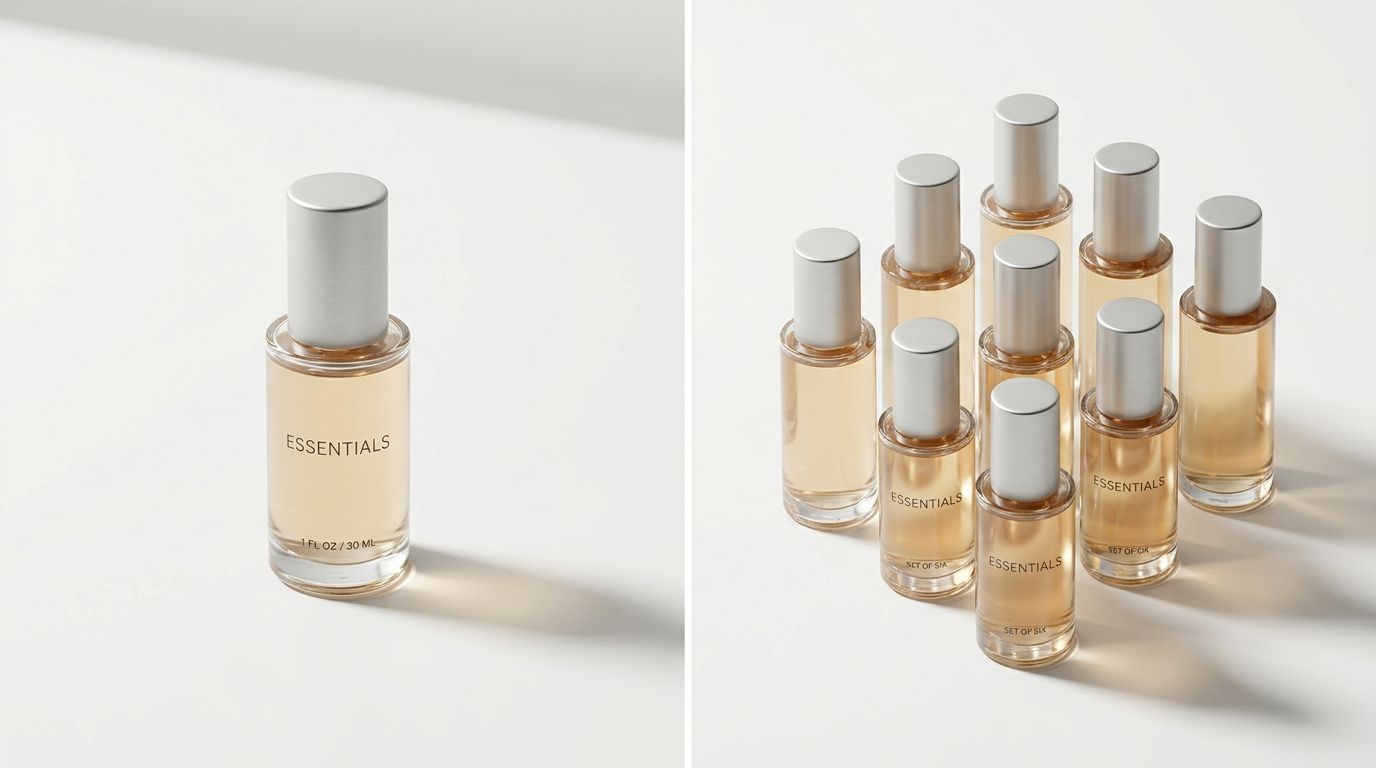
A three-pack configuration showing natural overlapping shadows and staggered depth to visually communicate volume.
Why Multi-Buy Photography Ecommerce Fails
Most founders I talk to cannot name the actual per-image cost of their last studio shoot. When they calculate it, the number is usually somewhere between $80 and $200 per finished image. Because that baseline cost is so high, brands cut corners when it comes to capturing their bundle variants.
They pay the photographer for the hero shot of the single unit. Then they tell their graphic designer to just duplicate that single image three times in Photoshop to create the bundle graphic.
(Worth noting: customers spot this immediately. When three identical bottles are placed next to each other digitally, the lighting highlights reflect light sources that do not exist in the space between them. It looks flat, fake, and cheap.)
| Visual Approach | Production Method | Customer Perception |
|---|---|---|
| Digital Duplication | Copy-pasting one image in Photoshop | Looks flat and lowers brand trust |
| Physical Multiples | Shooting actual grouped products in-studio | Creates tangible value and increases AOV |
| AI Generation | Rendering 3D spatial relationships from one photo | High realism with zero inventory waste |
Shooting multiple physical units means you have to deal with the spatial reality of the objects. But you have to do it. You must understand what makes product photos convert if you want to run a profitable catalog. Visual weight is a massive conversion driver. A customer scrolling past a single bottle feels a specific level of desire. A customer scrolling past three beautifully lit bottles grouped together feels a sense of stockpiling. It triggers the instinct to secure resources.
The Margin Problem with Physical Multiples
There is a real trade-off here. Shooting physical multiples means unboxing perfectly good inventory that you cannot sell later. For a high-ticket item or a brand with razor-thin margins, ruining three products just to get a photo gets expensive fast. When you start mapping out the real cost of product photography, the multi-pack shots often inflate the budget beyond reason.
This is exactly why so many brands fall back on bad Photoshop jobs. They know they need volume deal product photos but they cannot justify the studio time to shoot the same product in configurations of three, six, and twelve.
Composition Rules for Quantity Discount Product Images
If you are going to present a buy in bulk photography offer, the composition is everything. You are no longer just photographing an object. You are photographing a relationship between objects. How they sit next to each other tells the customer everything about the value they are getting.
The Staggered V-Formation
This is the most reliable setup for bottles, jars, and rigid packaging. You place one hero product dead center and slightly forward. You flank it with the remaining units positioned slightly behind and to the sides.
This formation does two things perfectly. First, it ensures the primary label is perfectly legible without obstruction. Second, it creates depth. The eye moves from the front product to the back products, measuring the physical space. That perception of physical space translates directly into perceived value.
Flat Lay Volume for Apparel
If you are selling a five-pack of t-shirts, you cannot use the V-formation. For soft goods, flat lay volume is your best tool. You fold the garments uniformly and fan them out. The trick here is repetition and rhythm. Ensure the distance between each folded edge is mathematically identical.
When a customer sees a perfectly fanned stack of colored shirts, the brain processes the uniformity as quality. It makes the quantity photography look deliberate rather than messy. A messy pile of shirts looks like a clearance bin. A perfectly fanned flat lay looks like a premium volume discount.
Managing Negative Space in a Product Set
When photographing a product set multiple units, the space between the objects is just as important as the objects themselves. Too much space and the items look disconnected. They look like individual purchases rather than a bundle. Too little space and the items crowd each other, hiding the labels and creating a cluttered mess.
You want the items close enough that their shadows interact naturally. That interaction is what tells the human eye the image is real.
How Value Photography Impacts Your Average Order Value
Brands try to increase AOV through pop-ups, cross-sells, and aggressive email funnels. Those tactics work. But they add friction. You can drastically increase AOV with product photography simply by making the bulk option the most visually dominant choice on the page.
If your single unit has a gorgeous, professionally lit hero shot, and your three-pack just has a tiny text overlay, the customer defaults to the single unit. The visual quality signals where they should spend their money. When your multi-pack photography looks premium, rich, and abundant, you give the customer permission to buy in bulk. They feel they are getting a premium experience alongside their savings.
Scaling Your Buy More Save More Photography
Any brand still running a full studio shoot to capture multi-packs of standard catalog items in 2026 is paying for logistics, not quality. The invoice is not just the photographer. It is the studio rental, the stylist spending hours arranging overlapping bottles, the art director checking the shadows, and the three weeks of waiting.
AI product photography changes that math completely. Upload a single product image, pick a visual mode, and CherryShot AI generates campaign-ready photos in minutes. You can create the perfect volume discount photography ecommerce assets without unboxing extra inventory.
The per-image cost drops to under $5. The turnaround goes from weeks to an afternoon. The bottleneck shifts from production scheduling directly to your own creativity. You can test a three-pack image against a six-pack image by Tuesday afternoon. The brands scaling their revenue right now are the ones moving at this speed.
Key Takeaways
- Duplicating a single image in Photoshop creates flat multi-pack visuals that degrade brand trust.
- Visual weight directly impacts perceived value. Show the physical abundance to justify the purchase.
- Use staggered formations for rigid products and uniform flat lays for soft goods.
- AI generation allows you to create bulk imagery without sacrificing sellable inventory.
Frequently Asked Questions
How do you photograph volume discounts to increase their conversion?
Increase conversion by physically grouping the items to make the abundance feel tangible to the buyer. Customers need to see the physical depth created by staggering the products instead of looking at a text overlay duplicated over a single image. Prove visual weight by using realistic lighting where the items cast soft shadows on one another, confirming they receive a substantial amount of product.
What makes multi-unit product photography more appealing?
Authentic spatial relationships and shared lighting environments make multi-unit product photography highly appealing to online shoppers. Seeing a product set with multiple units arranged naturally triggers a powerful psychological response linked directly to stockpiling and resource security. Ensure the physical items interact with the exact same light source so reflections and shadows match perfectly, building immediate buyer trust compared to obviously manipulated or duplicated stock photos.
How do product images help communicate volume discount value?
Product images bypass logical processing and directly hit the visual brain to communicate volume value. While reading a text description requires active thought, seeing beautifully lit bottles grouped together makes the customer instantly feel the weight of the offer. Scale the perceived value of the savings by increasing the actual physical space the grouped products occupy inside the camera frame.
What photography composition works best for quantity deals?
The staggered depth formation provides the highest conversion rate for most rigid physical quantity deals. This visual setup ensures the primary label remains perfectly legible while clearly demonstrating the multi-pack volume and actual physical bulk of the offer. Place one hero product dead center and slightly forward, then flank it with the remaining units positioned behind and to the sides, or fan out apparel in uniform flat lays.
Your volume offers deserve the same visual respect as your hero products. When you stop treating the multi-pack as an afterthought, your customers stop treating it like one too. CherryShot AI gives you the tools to build those high-converting sets in minutes, letting you focus on the offer rather than the logistics of the shoot.
Stop wasting physical inventory on multi-pack shoots
Review your current bundle product pages to see if you are relying on flat text overlays or bad Photoshop duplications. You can generate realistic, perfectly lit volume configurations from a single product image without unboxing another unit.
Try CherryShot AI