Ghost Mannequin Photography: The Complete Ecommerce Apparel Guide
Ghost mannequin photography is the industry standard technique for shooting apparel that looks three-dimensional without a visible model. You shoot the garment on a specialized modular mannequin, photograph the inner neck separately, and composite the two images in post-production. It creates a clean hollow man effect that keeps the shopper focused completely on the fit. But doing this at scale requires serious logistical overhead. Let us look at how the process actually works and where it breaks down.
Definition
Ghost mannequin photography is a production method used in ecommerce to display apparel items as if they were being worn by an invisible person. By compositing images taken on a modular mannequin with shots of the interior details, retailers provide customers with an accurate view of a garment's structure, volume, and fit without the distractions of a human model.
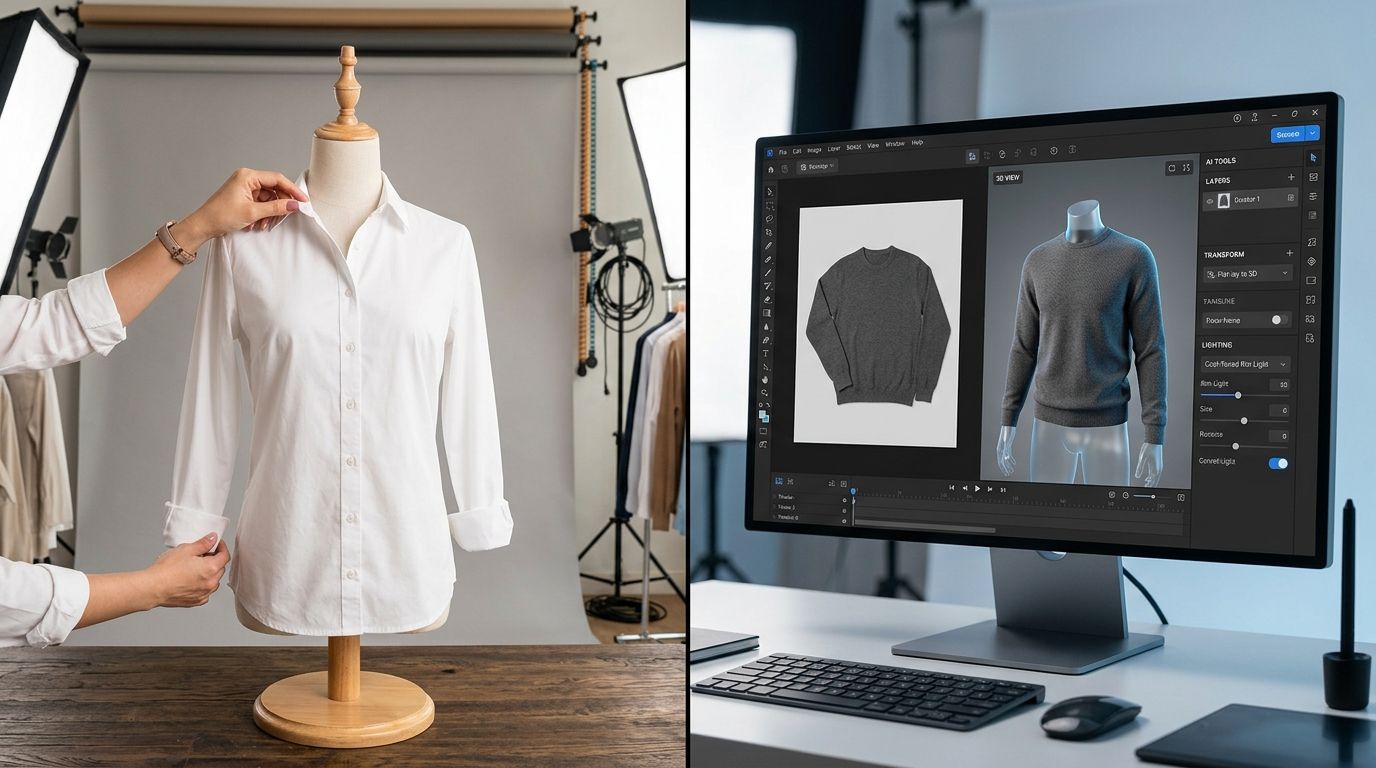
Any brand running a full studio shoot for standard catalog apparel images is paying for logistics disguised as quality. The invoice is not just the photographer. It is the studio rental, the stylist spending ten minutes pinning the back of a single shirt, the retoucher in another time zone managing the complex neck joints, and the three weeks you spend waiting for files to arrive before you can launch a new collection.
Worth noting, highly technical outerwear still occasionally requires traditional ghost mannequin techniques to show exact rigid seam placement or specialized internal layering. But for ninety percent of standard apparel catalog volume, the math on traditional composites no longer holds up.
Why the invisible mannequin technique became the standard
Shoppers need to understand the drape and structure of a garment before they buy it. When you lay a piece of clothing flat on a table, it loses all structural context. A tailored blazer looks like a square piece of fabric. A fitted dress loses its shape entirely.
While flat lay photography for ecommerce is excellent for social media or casual t-shirts, it fails to communicate the exact silhouette of structured apparel. Shoppers simply cannot visualize how the piece will look on a human body.
Live models solve the volume problem, but they introduce new distractions. Models obscure the neckline of a garment, hide the collar, and dictate a specific demographic style that might alienate parts of your customer base. They are also incredibly expensive to book for every minor SKU update or new colorway.
The apparel ghost mannequin bridges this gap perfectly. It provides the exact three-dimensional shape of a human body while remaining completely invisible to the final viewer. The focus stays entirely on the product.
The traditional ghost mannequin process
Achieving the hollow man photography look is not as simple as putting a shirt on a retail store display and snapping a picture. Retail mannequins are designed to look good in a window. Ghost mannequins are designed to be dismantled.
The specialized equipment
You need a modular photography mannequin. These mannequins feature removable magnetic pieces at the neck, the upper chest, and the arms. When you photograph a V-neck sweater, you remove the neck and upper chest blocks so the camera can see the inner back collar of the garment. These mannequins usually feature a matte white finish to prevent light from reflecting through sheer fabrics.
The two-shot capture method
Every single final image you see on an ecommerce site is actually a composite of at least two separate photographs.
First is the "A-shot". This is the garment worn normally on the mannequin. The photographer ensures the lighting highlights the texture and the stylist pins the back of the garment tightly so the silhouette is flawless.
Next is the "B-shot". The photographer takes the garment off the mannequin, turns it inside out or hangs it differently, and takes a specific photograph of the inside back collar or the internal lining. This shot must be taken with the exact same lighting setup and camera angle as the A-shot, otherwise the final composite will look obviously fake.
Why mannequin removal in Photoshop is a bottleneck
Capturing the images is only half the battle. The real delay happens in post-production. Ghost mannequin post processing requires a highly specialized editing workflow usually referred to as a neck joint service.
A retoucher opens the A-shot in Photoshop. They cannot just use a simple magic wand tool to remove the background. They must use the Pen Tool to draw a flawless vector clipping path around the entire exterior of the garment. This manual clipping is the only way to ensure sharp, professional edges.
Once the exterior is isolated, the retoucher brings in the B-shot of the inner collar. They place it behind the primary garment layer. Using the warp tool, layer masks, and extensive clone stamping, they blend the seams between the front of the shirt and the inner back collar. Finally, they must manually paint in realistic drop shadows on the inside of the collar to simulate the hollow depth of the garment.
This is exactly where production costs spiral. Standard product photo retouching involves simple background removal and basic color correction. A professional neck joint service takes significantly more manual labor per file. When you are launching a collection with three hundred SKUs, paying a specialized retoucher to manually mask and warp six hundred individual images becomes a massive financial and temporal roadblock.
| Production Type | Studio Shoot | AI Generation |
|---|---|---|
| Turnaround Time | Weeks | Minutes |
| Base Cost per Image | $80 - $200 | Under $5 |
| Equipment Needs | Modular mannequin | Standard flat photo |
| Editing Effort | Extensive manual retouching | Automated processing |
The shift to AI apparel photography
Most founders I have talked to cannot name the actual per-image cost of their last studio shoot. When they finally calculate the studio day rate, the specific mannequin purchases, the photographer fees, and the offshore retouching invoices, the number is usually somewhere between $80 and $200 per finished image.
AI product photography changes that math completely. The technology has advanced past the point of simple background removal and can now understand the volumetric shape of clothing.
Instead of buying a $600 modular mannequin and managing a complex two-shot Photoshop composite, brands use CherryShot AI. You upload a basic flat lay or an image of the garment on a standard hanger. You select a visual mode, and the system generates a campaign-ready, three-dimensional photo in minutes. The per-image cost drops to under $5.
The brands getting the most out of this workflow are not just saving money on retouching. They are accelerating their go-to-market speed. When you can generate imagery for a new seasonal colorway in twenty minutes instead of booking another shoot day, you fundamentally change how fast your brand can move.
When to skip the mannequin entirely
There is a secondary limitation to the hollow man effect. While it shows the shape of the garment perfectly, it completely lacks lifestyle context. A ghost mannequin image cannot show you how a dress moves when someone walks. It cannot show you how a jacket sits on a specific body type.
Historically, the only way to solve this was to hire a roster of models. Now, tools allow you to show clothing on a model without a photoshoot. You take the exact same flat input image used for your standard catalog shots and map it directly onto photorealistic AI-generated models. You can showcase the exact same sweater on five different body types in ten minutes, providing massive value to your shoppers without inflating your production budget.
Audit your product page images before your next campaign
Review your current catalog to identify items that lack depth or structural clarity. You can replace flat, unengaging shots with high-quality three-dimensional apparel images in minutes by uploading your current photos to CherryShot AI.
Try CherryShot AIFrequently Asked Questions
What is ghost mannequin photography?
Ghost mannequin photography is an apparel technique that produces a realistic three-dimensional hollow effect for ecommerce. Photographers capture the garment on a modular mannequin, then shoot the interior collar separately to composite the images during post-production. This method effectively displays the shape and fit of the clothing while removing the mannequin from the final frame so the shopper sees only the product details.
Do I need a special mannequin for ghost mannequin photos?
Professional modular mannequins are required for this specific photography style. These tools feature magnetic sections at the neck, chest, and arms that detach to reveal the garment lining or inner collar during the shoot. Standard retail mannequins lack these removable pieces, forcing editors to manually reconstruct hidden fabric areas in software. Investing in the correct gear avoids the extensive, costly manual cleanup work that standard mannequins demand.
How do I remove a mannequin in Photoshop?
Mannequin removal requires a detailed neck joint service workflow to blend two separate photos. Editors use the Pen Tool to create a clean clipping path around the garment exterior before masking out the mannequin structure. After placing the interior collar image behind the primary garment layer, they use the warp tool and layer masks to stitch the seams. This process demands precise manual adjustments to achieve a continuous fabric appearance.
What's the cost of ghost mannequin photography?
Equipment and labor costs for this style are significant for most growing brands. Modular photography mannequins typically cost between $300 and $800 each, and studio sessions add between $40 and $100 per finished image. Outsourcing the technical neck joint and masking work incurs additional fees ranging from $2 to $5 per image. These production steps often create delays that add weeks to your timeline for every new collection launch.
Can AI replace ghost mannequin photography?
Artificial intelligence successfully handles high-volume catalog needs by replacing the physical photoshoot and manual editing process. AI software analyzes a flat input image and automatically generates the lighting, volume, and drape required for a professional hollow man effect. This approach drops per-image costs to a few dollars while shrinking production timelines from weeks down to minutes. Modern brands use these tools to maintain consistent product presentation without heavy studio overhead.