T-Shirt Photoshoot: Flat Lay, Ghost Mannequin, On-Model, and AI
Every print-on-demand brand and streetwear label eventually faces the same wall. You have twenty new designs ready to launch. You need a T-shirt photoshoot. You look at the logistics of renting a studio, booking a model, hiring a photographer, and waiting three weeks for edits. The margins evaporate before you even list the product. Choosing how to photograph T-shirts for your online store comes down to balancing conversion rates against production costs.
Definition
T-shirt product photography is the technical process of capturing apparel for ecommerce sales using distinct styling methods like flat lays, ghost mannequins, or live models. The chosen technique dictates the visual context provided to the shopper and determines the total production cost per SKU. Modern operations increasingly supplement physical shoots with digital image generation to scale catalog output.
Flat lay is cheap but lacks context. On-model converts best but wrecks your launch schedule. AI bridges the gap completely. The trick is knowing when to deploy which method.
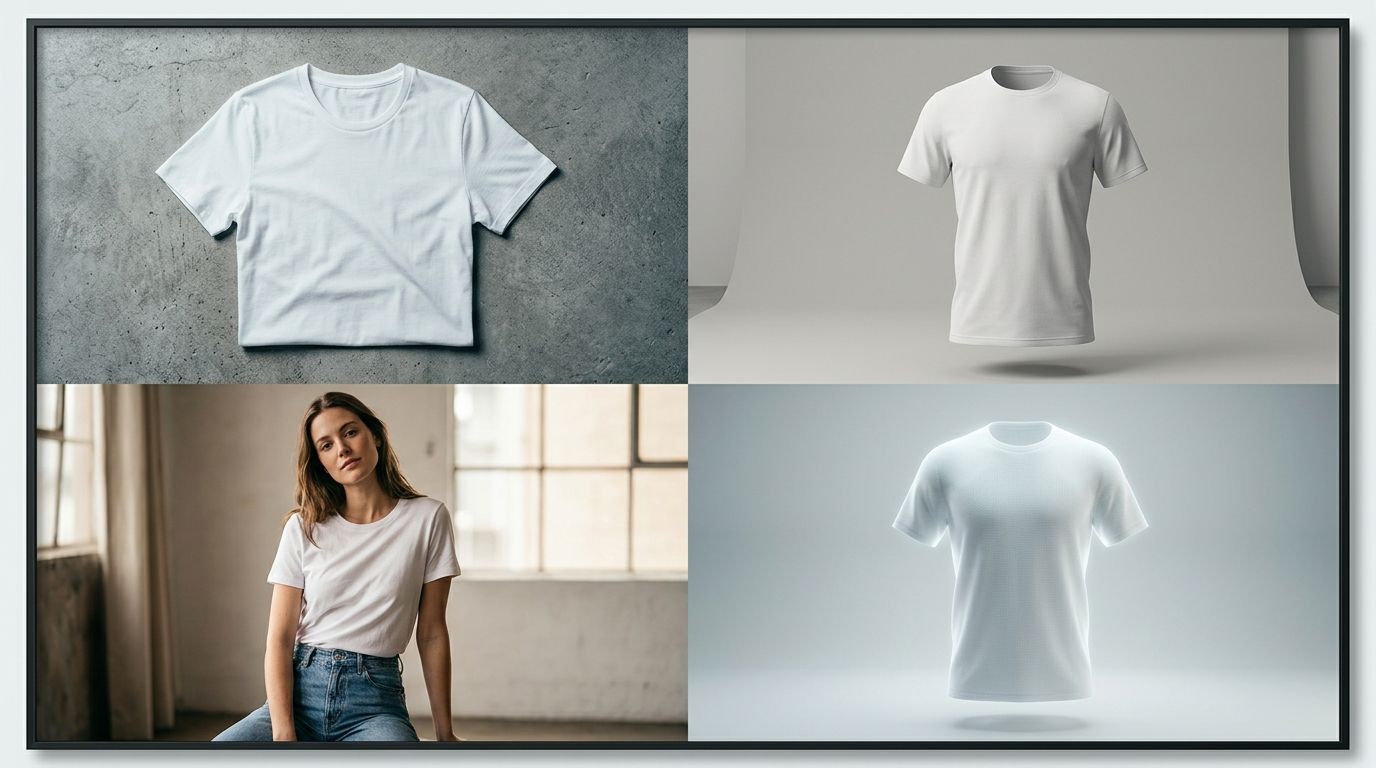
The method you choose for your T-shirt photoshoot directly impacts both your profit margins and your conversion rate.
The True Cost of a T-Shirt Photoshoot
Most founders lie to themselves about the cost of a photoshoot. They look at the photographer's invoice and assume that is the final number. It never is. The true cost of apparel photoshoot methods includes the time spent organizing the shoot, the shipping of samples, the styling and steaming, and the lost revenue from delaying your product launch while you wait for the final JPEGs.
If you are running a lean ecommerce operation, tying up your cash flow in expensive hero imagery for every single basic tee is a strategic error. You need volume. You need consistency. Most importantly, you need speed. A customer browsing your Shopify store needs to see what the shirt looks like, how the fabric drapes, and the accuracy of the print. They do not care how hard you worked to get the shot. They just care if the shirt will look good on them.
Flat Lay: The Low-Cost Baseline
T-shirt flat lay photography is exactly what it sounds like. You lay the garment flat on a surface, position a camera directly overhead, and take the shot. It is the most accessible entry point for new clothing brands because the barrier to entry is virtually zero. You do not need a model. You do not need an expensive studio space.
The process involves careful styling. You have to steam the shirt perfectly, tuck the sleeves inward to create an appealing shape, and use double-sided tape or pins to give the fabric a slight sense of volume. When done well, a flat lay grid looks highly organized and cohesive. Many premium streetwear brands use flat lay heavily on their Instagram feeds to showcase print details and tag placement.
(Worth noting: you will still need a handheld steamer. Even the best retouchers charge extra for heavy wrinkle removal, and shooting wrinkled flat lays makes your brand look incredibly cheap.)
The limitation of flat lay is the total lack of human context. A T-shirt on a table looks like a two-dimensional object. The customer cannot gauge how the collar rests against the neck or where the hem falls on the waist. If you want to dive deeper into making this method look premium, mastering the lighting is non-negotiable. Achieving professional flat lay results requires specific diffusion techniques to keep the fabric looking soft rather than harsh and blown out.
When to use flat lay
- When you are shooting extreme close-ups of embroidery or screen print details.
- When your brand aesthetic relies on a heavily stylized, grid-like Instagram feed.
- When your budget is zero and you have to shoot the collection in your living room.
Ghost Mannequin: The Standard Catalog Look
If you browse a major department store website, you will mostly see ghost mannequin T-shirt shots. This method creates a three-dimensional hollow look. The garment appears to be worn by an invisible person. It gives the customer a clear understanding of the fit and drape without the distraction of a model's face or styling.
Creating a ghost mannequin image is entirely a post-production trick. You dress a specialized modular mannequin in the T-shirt. You shoot the front of the shirt. Then, you remove the shirt, turn it inside out, and shoot the inside back of the collar. Finally, a retoucher merges the two photos in Photoshop, erasing the mannequin pieces and stitching the collar together to create the invisible effect.
The ghost mannequin method solves the context problem of flat lays, but it introduces a severe bottleneck in post-production. You cannot simply shoot and upload. Every single image requires clipping paths and composite editing. If you are launching fifty new SKUs, that is fifty complex edits you have to pay for and wait for. You can learn the entire technical process in our complete guide to ghost mannequin photography, but be prepared for the time commitment it requires.
When to use ghost mannequin
- When you have a large, standardized catalog where uniformity is the priority.
- When you want to show the shape of the garment without paying model usage rights.
- When your T-shirts have critical interior collar branding that needs to be visible.
On-Model: The High-Conversion Heavyweight
There is no debate here. Clothes look best on humans. On-model T-shirt photography yields the highest conversion rates because it removes the guesswork for the buyer. A shopper sees a model with a similar build and instantly understands how the sleeves will hug their arms and where the bottom hem will sit.
The problem with on-model photography is the logistical nightmare it creates for your business. When you decide to shoot on-model, you are no longer just managing a product. You are managing a production. You have to cast the models, negotiate their day rates, pay for agency fees, arrange hair and makeup, rent a suitable location or studio, and feed everyone. If a model gets sick on the morning of the shoot, your entire production schedule collapses.
Furthermore, T-shirt product photo methods that rely on real humans come with usage rights. You might pay a model a day rate, but the contract limits your use of those images to one year or only for digital ads. When that license expires, you have to pull the images down or pay a renewal fee. For a $30 T-shirt with tight margins, the math on traditional model shoots gets incredibly dangerous.
When to use on-model photography
- When shooting the primary hero image for your homepage banner.
- When launching a highly anticipated, premium collection that demands lifestyle context.
- When you have the budget and the profit margins to absorb the production costs.
AI T-Shirt Photography: The Scalable Hybrid
This is where the industry has drastically shifted. AI T-shirt photography eliminates the choice between cheap production and high conversion. General AI tools struggle with apparel, but specialized AI product photography platforms change the math entirely.
Instead of booking a studio and a model, you simply upload a basic flat lay or ghost mannequin photo of your T-shirt. You select a visual mode inside CherryShot AI, like Lifestyle or Minimalist, and the system generates campaign-ready photos in minutes. The garment is accurately mapped onto a photorealistic model. The lighting is perfect. The background matches your brand aesthetic.
The per-image cost drops to under $5. The turnaround time goes from three weeks to a single afternoon. When you launch a new colorway, you do not have to schedule another expensive shoot day. You just run a quick flat lay through the software.
I will acknowledge a genuine trade-off here. AI is not perfect for highly complex, multi-person lifestyle imagery where models need to be interacting with each other dynamically. If you need a shot of three people hugging while wearing your brand, hire a photographer. But if you are deciding between AI model photography vs. real models for your standard product catalog, the traditional studio method simply does not make financial sense anymore.
When to use AI product photography
- When you need on-model imagery but cannot afford a studio production.
- When you are testing multiple T-shirt designs quickly to see what sells.
- When you want to generate dozens of lifestyle variations for paid ads without spending thousands.
Evaluating T-Shirt Photography Methods
To make the decision straightforward, you have to weigh the speed of execution against the visual impact. Here is how the four main methods stack up against each other for a standard ecommerce launch.
| Method | Average Cost | Turnaround Time | Conversion Impact |
|---|---|---|---|
| Flat Lay | $0 to $15 per image | 1 to 2 days | Low |
| Ghost Mannequin | $20 to $45 per image | 1 to 2 weeks | Medium |
| On-Model (Real) | $150+ per image (bundled) | 2 to 4 weeks | High |
| AI Photography | Under $5 per image | Minutes | High |
Look at your current pipeline. If you have a massive backlog of designs waiting to go live because you cannot get the imagery done fast enough, your production process is actively costing you revenue.
Frequently Asked Questions
What is the best way to photograph T-shirts for ecommerce?
On-model photography delivers the highest ecommerce conversion rates by demonstrating exact drape and fit on a human body. Launching large volumes of inventory requires faster execution, making ghost mannequin techniques practical alternatives to maintain grid consistency. Generating campaign-ready lifestyle imagery from a basic flat lay using artificial intelligence speeds up production while keeping costs under five dollars per SKU.
Should I use flat lay or on-model for T-shirt photography?
Choose on-model photography to maximize buyer conversion rates by providing clear visual context for how the garment hangs. Flat lay methods offer high cost efficiency for highly stylized social media grids or print-on-demand brands managing thousands of varying SKUs. Processing a standard flat lay image through a specialized artificial intelligence tool generates a realistic on-model appearance without requiring expensive studio rental fees.
How much does a T-shirt photoshoot cost?
Traditional on-model T-shirt photoshoots cost between $1,500 and $4,000 per day including photographers, studio space rentals, model day rates, and styling professionals. Ghost mannequin photography completed through a specialized post-production agency requires a payment of $20 to $45 per finished composite image. Processing basic product shots through artificial intelligence platforms drops the expense to under five dollars per image while completely eliminating external daily booking rates.
Can AI replace on-model photography for T-shirts?
Artificial intelligence effectively replaces human on-model photography for standard catalog grids and high-volume social media content creation. Specialized generation software maps a simple uploaded reference photo of your T-shirt onto a photorealistic figure in a specifically targeted environment. Reserve traditional studio photography productions for massive billboard campaigns, but direct your everyday ecommerce inventory through automated visual systems to scale new SKU coverage rapidly.
What backgrounds work best for T-shirt photography?
Pure white backgrounds matching hex code #FFFFFF fulfill universal vendor requirements for primary product listing images on Amazon and standard Shopify storefronts. Secondary catalog images demand textured backgrounds like concrete, wooden floors, or natural lifestyle environments to communicate a specific target brand aesthetic. Shoot your primary front angles against a seamless paper backdrop before transitioning the garment to contextual sets for targeted social media advertisements.
The logistics of apparel imagery should not dictate how fast your brand can grow. If you are tired of negotiating day rates and waiting weeks for retouched JPEGs, it is time to upgrade your process. Try CherryShot AI and get campaign-ready T-shirt photos in minutes.
Generate on-model T-shirt photos from existing flat lays
Calculate exactly how much time and money you spend shooting your basic tees. Upload one of your existing flat lay images to see how quickly it maps onto a realistic model. Stop paying daily studio rates for standardized catalog grids.
Try CherryShot AI