Supplement and Health Product Photography: The Visual Trust Signals That Convert a Skeptical Buyer
A bottle of pills is inherently terrifying. You are asking a stranger on the internet to trust you enough to ingest a product based entirely on a JPEG. If your supplement product photography ecommerce strategy relies on a single white-background render, you are losing sales to brands that understand how to build buyer trust online through visual evidence. Skeptical buyers do not just want to see your logo. They want to read the back panel, visualize the raw ingredients, and see the product existing in a clean, credible environment.
Definition
Supplement product photography is the specialized creation of ecommerce images that visually verify the quality, ingredients, and clinical safety of health products. This practice relies on macro label shots, ingredient styling, and high-resolution lighting to build trust with skeptical online shoppers.
Health and wellness is a category completely governed by perceived safety. Apparel brands can afford to have a moody, out-of-focus editorial shot. If a t-shirt fits poorly, the customer just returns it. If a nutraceutical product looks cheap, the customer assumes the ingredients are dangerous. You have to treat your product gallery as a digital compliance document.
Every single image you upload must systematically dismantle a specific objection holding back the sale.
The Anatomy of High-Trust Supplement Imagery
Most supplement brands launch with two images. They have the front of the bottle and a heavily compressed 3D render of the box. This is the fastest way to signal to a buyer that you are white-labeling a generic formula out of a questionable facility.
A high-converting listing requires a deliberate sequence of visual information. The buyer needs to travel through a specific narrative before they feel comfortable clicking the checkout button. This starts with the packaging but immediately moves to the reality of the physical product inside the plastic container.
Label photography supplements actually need
A front-only product listing is a massive red flag. Health consumers want to see the supplement facts panel. They want to read the inactive ingredients. They want to verify that your proprietary blend does not contain fillers they are actively trying to avoid. You must photograph the back and sides of your packaging.
Do not simply upload the flat PDF file your graphic designer sent to the printer. Buyers recognize vector artwork. They want to see a photograph of the physical label wrapped around the actual bottle. The texture of the paper, the reflection of the light on the plastic, and the curve of the text all prove that this is a tangible item sitting in a warehouse. Make sure the text is tack-sharp. If a customer zooms in to read your vitamin B12 dosage and the image pixelates, you have lost their trust.
Lighting that signals premium quality
Lighting dictates perception. Flat, overhead lighting makes a premium nutraceutical look like a gas station energy pill. To elevate your brand, you need to steal techniques from the cosmetics industry. When studying premium beauty product visuals, you notice the deliberate use of specular highlights. A sharp, bright line of light running down the edge of a glass tincture bottle implies cleanliness, clinical precision, and luxury.
Health product photography ecommerce assets require this same level of polish. If you use matte labels, light them with soft diffusers to highlight the premium texture. If you use glossy amber glass, use hard rim lights to separate the bottle from the background. The goal is to make the packaging look expensive so the buyer inherently trusts the formula inside.
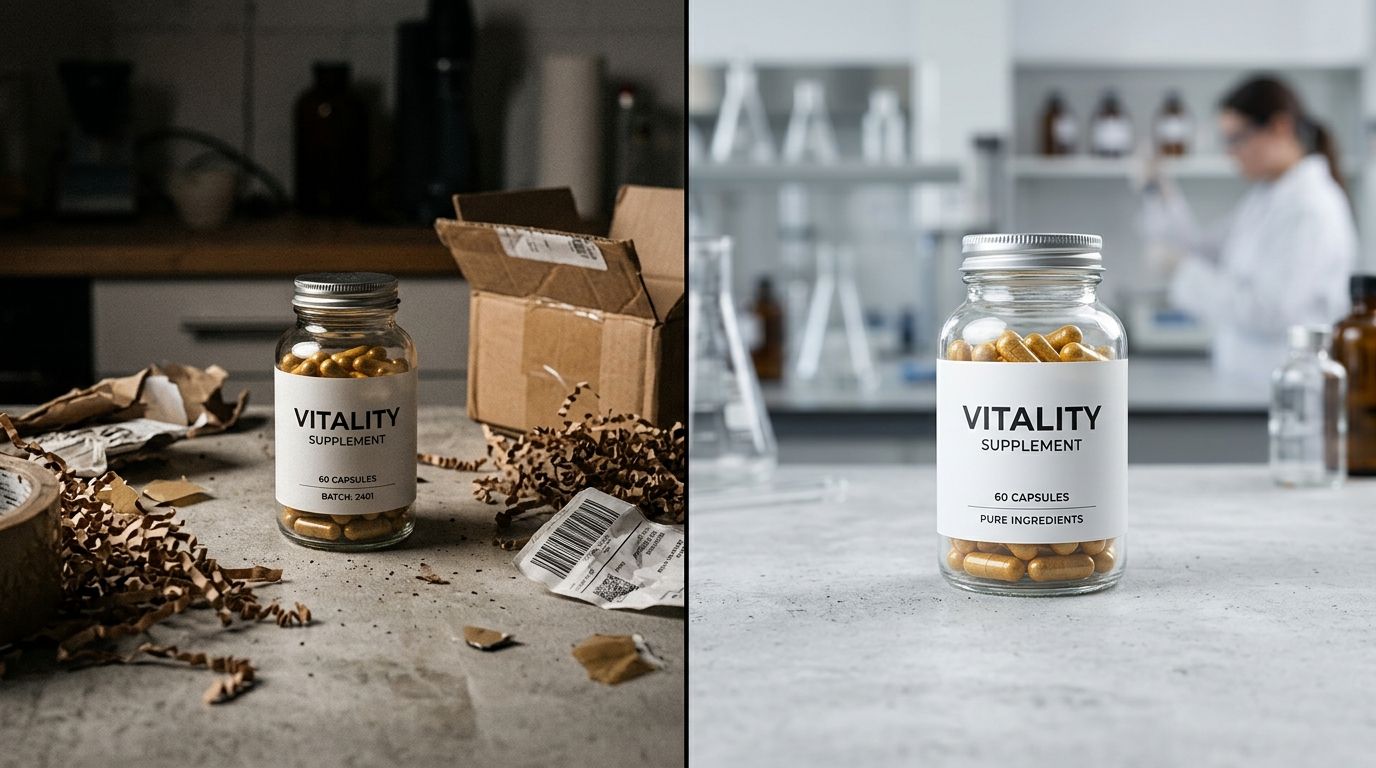
Showing supplements in bright, organic contexts shifts the perception from clinical medication to daily wellness.
Visualizing Ingredients Without Looking Like a Stock Photo
A closed plastic jar is visually boring. To generate desire and validate your marketing claims, you have to show the buyer exactly what they are consuming. This is where most brands rely on cheap stock vectors of leaves and berries.
Mastering supplement ingredients photography
If your formula relies on organic ashwagandha and black pepper extract, show the raw materials. A high-angle flat lay featuring your bottle surrounded by small, styled piles of raw ingredients creates a massive visual impact. It grounds your clinical claims in the natural world.
The difficulty is making raw ingredients look appetizing. A pile of loose brown powder can easily look like dirt if the lighting is flat. You must use strong directional lighting from the side to reveal the texture of the powders and herbs. This creates micro-shadows that give the ingredients depth and realism. Natural supplement photography thrives on this contrast between the rigid, manufactured bottle and the organic, textured raw materials.
Protein powder photography and the perfect scoop
For sports nutrition, the scoop shot is mandatory. Buyers have been burned too many times by chalky, unmixable powders. They want to see the consistency of the product before they buy a two-pound tub. Capturing protein powder photography requires absolute precision. The powder needs to look fluffy, fine, and perfectly blended. A macro lens is essential here to capture the specific grain structure of the whey or plant protein. Show the powder cascading perfectly from the scoop to communicate smooth mixability.
Escaping the "White Plastic Bottle" Trap
A catalog consisting entirely of white backgrounds feels like a pharmacy. Wellness brands need to project a lifestyle. Contextual backgrounds signal to the buyer how and where this product fits into their daily routine. A sleek pre-workout powder belongs on a matte black gym floor. A daily multivitamin belongs on a bright, marble kitchen counter next to a glass of water.
The logistics of high-volume nutraceutical imagery
This is where brands hit a massive operational wall. Sending your entire catalog to a studio to be shot in five different kitchen and gym sets is financially crippling. A single shoot day costs thousands of dollars and yields only a handful of usable environments. By the time you receive the final files, your launch date has passed.
This logistical nightmare is exactly why brands are shifting to AI generation. By uploading a single, clean image of your product, CherryShot AI can instantly place your bottle into a sunlit kitchen, a minimalist spa setting, or an aggressive fitness environment. You select the visual mode and the software generates campaign-ready photos in minutes. The per-image cost drops from eighty dollars to less than five.
| Production Approach | Speed and Cost | Primary Advantage |
|---|---|---|
| Traditional Studio Shoot | High cost, weeks to deliver | Capturing proprietary liquid capsules and specific macro textures. |
| AI Image Generation | Under $5 per image, instant delivery | Producing varied lifestyle settings and ingredient flat lays at scale. |
When you remove the friction of physical set design, you can finally test which environments actually drive conversions. You might find that your sleep supplement sells better when pictured next to an open book on a nightstand rather than floating in a generic void. Testing product photos that convert requires rapid iteration, something a traditional studio simply cannot offer.
(There is a genuine limitation here to acknowledge. AI is exceptional for contextual backgrounds, lifestyle settings, and ingredient flat lays. However, if you have a proprietary liquid capsule with a highly complex, translucent oil pattern that is the entire selling point of your product, you still need a macro lens and a physical photographer to capture that exact micro-texture. Use AI for your massive volume of lifestyle scenes. Pay the photographer for the hero macro shot.)
Scaling visual trust across the catalog
The health brands dominating Shopify do not have deeper pockets. They simply launch faster and test more visual angles. If you introduce a new flavor of magnesium powder, you need twenty new images immediately for ads, email, and the product page. Waiting three weeks for a freelance photographer ensures your launch loses momentum. Tools like CherryShot AI give you the speed required to keep your marketing channels fed with fresh, high-trust visual collateral.
Key Takeaways
- Health product buyers require higher visual proof than apparel buyers.
- Always include high-resolution photography of the supplement facts panel.
- Use contextual lifestyle environments to move away from the sterile pharmacy aesthetic.
- AI generation drastically cuts the cost of creating lifestyle and ingredient flat-lay imagery.
Frequently Asked Questions
How do I photograph supplements for ecommerce?
To photograph supplements for ecommerce, you must capture a sequence of images that includes a brightly lit hero shot, crisp macro details of the actual pills, and contextual lifestyle settings. Buyers need to see the physical reality of the product to overcome the natural hesitation of consuming an unknown formula. Ensure your listing features at least five varied images, placing items like daily multivitamins on clean kitchen counters to project daily wellness rather than clinical medication.
What photography builds trust for health products?
High-resolution label photography serves as the strongest visual trust signal for health and wellness products. Buyers require clear, legible images of the exact supplement facts panel and inactive ingredient list to verify your formula meets their dietary standards. Photographing the physical label wrapped around your bottle proves the product exists in reality, while placing styled raw ingredients nearby grounds your clinical claims in organic origins.
How do I show supplement ingredients in product photography?
Display raw ingredients in supplement photography by arranging high-angle flat lays that position organic materials directly next to your finished packaging. This specific composition technique visually proves the natural efficacy of your formula while pulling consumer attention away from the inherently clinical appearance of a standard plastic bottle. You must use strong directional side lighting to reveal the texture of fine powders and whole herbs, preventing them from looking flat or unappetizing in the final image.
What backgrounds work best for supplement photography?
Bright marble countertops, clean wooden surfaces, and minimalist botanical settings provide the highest converting backgrounds for health and wellness imagery. These warm, organic environments contextualize the product for the buyer, shifting the visual narrative away from clinical medication toward daily, proactive wellness. Limit pure white backgrounds strictly to your primary catalog hero shot, relying instead on contextual lifestyle scenes like gym floors or kitchen tables to help the shopper visualize the supplement fitting into their personal routine.
Can AI create supplement product photography?
Artificial intelligence reliably generates supplement product photography by taking a single source image of your bottle and placing it into countless realistic lifestyle environments. This production method eliminates the financial burden of renting physical studios while allowing health brands to rapidly test different visual contexts like sunlit kitchens or athletic facilities. Ecommerce teams rely on these tools to produce massive volumes of ingredient flat lays and contextual marketing assets at a fraction of traditional costs.
If your health brand is struggling to convert traffic, your imagery is likely failing to overcome consumer skepticism. Stop relying on sterile mockups and start building a visual narrative of transparency. Generate campaign-ready lifestyle environments for your entire catalog in minutes with CherryShot AI.
Audit your supplement product gallery before your next campaign
Open your top-selling listing on a mobile device and review the image gallery for clear labels and lifestyle context. If your visual trust signals are weak, you are actively losing conversions to brands that prove their quality visually. Upload a single bottle image to CherryShot AI to generate credible, campaign-ready backgrounds right now.
Try CherryShot AI